What is typical Australian food? I have been asked this question on many occasions over the years. Recently, I was asked the question again and it and it has got me thinking.
Many people assume that each country naturally has its own national dishes. It would be rather straightforward if dishes neatly coincided with national boundaries. However, this isn’t always the case. Dishes are constantly being created, adapted and they sometimes disappear altogether. They are works in progress. Some dishes are contested and are claimed by more than one country. The origins of a dish can difficult to pin down. Sometimes they may only be popular with one segment of the population or they may be regionally based and not eaten throughout the entire country.
Australia is a huge country, so it is natural to expect that one would find significant regional variation when it comes to food. While it is true that some ingredients are only native to particular parts of the country, many foods and dishes are consumed all over and would be considered national rather than regional.
Meat Pies
Americans will be disappointed with this one. In the United States, pies are sweet and more likely to be served for dessert than be the main item for lunch or dinner. Meat pies are more of a savory affair in Australia. A simple pie may consist of minced meat and gravy wrapped in pastry and baked in an oven.
Say ‘meat pie’ and many Australians will immediately imagine standing at a football game with a pie in one hand and a drink in the other. Meat pies run the full spectrum in Australia. To be sure, the cheap and nasty variety abounds, but you can also find great gourmet pies. There are Beef and Burgandy pies, Curry pies…you name it. Some people prefer their pies made with chunky bits of meat, others prefer a more even consistency.
Sausage Rolls
Similar to meat pies. The difference? I guess the use of sausage meat and the overall shape which is more like the handle of a tennis racket than the circle of the pie. Don’t forget, pies and sausage rolls also come in their miniature versions – party pies and sausage rolls! These used to be the first items to disappear at lunch gatherings, although I have noticed a change to healthier options in recent years.
ANZAC biscuits
ANZAC is the acronym for ‘Australian and New Zealand Army Corps’. The ingredients are simple – often rolled oats, flour, sugar, butter, sometimes golden syrup and sometimes desiccated coconut. These little gems were often sent to Australian troops fighting overseas. The ingredients used ensured that they could last for a long time prior to being eaten. The size can very between ‘three bites and they are gone’ to ‘as big as a saucer’. Consistency varies from hard to chewy and pliable.
Chicken Parma
Ubiquitous pub staple. Widespread and much-loved. It consists of a chicken schnitzel topped with a tomato sauce and melted cheese. Comfort food.
Pavlova
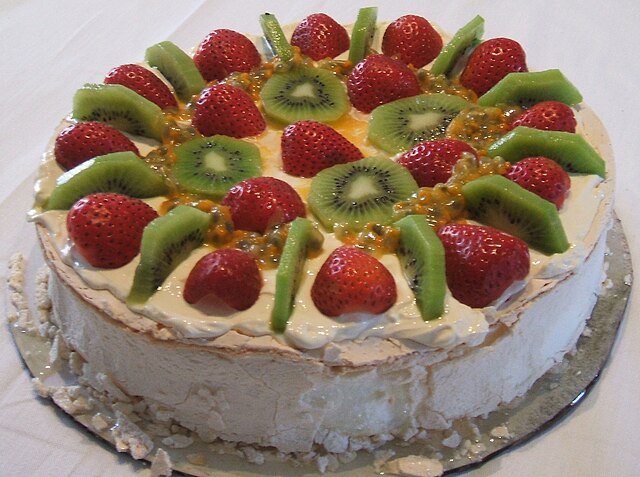
A meringue topped with whipped cream and fruits. It is often associated with summer and Christmas. It is a nice counterpoint to the dark and heavy Christmas desserts of the northern hemisphere. Perhaps it reflects the light and sunny Australian summer. It is said that the fruit chosen to put on top of the ‘pav’ should be seasonal. Popular fruits include passion fruit, kiwifruit or strawberries. These kind of fruits give the pavlova a tropical or subtropical feel. But, I eat it pavlova where I live in southern Australia and I don’t see it as a northern import.
I have even found one pavlova recipe online which is walnut and coffee-flavoured. I am not a purist when it comes to food, so I would definitely try this recipe, but the use of coffee (an ingredient native to Africa) and walnuts (from North America) mean that it won’t join my list for traditional Australian pavlova.
Pavlova is one of those foods that is contested between more than one country – in this case Australia and New Zealand. I only found this out while researching for this article. My New Zealand brethren will probably point to this as an example of Australian insensitivity. It seems that the pavlova may have been created in honor of the Russian ballerina Anna Pavlova when she visited this part of the world in the 1920s.
It seems that attempting to break the record for the largest pavlova has become something approaching a sport across the Tasman Sea. In 1999, a huge pavlova of 45 meters was made to celebrate an anniversary of the Te Papa Museum in New Zealand, which was cut by the Prime Minister no less. This was followed by another ‘pav’ in 2005 which was 64 meters. Then Norway got in on the action. A Norwegian chef and his team made a pavlova that was whopping 85 square meters. The attempt drew concern from some New Zealanders who cited possible issues with egg white and cream ratios.
The use of kiwifruit is interesting. The fruit itself is native to central or eastern Asia. It was introduced to New Zealand and over time, the fruit started being referred to as ‘kiwifruit’. Interestingly, Australians have also adopted this name without change. So, if the pavlova is indeed a New Zealand creation, putting kiwifruit on top may be a particularly powerful form of food patriotism.
Barramundi
Also known as Asian sea bass or giant sea perch, they can be found in saltwater and freshwater and are a much sought-after sport fish. Their average size is 1.2 meters, but they can reach close to 2 meters (although this is rare). The Barramundi is a tropical and semi-tropical fish species and can be found right across northern Australia, from the Mary and Maroochy river systems in south-east Queensland to Shark Bay in Western Australia. I venture to suggest that while Barramundi is eaten all over the country, it is probably more common up north than down south.
Lamingtons
Square or rectangle sponge cakes with a cream filling. The exterior is coated in chocolate and then covered with desiccated coconut. They can be found with a jam filling or without. They also come in pink.
Damper
Damper is a kind of bread and is as simple as they come. The ingredients are simple and few – flour, water and perhaps some salt or sugar. The companion to damper is tea from a billy or billycan (water boiled in a metal can over an open fire, perhaps with a gum leaf or two for flavor).
Making damper was common in Australia in the 19th century. It was associated with travelers, farmers, bushmen and the like. Such people were constantly on the move and mobility was a fact of life. They were not able to carry large amounts of food nor many ingredients. Hence the simplicity of the recipe. Once the dough was made, it could be wound around a stick and roasted over a fire. The result was a bread that resembled a coil and the flames of the fire could produce a slightly uneven char. But this is part of its charm.
I recently decided to make damper for some overseas friends. But, making it in the city with metal rods (instead of the traditional tree branch) in the oven isn’t the same as roasting it on a stick over a fire. It has been around thirty years since I last made damper. For me, it brings back memories of school camps and the outdoors. Damper has fallen out of favor with most Australians. I wouldn’t be surprised if many Australian children don’t even know what it is.
Bogong moths
Early Europeans noted that Aboriginal groups would periodically gather in the Victorian Alps in order to feast on Bogong moths. The moths were an important food source.
Quandong
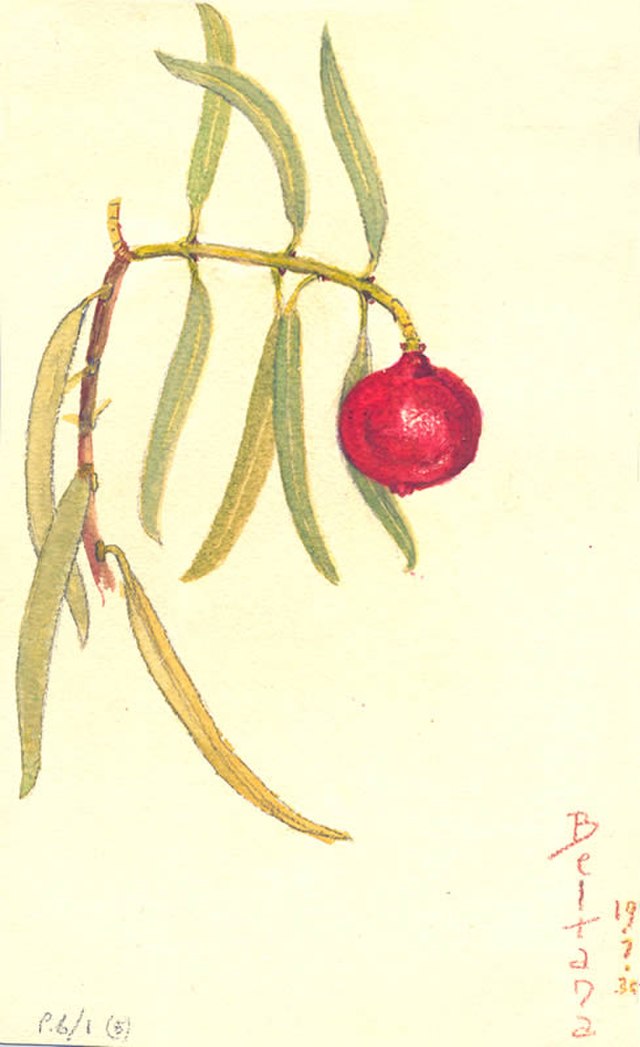
The quandong is an indigenous food associated with the arid areas of Australia. It can be used to make jams and chutneys. It is distributed throughout southern Western Australia, most of South Australia and in some pockets of the other mainland states.
Tea versus coffee
Tea drinking used to hold a higher position in the national psyche than coffee drinking. The famous Australian song , Waltzing Matilda, contains references to making tea. After WWII, there was an increase in the number of migrants arriving in Australia from Eastern Europe, Greece and Italy. Italians brought with them their experience with coffee, coffee machines and coffee culture. Like so many cultural innovations, coffee drinking first took off in the cities and then spread to regional and remote areas.
Lemon-scented myrtle
This is a flowering plant and is endemic to subtropical rainforests of central and south-eastern Queensland. Like finger limes (see below), its limited distribution may limit the extent to which they become identified as a ‘national food’.
Smashed avocado
Where was ‘smashed avocado’ invented? Can one really call crushing the inside of an avocado with the back of a spoon and then placing it on a piece of toasted bread an invention? Regardless of exactly where and when it first became popular, many Australian love it. Let us not forget that the avocado itself hails from the Americas. The dish really started to take off in the 1990s and 2000s and started to become a cafe staple.
Warrigal Greens
Also known as ‘New Zealand spinach’. The plant was encountered by Captain Cook on one of his voyages of discovery and was utilised by his crew to help stave off scurvy. For around two hundred years, it was the only vegetable from the Australia / New Zealand region that was cultivated in England. This plant with triangle-shaped leaves can stand up and take a bow. Warrigal Greens are used in salads. They are often blanched or boiled before they are eaten. Some people like to make a pesto.
Kangaroo
Kangaroo was a very important food source for the Aboriginal peoples of Australia. Indeed, groups would often choose where to camp based on the movement of kangaroos through the land. It has been estimated that there may be around 50 million ‘roos’ in Oz and 3 percent are killed for their meat. Kangaroo meat is exported around the world. Most states allow for a limited number of kangaroos to be culled through special licensing provisions for hunters and a quota system. In recent times, there has been discussion about possible kangaroo overpopulation and overgrazing in some locations. Overpopulation can have a negative impact on plant biodiversity. Still, having pads instead of hooves, kangaroos compact the soil less than cattle and sheep. Kangaroo meat is very lean is often described as ‘gamey’.
Finger limes
Another indigenous food. This fruit is limited to a small area of subtropical rainforest between New South Wales and Queensland. It has experienced a renaissance in recent times along with other native ‘bush tucker’ foods. There is a growing understanding of these foods and a greater appreciation of them in Australia. However, they can still be difficult to get your hands on. On a recent trip to my local supermarket, I couldn’t find quandong or finger limes on offer. They may be available online or from specialty shops in major cities, but even these are few and far between.
Yam Daisy / Murnong
The yam daisy is a kind of root vegetable. It was consumed by Aboriginal groups in southern Australia. This is certainly the case with the Wurundjeri people around present-day Melbourne. The tubers were dug from the soil with digging sticks.
So concludes our little tour of selected Australian foods and dishes. The list is by no means complete. Which is the most Aussie of them all? Well, what can be more Australian than a Kangaroo pie?
 Australia and the World Past and Present