Australia is huge country. It would be natural to assume that one would be able to find different accents in different parts of the country. However, generally speaking, accents in Australia are not regionally based.
In contrast the United Kingdom, while many times smaller, has a dizzying number of accents.
Even the United States displays much more regional accent variation than the land down under. Why?
Accents need time to develop. So it is no surprise that the United Kingdom has so many regional accents. Accent variation is driven by settlement patterns, contact, isolation and time.
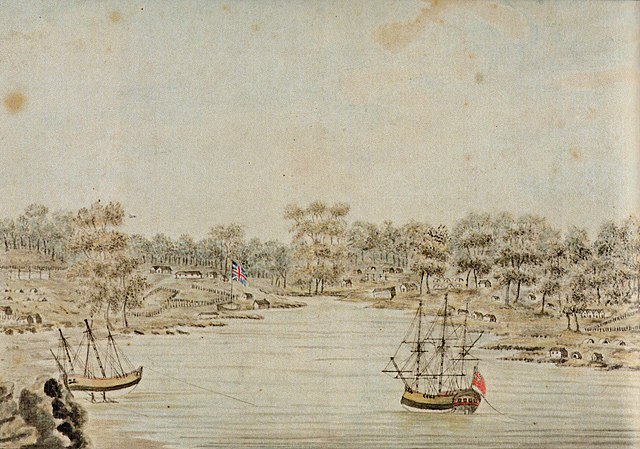
English speakers first came to live in Australia in 1788. They settled around a relatively small number of ports and were in constant communication with each other. Many of the earliest convicts and settlers hailed from the southeast of England and the London area, so accents from these areas were influential. These were supplemented by other English, Welsh, Scottish and Irish accents.
Accent variation in Australia tends to be more class-based. Many observers divide the Australian accent into three categories – cultivated, general and broad. A city-country divide may be stronger than any regional division.
1788 may sound like a long time ago, but in linguistic terms, it is not.
English speakers on the east coast of North America have had nearly two centuries more time to develop regional accents. Jamestown was the first permanent English settlement in North America, founded in 1607.
The Plymouth Colony was established in 1620 and was a haven for Puritans.
In contrast to Australia, North America was settled by multiple European powers. By 1624 the Dutch were in New Amsterdam.
In the 1600s, sectarian disputes and conflict in Europe led some many to seek a new life on the other side of the Atlantic. The American colonies often had a strong religious character to them, much more so than the colonies did in Australia. Maryland was founded in 1634 as a refuge for English Catholics.
A Swedish colony was founded in the Delaware River Valley and lasted from 1638 to 1655. It was captured by the Dutch and then the British.
In 1680, the King of England granted 45,000 square miles to William Penn (a Quaker) forming Pennsylvania.
There were the Amish of Swiss-German / Alsatian origins. They maintained their own language.
In 1778, the 13 British clonies proclaimed their independence. But the map of North America at that time was very different to what it is today. North America also contained New France and New Spain.
New France existed from 1534 to 1763. New France took in the Great Lakes region and the Mississippi River area. New France was incorporated into the Union through the Louisiana Purchase of 1803.
The British in Novas Scotia displaced the Arcadian French there and many moved to Louisiana after 1755. Parts of the South are heavily influenced by French. This can be seen in the case of Cajun English.
The Scots were influential in Appalachia.
Back in Australia, communications also played a role in maintaining relatively homogeneous accents. From 1788 to the early 1900s, Australia didn’t have mass broadcasting technology. That might sound like a long time, but it is not from a linguistic perspective. The first commercial radio stations were broadcasting from the mid 1920s. The national broadcaster, the Australian Broadcasting Commission (ABC) was set up in 1932. From the early 1900s many listeners were listening to the same broadcasting station.
Television was introduced in 1956. For the later half of the twentieth century, most major cities had only three commercial broadcast stations and the ABC. Television shows produced in Australia were invariably shown right around the country.
What will Australian accents be like in 100 or 200 years? In the past, time has led to greater accent divergence. With media deregulation and the rise of digital TV and streaming services, individual Australians have access to a greater variety of accents. But many of those English accents also come from outside of Australia. Will Australian accents grow closer to American accents? Or will we see a move towards a general international accent?
 Australia and the World Past and Present
Leave a comment