Captain James Cook is a major historical figure in Australia. His first Voyage of Discovery was the most important for Australia. Most Australians will be less familiar with his second and third voyages. I suspect that many Australians will also be less familiar with where Cook had sailed on his first voyage prior to sighting Australia.
I will follow up this article with a historical assessment of Cook (including his relations with indigenous people) and an article on two Tahitians – Tupaia and Omia – who sailed with Cook. Tupaia was on Cook’s first voyage, while Omia was on the second and third.
The First Voyage (1768-1771)
Cook was to sail to Tahiti to observe the transit of Venus. The astronomical information gained was meant to aid efforts in discovering how far the Earth was from the Sun. Once this part of the mission had been achieved, Cook opened his sealed orders. These called on him to search for a great southern continent which many presumed to exist somewhere in the great expanse of the southern oceans. If found, Cook was to claim the continent on behalf of the King of Great Britain.
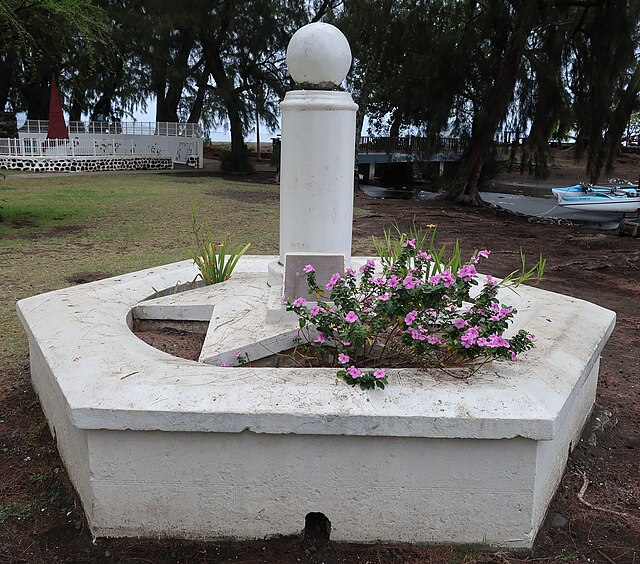
After Tahiti, Cook sailed on to New Zealand where he mapped the entire coastline. By sailing right around New Zealand, Cook proved that it was not part of a larger landmass.
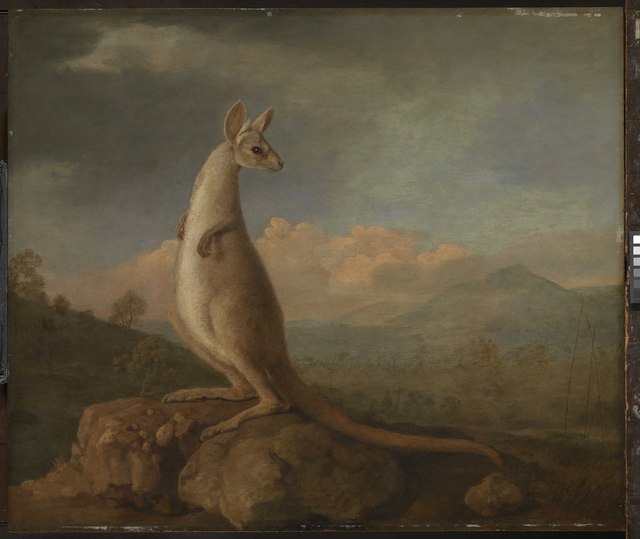
Cook and his crew crossed the Tasman Sea and explored the eastern coast of Australia, from Point Hicks (in modern-day Victoria) to the Torres Straight.
Cook stayed in Botany Bay for a week. Botanical specimens were collected by Joseph Banks and Daniel Solander.
Cook ran into trouble in the Great Barrier Reef. His ship struck a reef and had to be ran aground and repaired at present-day Cooktown.
The Second Voyage (1772-1775)
In 1771, Cook was promoted to Commander. Despite the discoveries of Cook’s first voyage, some still believed that a great southern continent may still exist, perhaps at a lower latitude than had previously been explored. Cook set out on another voyage with two ships, HMS Resolution (commanded by Cook) and HMS Adventure (commanded by Tobias Furneaux). During this voyage, Cook explored the lower latitudes, sailing much closer to Antarctica. Cook’s second voyage finally put to bed the myth that there was another unknown continent somewhere in the southern hemisphere. He returned to Tahiti, where he picked up the Tahitian, Omai, and then proceeded to visit Easter Island, Norfolk Island, New Caledonia and Vanuatu. Cook didn’t lose one man to scurvy during his second voyage.
The Third Voyage (1776-1779)
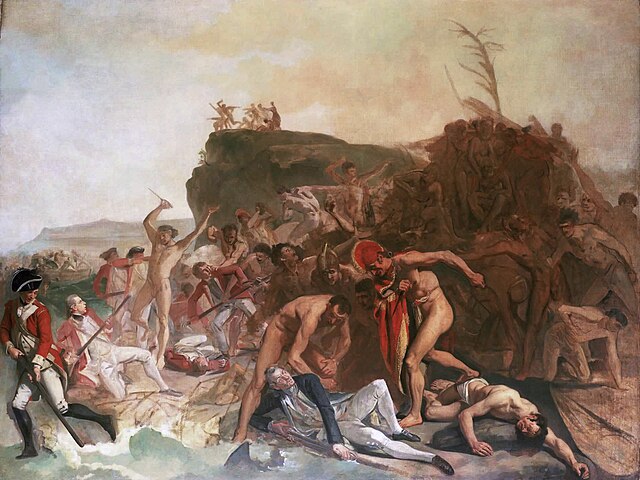
Cook sailed on HMS Resolution during his third and final voyage. Again, Cook sailed with two ships. He sailed on the Resolution and Charles Clerke commanded HMS Discovery. He returned Omai back to Tahiti. His main aim for this voyage was to find a Northwest Passage, a sea lane through the Arctic Ocean between the Atlantic and Pacific Oceans. After Tahiti, Cook headed north, exploring the central Pacific. He visited Hawaii and became the first European to establish permanent contact with the Hawaiians. He mapped the northwest coast of North America, the Bering Sea and the Siberian coast. He returned to Hawaii where he would meet his demise.
 Australia and the World Past and Present
Leave a comment