The battle of Spion Kop during the Second Boer War in South Africa was one of those curious intersections of history.
Louis Botha, future Prime Minister of the Union of South Africa was fighting for the Boers. Winston Churchill – the man who would stare down Hitler in the Second World War – was there as a war correspondent and later as a combatant for a short time. And believe it nor not Mahatma Gandhi – the man who would lead a non-violent struggle to get the British out of India – was a stretcher bearer on the field of battle.
The Boers would win the battle but not the war.
The Boers were Dutch descendants who had arrived in the Cape area of South Africa in the mid-1600s. The British became dominant in the late 1700s and early 1800s. Wanting to be free from increasing British control, some Boers moved northeast eventually establishing the Orange Free State in 1854 and the Transvaal in 1856.
Gold was discovered at Kimberley in 1866 leading to a massive of influx of British miners.
Cape Governor Milner was putting pressure on Paul Kruger to grant the miners citizenship rights. Kruger wouldn’t budge. In Kruger’s mind, the British were persecuting the Boers and by their actions were responsible for war. The British would use the Boer attacks as their pretext for annexing the Boer states. The Boers attacked the British towns of Mafeking, Kimberley and Ladysmith, laying siege to these towns.
Spion Kop lies around 38 kilometers from Ladysmith and the Battle of Spion Kop took place on January 23-24, 1900.
On the night of the 23rd, British soldiers advanced up the hill in thick mist. They reached a plateau and began digging trenches in order to fortify themselves.
The ground was rocky and hard to break. The trenches created were hardly worth that description.
Dawn came and the mist began to clear. It was then that the British understood the situation that they were in. The British were not on top of Spion Kop. They were in fact dug in on a lower hill with the Boers looking down on them from three sides!
In terms of men and firearms the Boers were outnumbered. However, the battle would become a bloodbath for the British. They suffered 243 deaths while the Boers suffered 68.
Louis Botha
After the war, Botha would become the first Prime Minister in the Union of South Africa, while the intelleligent Jan Smuts would hold important ministries. In another twist of history, Jan Smuts would become a very important advisor to Churchill during World War II.
Churchill
Churchill had been a war correspondent for the The Morning Post. He had arrived in Cape Town with the British forces, but he wanted to get to Ladysmith before the British arrived. He took a steamer to Durban. He then took a train from Durban which was attacked by the Boers. Churchill himself was involved in the shootout. He was captured and became a prisoner of war. He then escaped, made his way to Mozambique and headed straight back to Durban. This free-wheeling fellow became something of a celebrity when news of his exploits became known back in the UK.

Churchill’s actions at Spion Kop and in the Boer war became a springboard for his entry into politics. Eventually, he would become a wartime Prime Minister and play a hugely significant role in defeating Hitler, Nazism and in defending democracy in Western Europe.
Gandhi
Although born in India, Ghandhi spent a considerable part of his life in South Africa – 22 years in all. It became an important training ground for him where he would form views on race relations, British colonialism, state power and civil disobedience.
Gandhi had volunteered for action. Some have speculated that in helping the British, he was hoping that he could secure British concessions for the Indian community in South Africa.
Gandhi was serving in the Indian Ambulance Corps. He was a non-combatant. He had also served at the Battle of Colenso where he had removed wounded soldiers from the battlefield. It was dangerous work. He and his colleagues were working under fire.
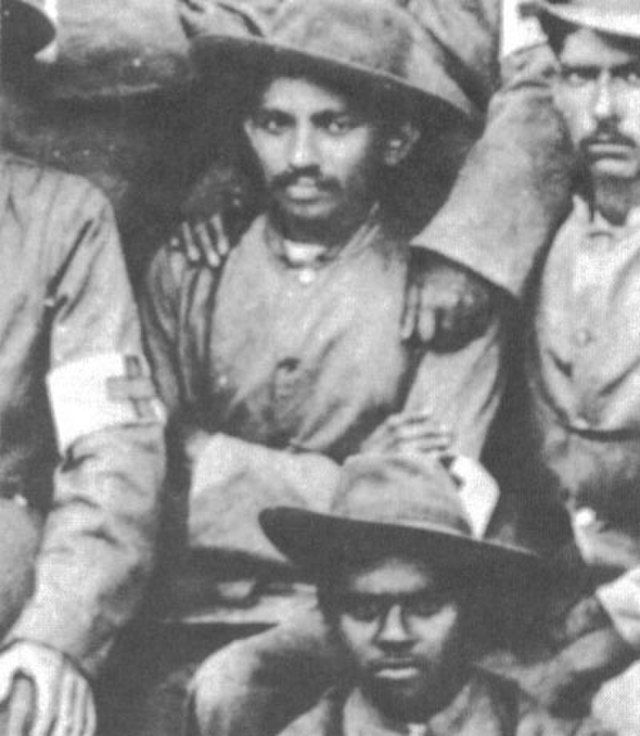
After the Boer War, Botha and Gandhi would sometimes meet to discuss the extension of the Indian franchise in South Africa. It is possible that Gandhi’s involvement at Spion Kop influenced him to use non-violence a method to achieve political change.
All three men were all directly involved in the battle at Spion Kop. All three were relatively young at the time. All three men would become hugely influential leaders in their own right. It was one of the curious intersections of history.
 Australia and the World Past and Present
Leave a comment