Affecting the area of South Gippsland, these fires were a hugely significant event for early settlers of the area.
The fires covered an area from the main Gippsland train line to the coast and from Westernport Bay to Mirboo.
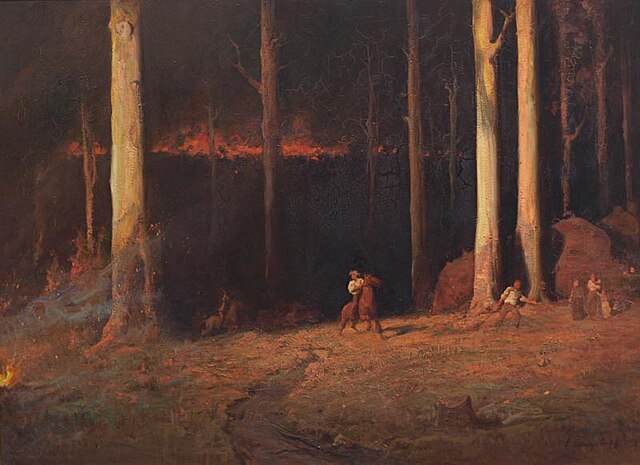
The 1st of February was known as ‘ Red Tuesday’. Losses were huge. Livestock was wiped out. Fencing was destroyed.
Bullocks were more common than they are now and at the time many were used as beasts of burden, helping to clear dense forests.
During the fire many bullocks had sought refuge in tiny creeks. Having been surrounded by fire, they would be found piled on top of each other when people began to survey the damage.
Some early settlers had constructed underground water tanks and had sheltered in them when the fires threatened to overwhelm them.
The first sign many saw of the fires were masses of dark clouds. Of course they wern’t clouds at all but vast columns of smoke.
The flames at times looked like copper, at other times they resembled ‘blue steel’ or silver.
Then embers would begin to flutter in, carried by strong winds.
So much of peoples wealth and livelihoods were bound up in their livestock. Minds immediately turned to cattle and sheep. If settlers were fortunate, they may have a section on their property that had recently been burnt out and this could be used as a safe haven.
Sheep had a habit of wondering into pokey gullies. Some went into hollow logs from which they never came out.
Some settlers buried their bedding, clothes and valuable items in the ground as the fires approached in order to protect them from the flames and heat.
The livestock that did survive faced the prospect of starvation. Many were immediately sent to market. But with so many put on the market at the same time, there was a glut which lowered prices.
The governement offered free fodder or at least very cheaply. Interestingly, many early settlers were reluctant to take advantage of it as they had a very strong sense of independence.
The process of rebuilding houses and fencing began.
This was a multi-day event. For some, it was a week-long battle for survival. Some lost all of their possessions not to mention the mental scars left behind.
Some believed the smoke contributed to some later losing their sight.
For the people who experienced it, it became a defining event in their lives. There was life before the fires and life after the fires.
For these early settlers these fires became a marker from which other events would be referenced.
 Australia and the World Past and Present
Leave a comment