By the 1870s land was being surveyed and auctioned off in South Gippsland.
Rail had already developed strongly on the main Gippsland line but small, fledgling settlements between this line and the coast were only serviced by dirt tracks.
First, a possible route had to be surveyed. Surveyor Griffin set out with twelve men to solve the puzzle of where the line could go. They worked on this from 1884 to 1886. By far the most difficult section to survey was the 14 miles from Bena to Leongatha which was covered in dense forest.
Griffin had to choose where to place culverts and bridges.
In March 1887, the Commissoners set out to inspect the route. Residents gathered to meet with the Commissioners as they traveled along the line in order to advocate for a station in their area. Residents would highlight livestock numbers, the number of residents and any significant roads by which people could bring their goods to meet the trains.
There was suspicion of ‘ring-ins’. This was suspected at Whitelaw where a mob of fifty bystanders showed up for the Commissioners, yet there was no Whitelaw settlement. Whitelaw would receive its own station.
Construction began in 1887. The first section ran from Dandenong to Whitelaws Track. This section took five years to complete.
The issue for the first section was the swampy land that it traversed, especially around Tooradin and Koo Wee Rup. To deal with this, bridges were constructed in certain locations.
The bridge over the Main Drain was said to have had 137 openings through which water could pass.
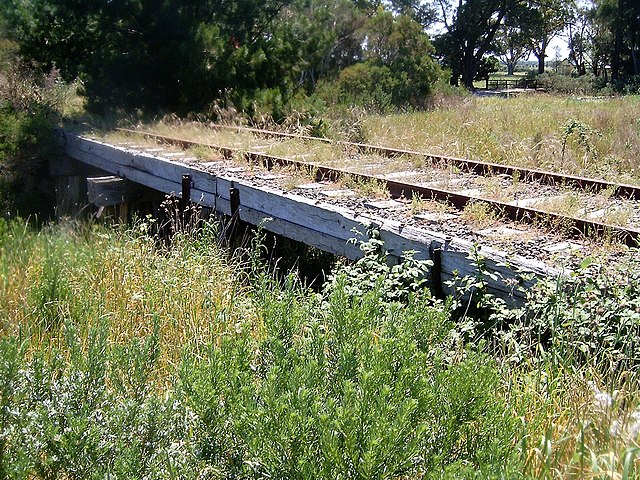
The second section went from Whitelaws to Toora. It was contracted to a different party than the first.
In the second section, the construction crew had to build a mammoth bridge just outside of Meeniyan. Due to the steep, hilly country, cuttings were required to be made in the Black Spur near the Tarwin River. Landslides were a problem.
Trees were felled and used as sleepers
The third section extended from Toora to Port Albert. Again, this was contracted to a separate party.
The third section was by far the easiest section of the track to build as the land wasn’t as wet as the Koo Wee Rup section, nor as hilly or dense with forest like the second section.
The first train ran the entire line on 13 January 1892.
Once open the line would take coal, livestock, timber, dairy products, vegetables and passengers to Melbourne.
Trains could bring in important consumer goods that were not able to be sourced locally. Furniture and even cars would be brought in on the train.
By the mid-nineties the line was no longer servicing freight or passengers and had been replaced by bus and truck services.
The South Gippsland Tourist Railway operated for many years, but much of the line has now been converted into the Great Southern Rail Trail for walkers and cyclists.
 Australia and the World Past and Present
Leave a comment