If Trump wins a second term, what can we expect from his foreign policy? The experience of his first term (2017-2021) is instructive.
There is one thing that is very predictable about Trump’s foreign policy – it is very unpredictable. Trump does not have a problem in laying out a position one day and then saying the exact opposite shortly afterwards. Policy consistency was not a trait of his administration.
He had no problem in pulling out of international agreements. Bilateral forums ‘trumped’ multilateral ones. Trump prefers dealing with people one on one and making transactional arrangements to sitting in multinational forums and being lectured on long-standing international norms.
His rhetoric and indeed many of his policies are strongly nationalistic.
He preferred listening to his White House advisors than relying on the State Department. The glaring example of this was his Middle East Peace Process which was led by his son-in-law, Jared Kushner. Kushner had been a property developer with no experience in diplomacy in the Middle East, but Trump trusted him more than State Department officials with decades of experience.
The Peace Plan didn’t have significant input from the Palestinians and was rejected by them. Many analysts agreed that the plan favoured Israel. Furthermore, the development of the plan didn’t have Kushner’s undivided attention. He was also working on selling American innovation and responding to the US opioid problem.
Trump withdrew from the Trans-Pacific Partnership and from the Paris Climate Agreement.
He placed more pressure upon NATO countries to contribute more towards NATO expenditure.
The President slapped a travel ban on some Muslim countries and he recognised Jerusalem as the capital of Israel.
He disengaged from the Iran nuclear deal.
In February 2020, the US and the Taliban in Afghanistan finalised the Doha Agreement. Trump agreed that all US troops would pull out of Afghanistan by 2021. The deal was conditional with the Taliban agreeing that they would prevent any militant group from attacking the US or US allies. The Afghan government was not involved in the talks and did not support the deal. In line with the agreement, the US continued to bring troops home.
Joe Biden was inagurated President in January 2021. The Taliban launched action to retake Afghanistan and they were successful in overthrowing the US-installed Afghan government. They took Kabul on 15 August 2021.
So as we can see, the agreement to end the war was made during Trump’s tenure but the deal excluded the Afghan government and was criticised in certain respects. Biden agreed to honour the deal and the final troop withdrawals happened under his watch. The Taliban ended up in power in Kabul as they had been before the beginning of the war.
Trump also oversaw the Abraham Accords. These Accords were significant. They relate to the normalisation of the relationships between Israel and some of its neighbours. They are bilateral in nature. One was concluded with the United Arab Emirates and one was concluded with Bahrain. These two counties both recognised Israel’s sovereignty. Morocco followed. In exchange for Morocco’s support the US agreed to recognise Morocco’s claim over Western Sahara. These agreements open the path for greater economic cross-investment. As a result of normalisation it will be easier for these nations to access Israeli defense products and take out a stake in Israeli assets.
Trump’s first overseas trip gave us an idea about his priorities. He visited Saudi Arabia, Israel, the Vatican and Brussels (for NATO business).
Asia:
North Korea
In June 2018, Trump met the leader of North Korea, Kim Jong Un in Singapore. They released a joint statement. There was talk of a security guarantee for North Korea and Kim made some vague reference to working towards the denuclearisation of the Korean peninsula. Trump surprised many by announcing that he would end military drills with South Korea.
Trump followed this up with a visit to North Korea in 2019. Trump met Kim in the Demilitarized Zone becoming the first US President to enter North Korea while in office.
Trump’s meetings with Kim Jong Un were window dressing for the North Korean leader. Kim could claim that to his domestic audience that he was important enough to occupy the time of the US President. Trump’s rapprochement with Kim did not significantly change North Korea’s behaviour.
China
In May 2019 Trump fuelled a trade war with China. The US raised tariffs on $200 billion worth of Chinese products.
American-Chinese relations continued downhill. During the COVID-19 pandemic Trump referred to Coronavirus as the ‘Chinese virus’.
Australia
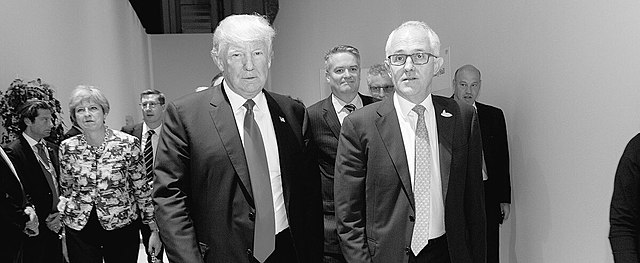
Australia-US relations took a blow in 2017 when Trump made it clear that he didn’t want to honour an agreement made by his predecessor. President Obama had agreed that that the US would take in 1,250 refugees. Australian Prime Minister, Malcolm Turnbull, insisted that Trump honour the deal but relations between the two would never be warm.
The foreign policy of Trump’s administration was chaotic. Other countries look to US policy as a guide to future events. Other counties are looking for policy stability. It is reasonable to assume that a second Trump Presidency would continue to distrust multinational forums and agreements. There is a good chance that US foreign policy will return to being erratic and idiosyncratic.
 Australia and the World Past and Present
Leave a comment