This year academics Justin Vaughn and Brandon Rottinghaus published data from their Presidential Greatness Project.
They polled 154 past and recent members of the American Political Science Association and asked them to rank all US Presidents on a scale of 0 to 100.
0 meant that the President was seen as a failure. 50 meant that they were viewed as being average and a score of 100 signaled greatness.
The respondents ranked Biden in 14th place and ranked Trump last.
Biden had an average score of 62.66, which was above a favourite of conservatives – Reagan.
Here’s how the top 10 looks:
1. Abraham Lincoln (Republican)
Lincoln received an average score of 95. The largely self-taught lawyer and politician was President from 1861-65. The saw the country through the Civil War and maintained the union. He rose out of poverty and would end up abolishing slavery.
He had been moved by the Kansas-Nebraska Act of 1854, which opened these territories to slavery. Four years later he took part in a set of now famous Senate campaign debates with Stephen A. Douglas. During the Civil War, Lincoln selected Generals whom he thought would be most effective. Lincoln delivered the Gettysburg Address and in 1963 he issued the Emancipation Proclamation declaring that slaves in slave states were free.
2. F.D. Roosevelt (Democrat)
Roosevelt was the longest-serving US President. He saw the US through the Great Depression and World War II. He had to contend with being a paraplegic later in his life. He implemented his ‘New Deal’ giving relief to those in need, starting economic recovery and undertaking financial reform. He brought in the Labor Relations Act and Social Security. Despite his many positive achievements, many would point out that he sanctioned placing Japanese Americans into internment camps during WWII.
3. George Washington (no party)
Known as the Founding Father of the United States, Washington was a military officer and had been active in the French and Indian War. He had been elected to be commander of the Continental Army in the American Revolutionary War.
He drafted the US Constitution and established the two-term tradition of American Presidents. In 1796 he gave his farewell address in which he warned against the dangers of separatism and foreign influence.
4. Theodore Roosevelt (Republican).
Roosevelt had been a soldier. In 1898 he helped plan the war against Spain. He would lead his Rough Riders in Cuba against Spanish forces there. He returned to the US a war hero and went on to become governor of New York.
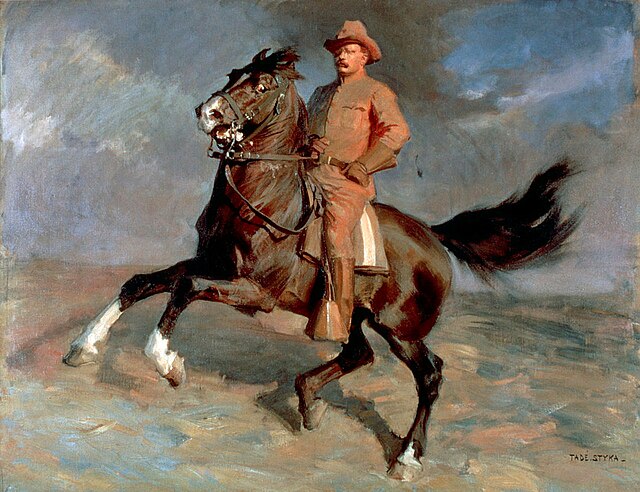
His first wife and mother died on the same night and he took to cattle ranching in the Dakotas for a while.
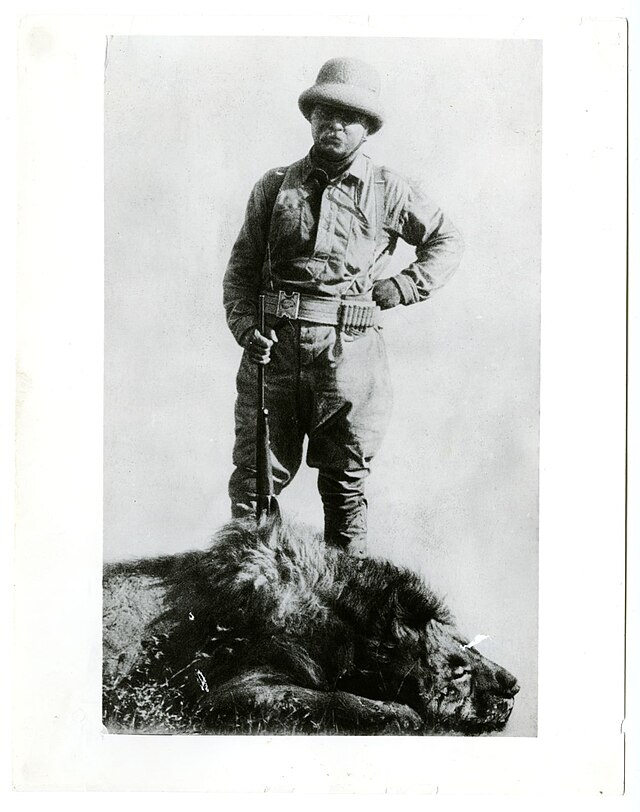
At 42, he was the youngest ever President. He regulated the railroads, focused on Central America in terms of foreign policy and began building the Panama Canal. In 1906 he was awarded the Nobel Peace Prize for his efforts to stop the Russo-Japanese War. This Bison-hunting President was known for his masculine and brave character. Dalton called Roosevelt’s efforts a ‘strenuous life’.
5. Thomas Jefferson (Dem-Rep)
Lawyer, architect and philosopher – Jefferson was something of a Renaissance man. The third President of the United States was the primary author of the Declaration of Independence.
Jefferson was a thinker and is remembered for his promotion of democracy, republicanism and individual rights.
The Planter from Virginia would double the size of the US through the Louisiana Purchase. His 1807 Embargo Act was an act of protectionism that stimulated a nascent American manufacturing industry.
Jefferson stressed religious freedom, supported the Lewis and Clark expedition that paved the way for later westward expansion and advocated the importance of science.
6. Truman (Democrat)
President from 1945 to 1953 and responsible for implementing the Marshall Plan that rebuilt the economies of western Europe after the war. The Missouri native also oversaw the creation of NATO. Truman was thrust into the role of President when FDR died in office.
He authorised the dropping of the atomic bombs that devastated Hiroshima and Nagasaki.
Truman was no isolationist. His Presidency also saw the Berlin Airlift and the start of the Korean War. Truman’s Presidency coincided with the beginning of the Cold War and the development of a containment strategy to deal with the Soviet Union.
On the home front, Truman proposed major civil rights legislation in 1948.
He was very unpopular when he left office. However, he died during the Vietnam and Watergate Crises and his reputation improved at this time. This was a time of great disillusionment in US politics and Truman was recast as being relatively successful by comparison.
With the passing of even more time, the fall of the Soviet Union seemed to vindicate his approach of containment.
7. Obama (Democrat)
8. Eisenhower (Republican)
‘Ike’ had been Supreme Commander of Allied Forces in Europe during World War II. This five-star general supervised the invasion of Normandy.
Following the war, this native of the South acted as military Governor of American-occupied Germany (1945) and was later the Supreme Commander of NATO (51-52).
Philosophically, Eisenhower was anti-communist and against running federal deficits.
More controversially, he was in favor of American support for coups in Iran and Guatemala.
He did not join British and French intervention in the Suez Crisis and condemned their actions there but he did approve the Bay of Pigs invasion of Cuba.
Domestically, he expanded social security. He signed the Civil Rights Act of 1957. In a historically significant event etched into the memory of Americans he sent troops to Little Rock, Arkansas to enforce federal court orders on school integration.

He oversaw the construction of the Interstate Highway System and established NASA.
He was criticised by some for not keeping up with USSR in technological innovation.
Eisenhower ended the Korean War, oversaw a prosperous middle class in America and balanced the budget.
At the end of his Presidency he warned of a growing ‘military-industrial complex’. It was quite ironic that this military man was warning of military overreach.
9. L.B. Johnson (Democrat)
Lyndon Baines Johnson was President 1963-69. Like Truman, he became President upon the death of his predecessor. This former teacher is well known for his ‘Great Society’ programs.
Johnson pursued civil rights reform – extending health care and education programs. Medicare and Medicaid were created during his tenure.
He was proud of his Civil Rights Acts of 1964 and 1968.
He was extremely popular at the beginning of his Presidency but steadily lost ground as the Vietnam War dragged on. During his time in office there were major race riots in some major cities and some have criticised his escalation of involvement in Vietnam.
10. Kennedy (Democrat)
Andrew Jackson and Woodrow Wilson have slipped in esteem in recent years most likely due to increased focus upon their views and records on racial issues.
Jackson had owned slaves and oversaw the removal of Native Americans from their homelands.
Wilson was President during World War I and was instrumental in setting up the League of Nations and the post war international architecture.
However, some are critical of his views on race and point out that he supported racial segregation.
In contrast to Jackson and Wilson, Ulysses S. Grant has moved up in the rankings in recent times perhaps based on the efforts push on with Reconstruction in the South and his fight against the Ku Klux Klan.
Presidents who often appear at the bottom of rankings include Franklin Price, Warren Harding and William Henry Harrison.
So does James Buchanan who is often seen as failing to stop the nation from sliding into Civil War.
Many modern Democratic figures have moved up in the rankings in recent times while many Republicans have moved down.
Is this due to an increasing focus on slavery and race relations? Or perhaps it is because significant civil rights changes are often a feature of Democrat Presidents (although not exclusively). Or are there are more Democrat-inspired academics taking part in these kinds of surveys?
Ronald Regan is a Republican favourite but even he has had a downward journey in recent times.
Only Lincoln, F.D. Roosevelt and Washington received a score higher than 90.
There is a partisan divide seen in relation to some Presidents with academics who self-identify as Democratic having very different views from those who self-identify as Republican.
This is the case with FDR, Obama, L.B. Johnson, Madison, Kennedy, Coolidge and G.W. Bush.
It is interesting to note that although he was Republican, Lincoln is even more popular with Democrat respondents than Republican ones.
Some Patterns
War is a key theme with Presidents who are well-respected.
Washington, Theodore Roosevelt and Eisenhower were military men and seemed to have risen in prominence due to their service. Even Kennedy had served in the military.
Even if a President hadn’t served in the military, they often rose in popularity if they were at the helm during armed conflict and won.
This is certainly the case with FDR. World War II was seen as a moral or noble endeavor – fighting against Nazism and fascism.
Washington was the hero of the Revolutionary War.
Eisenhower’ role in WWII and in ending the Korean War were well-regarded.
Lincoln won what many Americans regard as their ultimate war – their fraternal Civil War and for it he is esteemed. However, if Lincoln had not won the war he may have been viewed like James Buchanan.
War can be a double-edged sword – particularly if the war is lost. L.B. Johnson was losing skin as the war in Vietnam dragged on.
There are some Presidents who established critical founding documents or institutions. Washington falls into this category. There is a certain benefit from being amongst the first. These leaders become associated with the birth of the nation.
The other area in which Presidents seem to distinguish themselves in history is in passing important civil rights laws. They rise above the everyday administration of government, get on their moral high-horse and go and stand on an ethical pinnacle. These efforts seem to be remembered in the chronicles of history.
 Australia and the World Past and Present
Leave a comment