Last month former Peruvian President, Alberto Fujimori, passed away.
His passing was noted in Peru and further afield and many have reflected on his legacy.
Fujimori was born in Lima in 1938 to Japanese parents who had immigrated to Peru four years earlier.
Hi parents were Buddhist but Alberto would become Catholic.
He studied agricultural engineering, graduating in 1961 at the top of his class.
He lectured in mathematics and later studied physics.
Fujimori was President from 1990 to 2000.
Some have labelled his administration as a ‘civilian-military dictatorship’.
He was a member of the political party was ‘Cambio 90‘ (1990-1998).
Alberto divorced from his wife, Susana, in 1995 – right in the middle of his time as presidency. She would become a vocal critic of his administration.
They had four children and two of them, Keiko and Kenji, have both pursued careers in politics.
Upon becoming president, Fujimori faced some big challeges.
He had to address a troubled economy and inflation that was out of control.
Fujimori became president in 1990, beating well-known novelist Mario Vargas Llosa.
In terms of economic policies, some regarded him as ‘neoliberal’. His suite of reforms were sometimes referred to as ‘Fujishock’. He brought inflation under control. It was a time of privitisation and an influx of foreign capital. The currency at the time – the inti – was replaced by another – the nuevo sol. There was less desire from his administration to fork out government subsidies. The minimum wage was increased.
Besides restroing the economy, the other big challenge was dealing with two internal insurgencies – Shining Path and the Túpac Amaru Revolutionary Movement (MRTA). Fujimori set out to eliminate the threat posed by these groups. Shining Path and the MRTA were based in remote areas of the country. So, it was always challenging for the military to respond and protect citizens living in these areas. As one method to deal with this problem was to set up peasant patrols (rondas campesinas).
Some massacres perpetrated by military death squads would become well known.
One was the Barrios Altos massacre by the Groupo Colina in 1991 and La Cantuta massacre in 1992.
By 1992, Shining Path activities had been much reduced.
At the beginning of his administration, Fujimori didn’t control either house of parliament. This made his passing his reforms more difficult.
There has been much discussion this year about the attempted coup in Bolivia and whether it was an ‘autocoup’. Autocoups are not new and on 5 April 1992 Peru witnessed its own ‘Fujicoup’. The military shut down Congress. Initially, the coup was rather popular. However, the Organization of American States (OAS) denounced it. Venezuela cut off diplomatic ties and Chile and Argentina wanted Peru suspended from the OAS.
A new constitution was drafted in 1993 but the body drafting it was dominated by politicians sympathetic to Fujimori. The constitution was subsequently approved in a referendum.
In Fujimori’s first term, his regime was already being accused of overseeing thousands of politically-motivated murders.
In 1995 Alberto was still riding a wave of popularity and he won the presidential election of that year with around two-thirds of the votes.
The new Congress would only have one chamber and it was dominated by supporters of Fujimori.
Fujimori would govern more and more by decree.
A border dispute was settled with Ecudaor. This issue had been festering for over a century.
In 1996 the government was forced to deal with the Japanese embassy hostage crisis. The MRTA has taken the Japanese Ambassador hostage along with around 400 other hostages. The majority of them were released but the MRTA still decided to keep many detained.
The MRTA demanded that fellow members of the group be released from prison. They had misjudged the resolve of the Fujimori administration. The government refused their demands and opted for a military resolution to the crisis which had dragged on for four months. In the subsequent raid one hostage, two members of the military and 14 MRTA members were killed.
Between 1996 and 2000 there were allegations of forced sterilisations of indigenous communities. The program was ostensibly for population control. The program was said to have affected hundreds of thousands of people and women were not the only ones affected. Many men had undergone vasectomies.
Fujimori ran for the presidency once more in 2000. However, these elections were widely considered to be neither free nor fair. OAS observers left Peru in protest.
2000 was a watershed year for Fujimori. A bribery scandal broke out implicating Vladimiro Montesinos – head of the National Intelligence Service (SIN).
The tide had turned against the president.
Fujimori went to Japan where he would remain for many years. Fujimori held Japanese citizenship and Japan was not amenable to extraditing one of its own citizens.
In 2005 he travelled to Chile where he was arrested and subsequently extradited to Peru.
Fujimori’s legal trials had more twists and turns.
In 2007 he was convicted for illegal search and seizure and was sentenced to 6 years imprisonment. This was appealed but was upheld by the Supreme Court.
In 2009 he was convicted for human rights violations and given 25 years. Specifically, it was related to his involvement in kidnapping and murder by the Grupo Colina death squad that had been fighting the MRTA.
This was the first time that a democratically-elected head of state had been convicted of human rights abuses in his own country.
In the same year he faced charges of embezzelement. He was convicted and given seven and a half years.
Also in 2009, he faced a bribery case – gaining another 6 years.
In Peru sentences are served concurrently. All up, the former President was looking at 25 years behind bars.
In 2017 he was pardoned by the then-president of Peru and released. However the Supreme Court didn’t agree with this decision and ordered him back to prison.
The legal manouvering continued and the Constitutional Court of Peru, in a split decision, ruled that the pardon could stand.
Not to be outdone, in 2022 the Inter-American Court of Human Rights overruled the Peruvian court’s decision, ordering Fijimori to not be released.
The Supreme Court had the last say and ordered Fujimori be released once more.
In the end, Alberto would succumb to cancer.
The boy of humble origins had risen to the highest office in his nation. To his supporters, Fujimori was the saviour of the Peruvian economy and had put down two devastating insurgencies. To his detractors he had perverted Peruvian democracy.
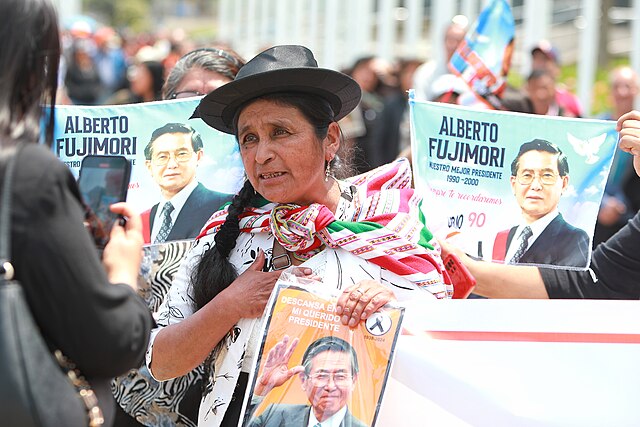
His time as leader reflected many of issues facing Latin America at the time – guerilla insurgencies, the nature of the state and democracy, the relationship between the politicians and the military and the status of indigenous people.
 Australia and the World Past and Present
Leave a comment