Shigeru Ishiba has emerged as Japan’s next prime minister showing that his perserverance has paid off.
Ishiba is from the Liberal Democratic Party (LDP) and has previously served as defence minister.
He is an ex-banker and has also served as agriculture minister.
Ishiba won in a runoff with Sanae Takaichi, the 63-year-old economic security minister.
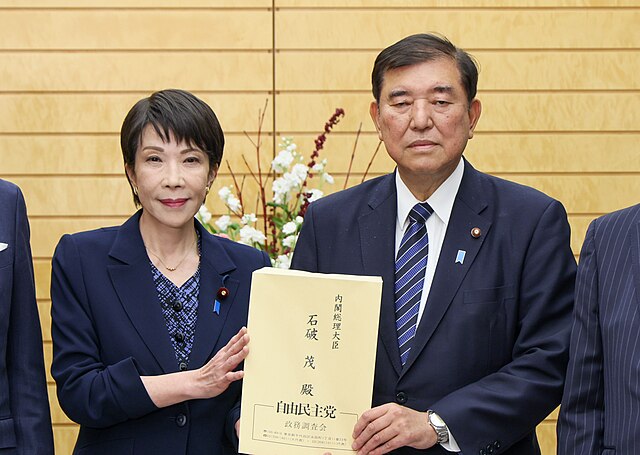
There were nine contenders for the prime ministership this time around – high in historical terms.
Ishiba, 67, has attempted to become prime minister on five seperate occasions.
Despite winning the latest contest, he has been viewed with suspicion by many in his own party as he often speaks out against the LDP if he has a different view.
He is more popular with ordinary voters than he is with his own party.
He is known for being direct and a policy wonk.
He is comfortable talking about disater relief programs.
Ishiba is attracted to pursuing a asian NATO-style alliance.
Japan still hasn’t had a female Prime Minister. Sanae Takaichi has come as close as any.
She is seen as a social conservative and a protoge of former PM Shinzo Abe.
She is opposed to seperate surnames for women after marriage.
She frequently attends the Yasukuni Shine which honors Japan’s war dead. While it is a site of commemoration for all of Japan’s war dead, it also commemorates some who were convicted of war crimes during World War II. Therefore it can be controversial for politicans to visit the shrine. When they do they often get an terse response from the Chinese and South Korean governments.
Sanae cites Margaret Thatcher as someone that she admires. She also wants to look at changing Japan’s pacifict constitution.
Another of the contenders for the priministership this time around was Shinjiro Koizumi. He is the son of former prime minister, Junichiro Koizumi. Relatively young in terms of Japanese politics (42), he is viewed by many of his colleagues as still inexperienced.
According to LDP rules, the party selects its leader in the following way – LDP party members have 50% of the vote and MPs have the other 50%. There are currently 368 MPs in the Diet (Japanese parliament).
The LDP is the perennial political party of Japanese politics. Since World War II it has only been out of office in 1993 and from 2009 to 2013.
Japanese politics is also well known for its high rotation of prime ministers.
Shinzo Abe was abnormal in this regard. He was prime minister for 8 years – a very long stint in Japanese terms.
The previous prime minister, Fumio Kishida, was in power for 3 years. His predecessor had even less time – 1 year.
This high rotation of leaders makes it difficult to tackle major reforms.
Yet another aspiring candidate was Foreign Minister, Yoko Kamikawa.
She has been more vocal on gender equality issues than Takaichi.
Kamikawa studied at Harvard and is seen as being more socially progressive than Sanae. This may have been a big factor in her receiving less support than Sanae. While it may difficult for a woman to break through to the prime ministership, it may be even more difficult for one who is socially progressive as she may being going against the tide of a socially conservative party culture.
Kamikawa has previously been minister for justice and in this role she was responsible for authorising the executions of some convicted criminals. Some of those executed under her watch were from the Aum Shinrikyo cult. This group had organised and carried out the sarin attack on the Tokyo subway system in the mid-1990s.
The LDP came close to electing its first female prime minister, but that milestone is still a way off. As is often the case, the LDP went for someone with high seniority. Will it be another year before the contenders are lining up again? In Japanese politics it is more likely than not.
 Australia and the World Past and Present
Leave a comment