Over the years, I have had some exposure to two Buddhist traditions – Zen and Theravada.
My first experience was joining a Zazen group in Japan. I would attend once a week. It was a highlight of my week. I remember getting off the train at the station and walking over the bridge and into the university grounds where the group would practice.
I recall walking over either in the sultry summer air or the crisp winter chill.
The university had been established by Jesuits and the Zazen sessions would take place in the oldest building on campus.
The room was European in style – a totally beautiful room. Dark wood paneling and plush carpet.
The group was led by a Jesuit priest, but he had been in Japan for decades and had practiced zazen himself for a long time.
Our group had three sittings, each lasting longer than the previous.
The first sitting lasted 30 minutes. This sitting started off slowly. People would wander in after finishing their work or other activities. But they would take care not to disturb others. We would collect a cushion, head to a spot in the room, face the wall, sit in the half lotus or full lotus position (if one could manage it) and settled in.
We were taught to practice with our eyes open. It was said to prevent one from getting too drowsy. I did have some trouble with the posture. While I have good general flexibility, I am not very flexible in that way. I could manage the half lotus position (to some extent). But the full lotus position was a bridge too far for me. Additionally, the longer I held the position the more discomfort I would feel. I felt the the discomfort would start to enter my mind and push out other things, so I would change my position around to become more comfortable.
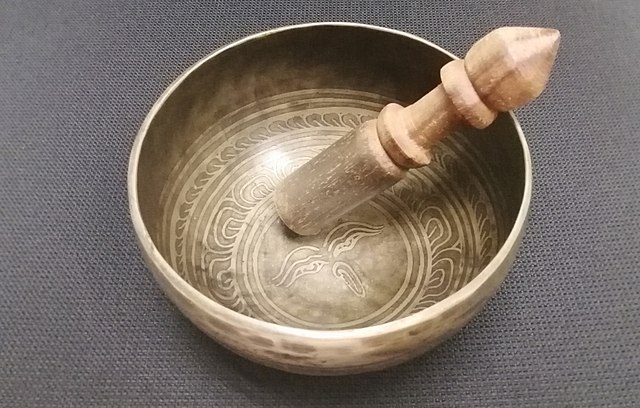
In between seated meditation sessions we would do walking meditation. When we heard the metallic sound of the bowl being struck we would slowly prepare ourselves for walking around the room. I often had be careful getting up as my my legs were often numb from the lotus position. The walking would be slow and deliberate, focusing on being present and aware.
Then we would begin our second session – forty five minutes. Hopefully each session would allow you to get deeper into your meditation.
After the second session there would be a short fifteen minute dharma talk which usually focused on some aspect of meditation.
The hard-core practitioners would then settle in for the final hour-long session while others would head for home. I sometimes joined in but not always. I listened to my mind and my body and respected their feedback.
I very much enjoyed my time with this Zazen group. It was a period of calm in my week. The environment within the room and the group was peaceful and I always left feeling refreshed.
My second experience was with another Zen group, this time back in Australia.
The group was led by a Japanese Abbot. Most of the attendees were lay practitioners. The session would run for a few hours. The main practice was still zazen (seated meditation). However there were other aspects of practice included which I hadn’t encountered in Japan.
Chanting was an important practice and it is something that I enjoy. Around half would have been in English and around half in Japanese. However, much of what it is chanted in Japanese is based on Chinese versions of the sutras (sutras may be written like this or as ‘suttas’ – depending on the kind of Buddhism you are following).
Sutras (discourses of the Buddha) were first written down in Pali and Sanskrit. Then translated into Chinese. From Chinese into the various languages of Tibet, Korea and Japan.
Japan imported the Chinese writing system as the basis of their own written language. But when the Japanese adopted the Chinese characters, they somewhat changed the sounds associated with the characters.
In Chinese translations of the sutras, like the Heart Sutra, each character corresponds to one word. When most Japanese chant the Heart Sutra, they use the Chinese version with the ‘Japanised’ sounds replacing the Chinese sounds. However, as most Japanese words consist of multiple syllables, these sounds don’t correspond to Japanese words. So if a Japanese person hears the sutra for the first time and isn’t reading it, they won’t be able to understand what is being said.

I have chanted the Heart Sutra on and off for years and while I enjoy it and have found some familiarity with it, I find that it still doesn’t connect with me the way it does if I chant it in English or even regular Japanese.
I wonder if I was a monastic and I was chanting it all the time for years and years – would it resonate with me more? I wonder how it feels for Japanese monastics who have been practicing for years. I haven’t asked them, so I don’t know.
The zazen group in Australia alternates between meditating facing the wall and meditating facing inwards – towards others in the room. Facing the wall ties in with the example of Bodhidharma (the monk who is said to have brought zen from India to China). Legend has it that he sat for 9 years facing a wall in meditation. There is a certain energy created from facing inwards towards the other practioners.
Zazen practice can be quite structured and exacting. In this group there is an exact seating arrangement, an exact way to receive and drink tea, an exact time to strike the wooden clappers together, the exact number of times to prostrate oneself before the Buddha.
Things can be regimented. This appeals to people of a certain way. Likewise, it will turn some off. One often finds that there is a ‘correct’ way to do almost everything – how to sit, how to walk, how to breathe and so on. That is why it doesn’t surprise me that zazen took root in Japanese culture. I sometimes wonder how much of zazen practice is Buddhist and much is just Japanese culture.
Zen looks to direct experience. It is often descibed as ‘Buddhism outside the scriptures’. It favours direct experience over discussion, dialogue, debate, questions and answers and verbosity.
The Zazen group in Australia had a dharma talk during their session but it was still relatively short. Silence was much more pervasive than speech.
Some zen schools use koans in their practice. Koans are short stories or anecdotes that set up a problem that can’t be resolved through the intellect. Their purpose is cut off dualistic thinking and to penetrate matters directly. Zen doesn’t give too much importance to discussion and so it is more common to encounter quiet practice.
Zazen practice can seem austere and hard. For me, it conjures up an image of sitting on a hard bench. It might be good for you, but it isn’t necessarily cozy and warm.
Most recently I have been attending a Theravadan Buddhist group. I go every couple of weeks – either for a meditation session or a dhamma talk. Additionally, on Sundays, the group often has a community lunch following the dhamma talk.
Most of the sessions are led by monastics but most in attendance are lay practitioners.
One small difference between Zen monastics and Theravaden monastics are the colour of their robes. Zen monastics wear black while Theravada monastics wear orange.
Meditation sessions last one hour and are followed by a half hour question and answer session. I have found that there tends to be quite a lot of questions asked about meditating – how do I concentrate?, What are the jhanas? How do I know if I am progressing?, How do I prevent sleepiness? And the monks tend to answer in practical terms rather than just saying – you need to do more practice, or investigate it more yourself through your meditation.
Dhamma talks also last 1 hour. There is usually a overarching theme – it may be suffering, rebirth, forgiveness, monasticism, family, relationships, depression, joy and so on. I find that they tend to be very useful in one’s everyday life.
The monks can tie teachings back to the Buddha’s life or what is written in the suttas. The Theravada tradition focuses on the earliest suttas of Buddhism and they don’t recognise many of the later sutras of the Mahayana.
After the dhamma talks there is a thirty minute question and answer session.
The monks are a great example. Living by the Vinaya (the rules for monastics), they help to set a very conducive environment within the meditation hall.
In this Buddhist community there is a sizable Sri Lankan lay community. However one finds people of all ages and backgrounds.
On the weekend sessions lay practitioners often take the five precepts – that is: I will not kill, I will not steal, I will not commit sexual misconduct, I will not use harmful speech and I will not partake in intoxicants.
In this Theravada community there is a lot of focus upon the 5 Precepts, the Four Noble Truths and the Eight-fold Path.
One can find more talking in the Theravada sessions than in Zazen sessions. As a result, I think that they tend to be more accessible to people than Zen. People are used to discussion – questions and answers. Zazen is less intuitive for people. It is harder for most.
It should be said that meditation is a huge part of the Theravada tradition – especially for monks who probably spend most of their time engaged in it. But it is a bit different when the monastics and lay community comes together.
On Sundays there is also the community lunch. Lay followers bring a plate of food to share with the monks and other members of the community. It allows the community to give food to the monks. This practice of giving or ‘dana’ is a very important aspect of practice. In the Theravada tradition monks are not allowed to prepare their own food. So there monastic and the lay community are bound together – the monastics rely on the lay community for its sustenance and the lay community relies on the monastics for their spiritual guidance.

The monks eat separately. The lunch offers a wonderful opportunity for the community members to meet, get to know each other and maintain relationships. It fosters community well-being. No doubt there is a spectrum of depth of belief within the community – as there is within all religious communities, and there will be some people for whom the community meal is the most important aspect of their attendance.
If I could sum up the Theravada practice that I have seen, I would describe it as ‘a warm hug’. That is the feeling.
These are just some personal reflections by a lay practitioner. Other people could point to different aspects depending on the group they have practiced with and the time span and depth of their involvement.
For me at this point in time it is the ‘hard bench’ or ‘the warm hug’. Which one are you more drawn to?
 Australia and the World Past and Present
Leave a comment