Mining contributed 13.6% of Australia’s GDP in 2023.
In 2019 Australia was the world’s largest producer of iron ore.
We were second in the world for gold, sixth in copper and nickel, eighth in silver and tin, first in opal and largest producer in diamonds.
Mining companies make up 20% of the Australian Securities Exchange (ASX) by capitalisation. Therefore many Australians benefit from mining through buying shares directly in mining companies or indirectly through their superannuation funds.
In 2020 mining exports made up 62% of all export revenue – some $270 billion.
Australia is the largest exporter of coal , iron ore and diamonds, second in gold and third in aluminum.
In 2021 mining helped to employ an estimated 270,000 workers – around 2% of all Australian workers.
By and large, Australia doesn’t do a lot of value-adding to our extractive industries.
According to World Steel Association Data for 2023 (in millions of metric tons):
China produced – 1,019.1
China led the pack by a huge margin.
Second was India with 140.2
Japan, the United States and Russia all produced between 75 and 90.
South Korea produced 66.7.
Italy, Vietnam, Indonesia, Spain, Poland, Austria and Belgium all produce more steel than Australia.
If we turn to the number of iron and steel plants found in countries around the world, we find that again China is way out in front with 404.
India follows with 92 and then the US with 85.
Japan has 40 while Russia has 32.
Italy has 25.
Germany, Indonesia, South Korea, Malaysia, Spain, Thailand and Vietnam all have between 10 and 20 plants.
Australia is on par with Canada with 8 each.
Italy is interesting. It is a realtively small country. Perhaps its central location in Europe makes it well situated to take advantage of large European markets.
South Korea is another relatively small country. But it has for a long time invested in value-adding technology and the state has backed industry strongly. South Korea is close to large markets in Japan, China and South East Asia.
South East Asian nations are growing and performing strongly. Indonesia alone has more than 280 million people.
What is perhaps surprising is that Australia and Canada have so few iron and steel and plants.
Most of Australia’s iron ore mining is located in Australia’s south and west. So although Broome is only 2,944 kilometers from Singapore, the distance from Adelaide to Singapore by ship stretches to 6,886 kilometers. From Adelaide to Beijing it is even longer – 8,631m kilometers.
So in effect, Australian iron ore mining sites tend to be relatively far from the key markets in north and South East Asia.
Australia has relatively expensive electricity.
It also has high labour costs and stringent environmental laws.
Some case studies:
Portland Aluminum Smelter (Victoria)
The Portland smelter has a capacity of 345,000 tons per annum.
The facility was commissioned in 1986-88.
Alumna comes to the plant from Western Australia. The plant was guaranteed subsidised electricity until 2016. Due to the fixed price of electricity to the plant, the state government missed out on the revenue it would have received if the cost of had gone up with rest of the market. In 2009 the historical cost of this subsidy was reported to be $4.5 billion.
What is interesting about the Portland Smelter is that raw material and the processing plant are very far from one another. Not only that but the plant is also over 500 kilometers from it’s power source.
Whyalla Steelworks
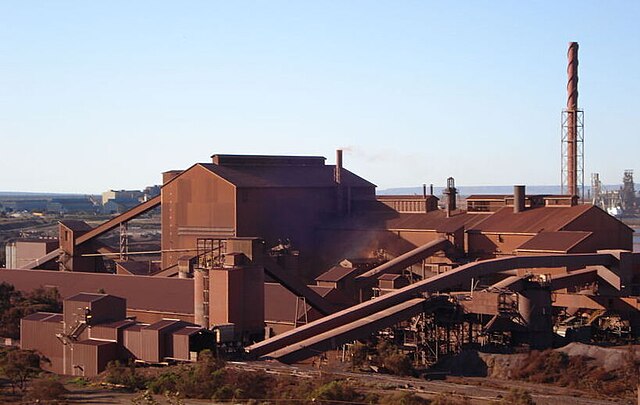
The Whyalla Steelworks can produce around 1.2 million tones of steel each year.
It does value-add to some finished products at the Whyalla Rolling Mill.
Whyalla is far from Asian markets but it is close to important mining sites within South Australia.
Sometimes Australia is called the ‘Lucky Country’. Much of that luck comes in the form having vast mineral resources. Australia was the only OECD country (out of 35) that saw positive economic growth every year between 1991 and 2016. The value of our mining resources has much to do with it. Of course these resources are finite. It is interesting to ask ourselves what would Australia look like if it didn’t have our mining resources to lean on? We need to ensure that our economy is diversified and that we are not simply relying on export revenue to prop up our nation’s finances.
 Australia and the World Past and Present
Leave a comment