Walvis Bay is the big brother of Namibia’s Atlantic coast.
It is a natural deep-water harbour. And because there are precious few harbours on this stretch of the African coast, it has been strategically important throughout history.
The waters off the coast are rich in fish and Walvis Bay is home to an sizeable fishing industry.
Diogo Cão – the famous Portuguese navigator – was exploring the area in 1485.
Following in his wake in 1487 was Bartholomeu Dias on his voyage to the East. Dias did not claim the bay for the Portuguese.
A settlement began to take shape at the close of the 18th century but it wasn’t settled all year round until the late 1800s.
The British already had the Cape Colony further to the south. By 1884 they had annexed Walvis Bay.
The ownership and administration of the Bay seesawed back and forth over time.
The early twentieth century saw the it change hands a number of times.
It became part of South Africa in 1910. The Germans took the territory at the beginning of WWI but were soon booted out in 1915.
By 1922 South West Africa was responsible for the administration of Walvis Bay and in 1994 it was transferred to Namibia. From a geographical point of view, it had always seemed a bit odd that this enclave had remained separate from Namibia. It was deemed that the territorial integrity of Namibia would take precedence and it has been part of that nation ever since.
Lüderitz
This is the little brother of Namibia’s coast.
Bartholomeu Dias christened the bay Angra Pequena.
In the 1800s is was a crucial site for whaling, sealing and there was even a lively guano trade. At this stage, Lüderitz was more of a trading post than a town.
Officially, the town was founded in 1883 by Adolf Lüderitz, who had bought land from a Nama chief in the region. Adolf died while on his Orange River expedition in 1886 and the town was named in his honour at this time.
Lüderitz has a dark side to its history. The railway to the east was built by prisoners who were kept at the Shark Island concentration camp and used as forced labour. The rail line was finished 1908.
The concentration camp lasted from 1905 to 1907.
It is estimated that 1000 to 3000 Herero and Nama lost their lives here. They were used as forced labour in the construction of the railway, the port and the town itself as well as on settler farms.
In 1909 diamonds were discovered in the area and as might be expected, Lüderitz experienced a population boom. The boom didn’t last long and by the 1920s the population was already in decline.
With a population of around 16,000, it is smaller than Walvis.
The city is well known for its architecture from the colonial period.
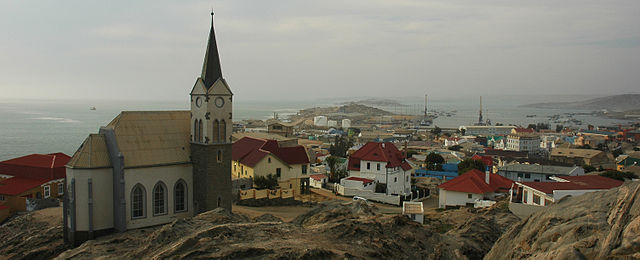
The railway running from Lüderitz to Keetmanshoop has been decommissioned.
Today, the port is the most important part of the town’s economy. It was significantly more important when Namibia didn’t have control of Walvis. It’s bay is shallower than that of Walvis.
Recently, there have been some attempts to reimagine the town. It has become an important hub for Namibia’s ‘green hydrogen’ project – some 80 kilometers to the south of the town.
It has been reported that the government will work with Hyphen Hydrogen Energy to produce around 300,000 tonnes of green hydrogen annually. Production is expected to start in 2026.
Wind turbines have also been proposed for the area. There is the Cerim Lüderitz Wind Power Station which is believed will provide 50 MW of electricity. Cerim is a joint venture project between China Energy Engineering Corporation and Riminii, a Namibian company. The station will be around 16 kilometers from Lüderitz.
Namibia has been keen to seize the opportunities that renewable energy present. These industries are quite a change from the shipping trade and the surrounding diamond mining operations of the past.
Kolmanskop
This tiny speck sits in the desert, ten kilometers from Lüderitz.
In 1908 diamonds were discovered here.
This sparked a veritable diamond rush and within a short period of time, this place in the middle of nowhere boasted a ballroom, a casino a hospital and even an ice factory. On the one hand an ice factory made perfect sense. But an ice factory in the middle of the desert also seems the ultimate folly.
Two electric railways joined with the main line at Kolmanskop. These lines were both private.
One ran to the south – to Pomona and then on to Bogenfels. The line was completed by 1913 but was destroyed during WWI.
The other line only went for seven kilometers and was completed in 1920, running to Charlottental.
By the 1920s Kolmanskop was already in decline.
Eight years later diamonds were discovered some 270 kilometers further to the south and residents left the town as quickly as they had arrived.
Kolmanskop would limp along for another few decades before being abandoned in 1956.
Since then the town has become Namibia’s quintessential ghost town.
It has become a popular place for photographers who stalk around the empty buildings that are being reclaimed by the desert sands.
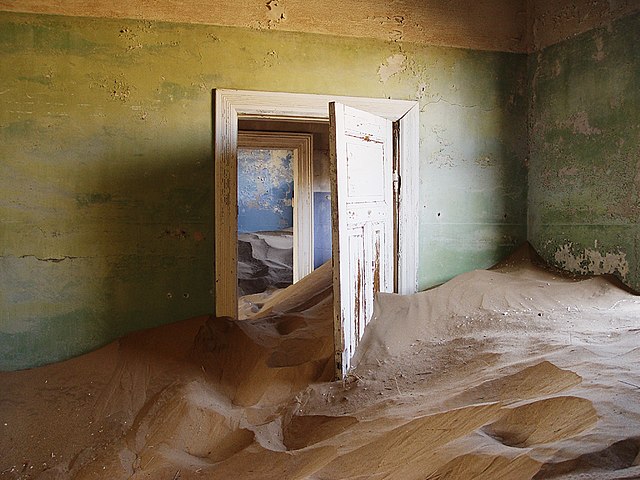
The history of Kolmanskop is the history man’s greed and propensity to move on to something else if it seems a better prospect. It is also a story of technical ingenuity and the desire to exploit the natural world for economic benefit.
 Australia and the World Past and Present
Leave a comment