Heroes’ Acre is a misnomer. The ground covers more than 50 acres.
The site sits just a few kilometers from the capital, Harare.
Heroes’ Acre commemorates those Patriotic Front fighters who lost their lives in the Rhodesian Bush War and to a lesser extent others who have contributed to the nation.
Once they pass away, those deemed worthy are interred at the site.
It is clear that most of those who are honoured at the site had strong connections with ZANU-PF.
Heroes’ Acre was partly designed by North Korean firm Mansudae Overseas Projects and construction began in 1981.
As of 2022, 161 individuals have been interred at the site.
Besides the tombs for named heroes, the site also hosts the Tomb of the Unknown Soldier, made from bronze. This statue features three fighters – two men and one woman.
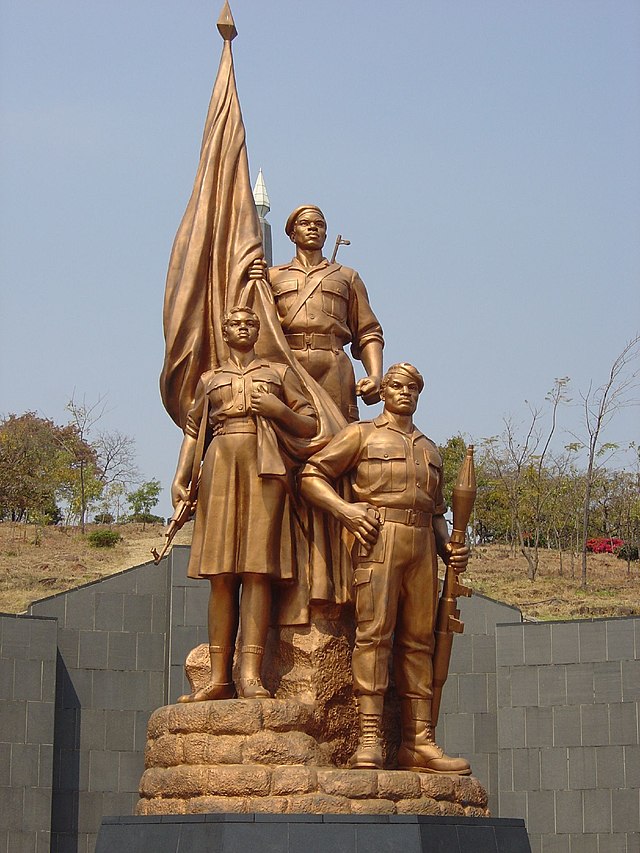
Another feature is the Eternal Flame with a tower some 40 meters tall.
Murals and a museum add even more opportunities for presenting the history of Zimbabwe, the fight for independence and majority rule.
By examining some of those selected as heroes, we can get a better understanding of who ZANU-PF believes is worthy of veneration. Who do they want to remember and who do they want to forget? Which events in Zimbabwe’s history do they seek to elevate and which do they want to discredit?
Edgar Tekere
Tekere was a politician and served as Secretary General of ZANU but later fell out with Robert Mugabe.
Tekere was dismissed from his Secretary General role and Mugabe himself assumed the position.
In the late 1980s Tekere was vocal on corruption and he was eventually thrown out of the party.
His promotion of multi-party democracy put his at odds with the regime.
Tekere ran as a candidate in the 1990 presidential election under the Zimbabwe Unity Movement.
Joshua Nkomo
Nkomo’s interment at the national monument is an interesting case.
He had been a trade union leader and a founder of the Zimbabwe African People’s Union in (ZAPU) in 1961 along with Mugabe.
The following year the party was banned and in 1963 ZAPU split.
In 1964 Nkomo was jailed and he would remain imprisoned for the next 10 years.
Ethnically, Nkomo was Ndebele. At independence there was a strong relationship between ethnicity and political parties with many Ndebele supporting ZAPU.
Following independence, there was widespread oppression of this ethnic group and it is estimated that around 20,000 Ndebele were killed.
In 1987, Nkomo agreed to a Unity Agreement – in effect joining ZANU. Some accused Nkomo of selling out. Years later, he said that he had made the decision in order to stop the violence that was being inflicted on the Ndebele.
In 1990, Nkomo was given the position of Vice President which he held until his death in 1999. This position was essentially powerless. That is probably the very reason that he was given the role.
Nkomo was an early collaborator with Mugabe. But he was also a rival.
The Unity Agreement made his ‘rehabilitation’ possible. If this had never occurred it seems impossible that the ZANU-dominated selection committee would have ever allowed him to be declared a hero.
It is possible to interpret Heroes’ Acre as an extension of ZANU-PF’s control over certain political rivals – in death as well as in life.
In choosing Nkomo as a hero, they can attempt to portray him as a supporter of ZANU-PF and downplay the ZAPU side of the equation. They can note the subordinate role that he played in ‘supporting’ Mugabe throughout the 1990s.
The selection committee could have chosen not elevate Nkomo but this ran a risk.
He was perhaps the second most influential leader of the pre-independence era. So to deny him would be to deny a huge part of Zimbabwe’s history. It would have also been seen as a slap in the face to the Ndebele. By bringing Nkomo into the fold, there was a hope that many Ndebele would also be brought into the fold.
Simon Mazorodze
Mazorodze had had a career as an member of parliament and as a medial doctor.
He had treated injured ZANLA fighters during the Bush War and besides his direct medical support he had also been instrumental in raising funds for the fight.
In 1980 he was elected as a member of parliament and later served as Minister for Health.
Sally Mugabe
Sally was the first wife of Robert Mugabe.
She was active in the ZANU-PF Women’s League and in 1989 she became its Secretary General.
As Mugabe’s wife she became the nation’s ‘First lady’ following independence. She also founded the Zimbabwe Child Survival Movement.
She passed away in 1992.
Herbert Chitepo
Chitepo had been a member of parliament and a leader of ZANU.
In 1975 he was assassinated and there has been much conjecture over his death.
He was the first African to qualify as a barrister in Southern Rhodesia and he was legal advisor to Nkomo.
In 1962 ZAPU was banned and Chitepo moved to Tanzania where he became the director of public prosecutions until 1966.
Chitepo traveled the world on behalf of ZANU and advocated for strong economic sanctions on Southern Rhodesia.
He died from a car bomb explosion in 1975.
J.L.Fisher has also examined Hero’s Acre in his ‘Pioneers, Settlers, Aliens, Exiles: The decolonisation of white identity in Zimbabwe (2010, ANU Press)
In Fisher’s view the monument centers around a ‘war memory’.
The national shrine makes the anti-colonial war the foundational event of Zimbabwean nationalism.
Murals at Hero’s Acres cover the period 1960 to 1980. Thus, they ignore much of Zimbabwe’s history before and after.
This frame of reference becomes a static window.
It was the ZANU-PF Politburo that considered nominations for Heroes’ Acre and the process was not a transparent one.
Fisher notes that as of 1998, two-thirds of the Heroes were either ZANU or ZANLA members. Given these figures and the way in which heroes are appointed it is unsurprising that some people question whether Heroes Acre is a place of reconciliation or more a site commemorating victory of one group over others.
There are very few white heroes. Some argue that the Tomb of the Unknown Soldier represents all soldiers regardless of their race or ethnicity.
There were missionaries, black and white that served others selflessly during the Bush War but they are generally not venerated at the national shrine. And this was a conscious decision. It further shows that the monument focuses on war and violence rather than religion or spirituality.
One white national hero commemorated at the site is Guy Clutton Brock. Brock, a missionary, arrived from Britain in 1949. He helped to form the South Rhodesian African Congress in 1957 and in the late 1960s helped locals to resist being removed from their land. He also helped to set up multi-racial farms. He was imprisoned for his efforts, lost his citizenship and was deported.
He was named a hero in 1995 and his ashes were scattered at Heroes Acre.
Another criticism is that the Coloured and Asian people of Zimbabwe are not well represented at Heroes’ Acre. Individuals from these communities had joined ZANU and ZAPU, and some had fought in the bush with their comrades. However, they were not accepted for registration as war veterans in 1997 – a bitter blow leaving them unable to receive financial compensation.
Mugabe and ZANU-PF routinely criticised the white population for not attending Heroes’ Day events. Some see this as proof that many in the white community have never accepted the new social climate while some note that when they have attended these events, they feel that whites are demonised in the speeches given. They feel that the official narrative only allows for two categories – black and white, oppressed and oppressor, native and alien, righteous and morally corrupt.
The families of some national heroes did not want to see their loved ones buried at Heroes’ Acre and instead wished for them to be buried closer to their kin or on ancestral land.
At times Heroes’ Acre has become a site of protest as well as commemoration.
In 1997 war veterans interrupted the service at the monument and in the following year, widows of war veterans protested, drawing attention to their plight, their poverty and their belief that the government hadn’t looked after them.
In building Heroes’ Acre, ZANU-PF has made the anit-colonial war the defining event of Zimbabwean nationalism. The focus is on war and struggle. Heroes interred at the site are overwhelmingly those associated with ZANU-PF. By having a wider array of Heroes, the site could reflect a fuller conception of Zimbabwean nationalism and rise in esteem as the preeminent national site. The site should reflect not just one party, not just one race, not just one experience and not just one historical event. If most Zimbabweans can see themselves reflected at Heroes’ Acre then it will be a truly national monument.
 Australia and the World Past and Present
Leave a comment