History is written on the streets of Maputo. Literally. More than any other city I can think of, Mozambique’s capital is full of streets named after famous figures from history. 1975 was a watershed year. Before that time, Mozambique was a Portuguese colony and most of the streets were named after significant Portuguese individuals. After the country gained independence, the government moved quickly to replace these names with icons of Mozambique’s fight for independence, other African leaders and figures from Communist history.
Here I look at some street names as they were in the colonial period and the Portuguese figures behind them.
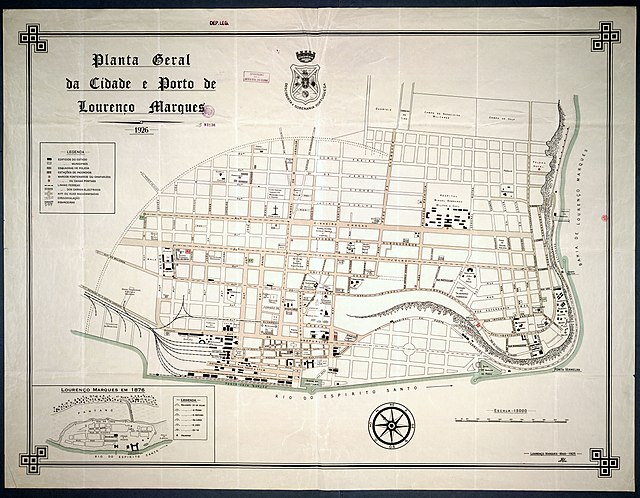
The urban area of Maputo can be read as a cultural landscape and street names play an important role.
Street names mirror the power dynamics of an era.
In the colonial period one could see the imprint of Portuguese colonialism.
The city itself, Lourenço Marques, was named after a Portuguese explorer active in the area in the 16th century.
Portuguese statesmen were well represented.
Not only was there a conscious elevating of Portuguese names, but local African names were sidelined in the process.
Portuguese street names in the capital presented colonisation as a heroic and benevolent enterprise.
The capital of the of the colony featured roads such as Rua de Lisboa and Rua de Porto. The names of Portuguese cities were transported and grafted into the city’s streetscape.
The colony became a copy of the metropole.
One could find the names of members of the Portuguese royal family. There was the Avenida Dom Carlos and the Avenida Rainha Dona Amélia . Africans too had their royal families, but they were marginalised and pushed to the side. Africans in Mozambique wondered what relevance a king on the side of the world had for them.
One could find streets named after catholic saints. There was the Rua de Santo António. Saint Anthony (1195-1231) was perhaps the earliest figure of history with a street named after him in Maputo. He was known for the eloquence of his preaching. It is said that he once went to preach to a group of heretics who weren’t interested in hearing what he had to say. He proceeded to the shore nearby and began preaching and soon enough a shoal of fish had assembled to listen to him. Portuguese religion was imported to Mozambique and raised up as something worthy of respect.
The urban landscape also had a particular spatial organisation – often along racial fault lines.
Suburbs where most whites lived, usually had the best infrastructure and the most reliable water and electricity. They often boasted wide boulevards and ornate signage.
Signage in black areas was more mundane, if it existed at all.
Doigo Cão (c. 1452-1486)
Cão was an explorer who carried out two expeditions for the Portuguese along the west coast of Africa.
Cão explored the Congo River.
His ships carried stone padrãos which would be erected at important sites along the coast to show that the Portuguese had been there.
A padrão was erected at the mouth of the Congo River. This stone pillar remained in place until 1642 when it was torn down by the Dutch.
Sailing on to present-day Angola, the Portuguese set up another padrão at Cabo de Santa Maria.
Cão’s second voyage took place from 1484 to 1486.
He returned to the Congo and traveled up the river 170 kilometers.
He also had two more padrãos erected at Cabo Negro (Angola) and Cape Cross (Namibia)
Alfonso de Albuquerque (c. 1453-1515)
Alfonso had been influential in the expansion of Portuguese maritime trade in the Indian Ocean.
In 1471 he was involved in the capture of Tangier (Morocco) and was stationed there for some years.
In 1503 he went on his first expedition to India. He battled forces in Calicut. He secured the position of the King of Cochin and in return, was granted permission to build Fort Emmanuel / Fort Kochi in what is today Kerala, India.
His second expedition went from 1506 to 1509.
The objective of the voyage was to take control of Socotra (an island that today is part of Yemen) and to build a fort there. He succeeded in this but the fort was abandoned only four years later.
He took the city of Hormuz (Persia) which became a tributary of the Portuguese.
In 1509 his forces won the battle of Diu, defeating the Ottomans and the Sultan of Gujarat. With this victory, Portugal was now in control of trade in the Indian Ocean and became the first truly global empire.
Alfonso served as the Viceroy of Portuguese India from 1509 to 1515.
He was closely involved in the Portuguese spice trade and was involved in the capture of Goa in 1510.
The following year his forces captured Malacca.
He also began diplomatic relations with the Ayutthaya Kingdom in southeast Asia and played a role in starting trade with Ming China and in establishing diplomatic relations with Ethiopia
Undoubtedly Alfonso was a gifted military leader. He oversaw a large expansion of Portuguese power in the Indian Ocean.
Some might emphasise his exploration. Others may emphasise his subjugation of sovereign people using superior military technology.
Pêro da Covilhã (c. 1460- c 1526)
da Covilhã was an explorer and diplomat.
In 1487 he traveled overland to India looking to trade with people he met along the way. He made his way to Aden in 1988, India in 1489 and Ethiopia in 1490.
In 1497 he joined Da Gama’s voyage, traveling to Hormuz, Calicut and Goa.
He spoke Arabic and Castillian. He was concerned with discovering the origin of precious spices. He was an important source of trade information for the Portuguese and he gathered information on sailing currents, trading posts and strategic ports.
Manuel I (1469-1521)
Manuel reigned as King from 1495 to 1521.
At the time the Portuguese Empire was expanding rapidly.
The King sponsored Vasco de Gama.
Under Manuel the Portuguese colonisation of the Americas and India began.
In 1500 Pedro Álvares Cabral ‘descovers’ Brazil.
In 1505 a Portuguese fort was built at Sofala (present-day Mozambique).
Manuel I also had missionaries sent abroad.
The 1506 Lisbon massacre of Jews occurred under his reign and he was also ordered all Muslims to leave Portugal.
João Albasini (1813-1888)
Albasini was an explorer.
He was in fact Italian but he traveled the globe on Portuguese ships.
He made his way to Lourenço Marques (current-day Maputo) in 1831 where he pioneered trade routes into the interior.
He became familiar with the Tsonga people and he introduced them to and supplied them with rifles.
In time he was made a chief of the Tsonga and he is remembered as one of the only a few Europeans to have made this transition.
In 1858 he was made Vice Consul of Portugal in South Africa.
João de Andrade Corvo (1824-1890)
Corvo was an agronomist, diplomat and writer.
He specialised in the diseases affecting the vineyards of Madeira.
He had trained as a military engineer and in 1865 he transitioned into politics.
He was made minister of Public Works (which included projects in Africa) in 1866.
In 1871 he became Minister and Secretary of State for Foreign Affairs.
He had a significant role in drafting the Delgoa Bay (Maputo) Protocol.
He was also at one time the Minister of the Navy and Overseas.
Corvo was an individual with senior roles at a crucial time for Mozambique. It is not surprising that he was chosen by the Portuguese to be honored with a street name in Maputo.
Anchieta (1832-1897)
An explorer and naturalist. Anchieta traveled in Angola, Mozambique and Cape Verde studying and discovering new plant and animal species for the Portuguese. He is credited with identifying 25 new animal species, 46 bird species and over 40 reptiles and amphibians.
Manuel de Arriaga (1840-1917)
A lawyer and attorney-general.
A republican, he was a Prime Minister in the First Portuguese Republic.
António Enes (1848-1901)
A journalist and a writer. A politician and a minister.
Remembered as an administrator in the Portuguese colonies, he was appointed High Commissioner in Mozambique.
He played a role in the 1891 war in Gaza.
Abilio Manuel Guerra Junqueiro (1850-1923)
A civil servant and journalist. A poet and a politician.
Junquiero was a republican and was critical of the Portuguese monarchy and the Catholic Church.
Joaquim Augusto Mouzinho de Alburquerque (1855-1902)
A military officer and governor-general of Mozambique.
In the 1880s he saw service in India.
He was appointed governor of Gaza Province in Mozambique where he was instrumental in the subjugation of Gungunhana – the king of Gaza. The king was exiled, first to Lisbon and then to the Azores.
João Pinheiro Chagas (1863-1925)
Chagas was a journalist, republican and politician.
He had been involved in the Lisbon Regicide of 1908 and was a leader of the 5 October 1910 Revolution.
He was Prime Minister in the First Republic.
Following the Revolution he was appointed ambassador in Paris although he would tender his resignation of this post twice.
He was born in Brazil rather than Portugal and his mother was indigenous.
He was orphaned while in Portugal.
He was imprisoned more than once – in Angola in 1896/7 and he was also arrested in Portugal.
Gago Coutinho (1869-1959)
Coutinho was a naval officer and cartographer.
He joined the navy in 1886 and by 1888 he was on his way to Mozambique.
In 1898 he was active in Port Timor establishing borders in the Portuguese province.
In 1900/1901 he was back in Mozambique deliniating borders in Niassa Province.
He was the go-to guy in his field and he deliniated Noqui in Angola (1901) and Tete in Mozambique (1904/5). He also worked in São Tomé and Príncipe from 1915 to 1919.
Craveiro Lopes (1894-1964)
Lopes was a member of the Portuguese Air Force and later transitioned into politics.
He served as the Governor General of Portuguese India (1936-1938) and led volunteer forces during the Spanish Civil War.
He was chosen by Salazar to be President of Portugal from 1951 to 1958.
He played a role in the failed coup against Salazar in 1961 and died three years later.
Many of the men honored in street names in Maputo were republicans. Many of them had fought against a political system in Portugal that they saw as unjust and many of them suffered because of it. They were often harassed by the police, sometimes arrested and sometimes imprisoned.
Some themes emerge when one considers Portuguese street names in the colonial area. Explorers are honored as are military men. We see traders and we see the vanguard of the Portuguese empire in the Indian Ocean. There are politicians and administrators. Republicans that fought against the Portuguese monarchy and those who were prominent after the Regicide were often honored on the streets of Maputo.
 Australia and the World Past and Present
Leave a comment