Trump hasn’t wasted any time.
He said that he would act and deport immigrants who were in the US illegally.
Government agencies have been busy identifying, taking into custody and deporting illegal immigrants.
Among those deported were a group of Colombian nationals – transported by military craft back to their country of origin.
It appears that communication between the US and Colombian authorities had been minimal before the flights.
In classic Trump style, he just went ahead and acted.
But the Colombian government refused to let these flights to land and an international incident was born.
Colombia had refused to take back their own nationals – at least in this manner.
In response, Trump threatened Colombia with an immediate 25% tariff on Colombian goods entering the US, increasing to 50% if the issue wasn’t resolved within the week.
He also imposed a travel ban on Colombian government officials
Colombian President, Gustavo Petro, responded on social media with the following:
“So if you know anyone stubborn, it’s me, period. You can try with your economic strength and arrogance to carry out a coup like you did with Allende. But I will die by my law; I resisted torture, and I resist you. I don’t want slaveholders beside Colombia, we’ve had many, and we’ve freed ourselves. What I want beside Colombia are lovers of freedom. If you can’t accompany me, I will go elsewhere. Colombia is the heart of the world, and you didn’t understand it. This is the land of yellow butterflies, the beauty of Remedios, but also of Colonel Aureliano Buendía, of whom I am one, perhaps the last.
You will kill me, but I will survive in my town, which is before yours in the Americas. We are peoples of the winds, mountains, the Caribbean Sea, and freedom.
You don’t like our freedom, that’s fine. I don’t shake hands with slaveholders. I shake hands with libertarian whites, heirs of Lincoln, and with the black and white farmers of the U.S., in front of whose tombs I wept and prayed in a battlefield after walking the mountains of Tuscany and surviving COVID…
Colombia stop looking north now, look to the world. Our blood comes from the Caliphate of Córdoba, the civilisation of that time, from the Roman Latinos of the Mediterranean, the civilisation of the that time, who founded the republic, democracy in Athens; our blood carries the resistance of black people made slaves by you. In Colombia is the first free territory in America, before Washington, before all of America, and there I take shelter in its African songs.
My land is of goldsmithing from the time of the Egyptian pharaohs and of the world’s first artists in Chiribiquete.
You will never dominate us. The warrior who once rode our land, shouting freedom, is Bolivar.
Our people are somewhat fearful, somewhat shy, naïve, and kind, loving, but they will know how to win the Panama Canal, which you took from us by force. Two hundred heroes from all over Latin America rest in Bocas del Toro, Now Panama, before Colombia, whom you killed.
I raise a flag, and as Gaitán said, even if I remain alone, it will still fly with Latin American dignity, which is the dignity of America, which your great-grandfather did not know, and mine did, Mr. President, immigrant in the U.S.
Your blockade does not scare me because Colombia, in addition to being a land of beauty, is the heart of the world. I know you love beauty as I do, do not disrespect it, and it will offer you its sweetness.
COLOMBIA, FROM TODAY OPENS UP TO THE WORLD, WITH OPEN ARMS. WE ARE BUILDERS OF FREEDOM, LIFE AND HUMANITY.
I am informed that you will impose a 50% tariff on our human labor’s products entering the U.S., I will do the same.
Let our people sow maize, which was discovered in Colombia, and feed the world.”
Perhaps Petro was waiting for an event such as this – a confrontation with the US – so that he could present his ideas on the nature of the Colombian psyche and many other things besides.
Let’s break down his response.
He mentions the Chilean leader, Allende, elected democratically and overthrown in a coup that was supported by the US. In Latin America, Allende’s downfall represents the interference of the US over the will of the people. It was people power against imperial or neo-colonial power. Native self-determination versus gringo conceitedness.
He references yellow butterflies, the Remedios and Colonel Aureliano Buendía.
These are all references to One Hundred Years of Solitude, the fictional work by Gabriel García Márquez. Márquez’ Magical Realism style of writing sprang out of Colombian culture and his work is held in high regard in his homeland. To be sure, Colombia has it’s real yellow butterflies, but here Petro’s meaning has multiple layers. In the book, yellow butterflies symbolise love, passion or even impending change. Remedios and Colonel Aureliano Buendía are characters appearing in the novel.
Like most countries these days, Colombia is a mix of people with different ancestries. Some are indigenous, some have European ancestry and there are those with African roots. Nation-states today are trying to work out national narratives that can take these diverse strands of origin and weave them together into one nation. What is interesting is the examples Petro uses for Colombia.
He talks about the Caliphate of Córdoba, Roman Latinos and links this with Athenian Democracy. I’m sure he could have a good debate with Greeks on that one. So this accounts for those with European heritage.
He talks of Africans brought to the Americas as part of the trans-Atlantic slave trade. Their ancestors are also present in modern-day Colombia.
Finally he talks about the artists of Chiribiquete. In this region of Colombia, the indigenous people drew tens of thousands of images on rock walls – including the revered jaguar and these images have been dated to around 20,000 BCE. That rounds out the three main groups – European, African and indigenous. Leave any one of them out and you will have difficulty in accounting for modern Colombia.
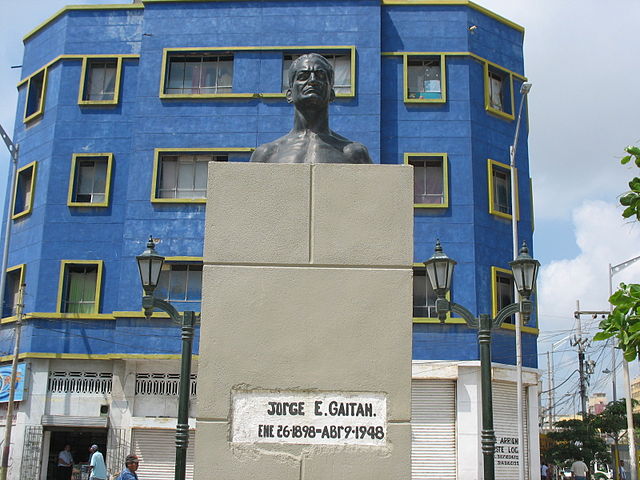
He goes on to draw a line from these influences to Simón Bolívar (that hero of Latin American independence) and then to Jorge Gaitán, a Colombian political figure assassinated in 1948. Gaitán was leader of Liberal Party and was contesting the presidential election when he was killed. It widely believed that had he not been assassinated he would have become President. He had previously been mayor of Bogota and the Minister for Education. Sometimes called a liberal, sometimes called a socialist, his death led to period of Colombian history known as La Violencia in which the two main political forces in the country fought each other. Gaitán was known as a great orator and he talked about the country as if it were divided between two groups – an oligarchy and ‘the people’. His central themes were economic inequality, taxation, support for farmers, the importance of literacy and education and land redistribution. As Petro is a of the Left, it is unsurprising that he references Gaitán.
Petro makes much of the fact that Colombia gained its independence prior to the US. The US likes to talk up freedom as one of its fundamental principles, however it is clear that Colombia’s early independence is a source of pride for Petro.
Petro references slavery in the US. This is something that the country dealt with more than 150 years ago. Calling Trump a slavery sympathiser doesn’t help to paint Petro in a good light.
The Colombian President calls Trump “immigrant in the US”. Over the top. Of course Trump is not an immigrant. He was born in the US. One of Trump’s grandfathers came to America in the late 1800s. There is nothing unusual about this. The US is in many ways an immigrant nation and so is Colombia for that matter. Petro’s own great-grandfather emigrated from Italy in 1870.
Petro calls Colombia “the heart of the world”. His language is poetic, overly so to international ears, but I am assured that Petro is known for this kind of language and that it doesn’t sound out of place in Colombia.
It would seem that Petro was addressing his remarks more towards his domestic audience than to Trump. He can play up his anti-neocolonial rhetoric and beat the nationalist drum a bit.
Trump has shown that he is prepared to act how he likes and is prepared to threaten other countries with higher tariffs if his wishes are not carried out. Perhaps he is also playing to his domestic audience.
 Australia and the World Past and Present
Leave a comment