The term executive order is being heard a lot recently.
President Trump has wasted no time in issuing a slew of them at the start of his second term in office.
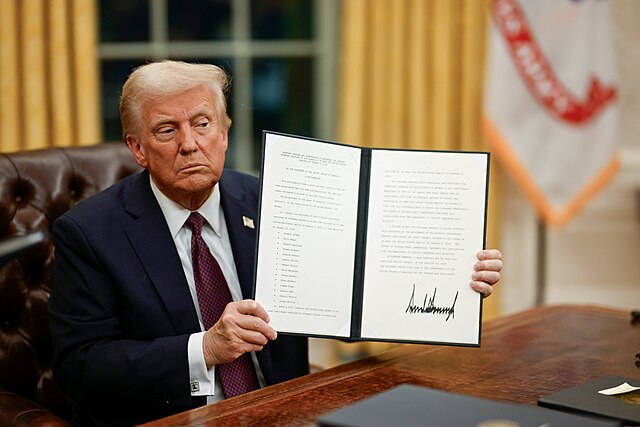
An executive order is a directive from a president to the executive branch of government.
It relates to the operations of the federal government and is linked to the ‘enforcement authority’ in the the US Constitution.
Article II, section I, clause I of the Constitution says, ‘The executive power shall be vested in the President of the United States of America’.
They are supposed to be about enforcing law rather than creating it. The Constitution gives the Congress the power to make laws, not the President.
An order should be, in all respects, constitutional. In other words they should be in line with that document and they will usually reference either a relevant Congressional law or the Constitution itself.
The issuance of orders can have a significant impact on the operations of government. Laws may exist, but enforcement is another matter. If a President orders federal agencies and staff to focus on particular issues, it can have a profound effect.
Executive orders are nothing new and in fact date right back to George Washington.
For around a century of US history, these orders took a variety forms before a new numbering process was introduced by the US Department of State in 1907.
George Washington issued 8 Executive Orders.
Abraham Lincoln issued 48. His famous Emancipation Proclamation was one.
William Henry Harrison was the only President not to issue any executive orders.
There was a big jump under President Ulysses S. Grant who issued 217.
That seems like small fry compared to Theodore Roosevelt’s 1,081 and that’s nothing compared to FDR’s 3,721.
Using an executive order, President Truman ordered that all US steel mills be placed under federal control, however this was overturned by the Supreme Court on the basis that is was making law rather than enforcing it.
Orders are sometimes used during war. This occurred under President Clinton during the Kosovo War in 1999.
Trump’s first term seems quite restrained by comparison, when 162 orders were issued.
Congress does have some avenues for dealing with executive orders. It could override them with new legislation or it could withhold funds for their enforcement. However, the meeting procedures of Congress means that it is difficult to implement these measures quickly. A president can get the ball rolling with the flourish of a signature. Congress is much more cumbersome.
Also, right now Republicans control the Congress and the Senate. So the chance of Congress voting against Trump’s executive orders is almost non-existent. Trump is riding a wave of popular and personalised power. We have seen that any Republican Congressman or woman that opposes him is likely to lose their nomination at the next election. So the incentive for them to raise the head above the parapet and oppose him is not there.
 Australia and the World Past and Present
Leave a comment