Unitary executive theory is the idea that the President of the United States has sole authority over the executive branch of government.
The executive arm of the US government is huge and is made up of a galaxy of authorities and commissions.
The majority of the government’s work is carried out here by armies of federal employees.
As with all theories, there is a spectrum of views. However many who subscribe to unitary executive theory would hold that President Trump can hire and fire agencies heads and general employees whenever he likes and for whatever reason. Believers also argue that he holds the right to intervene in agency policy.
Obviously in such an arrangement power is centralised, not decentralised.
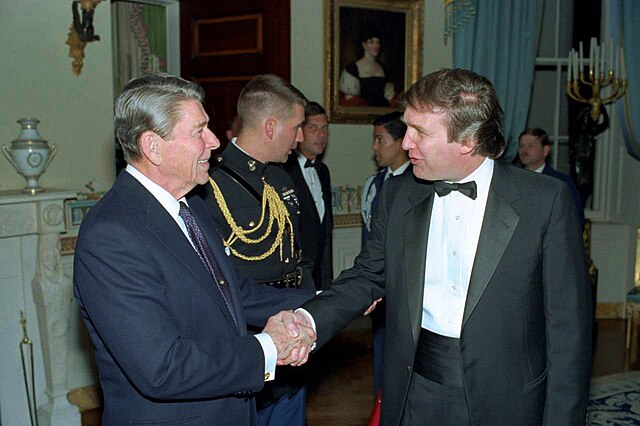
The idea started to gain some traction in conservative circles during the Reagan administration in the 1980s.
Many agencies have already seen their directors fired, replaced by Trump appointees, mass sackings and significant changes to their operations.
The Trump administration took a chainsaw to USAID – the country’s foreign aid program. Aid was frozen, employees were fired and the organisation’s website was shut down. It was declared that USAID would be merged into the State Department. Staff were pulled from service abroad. The move was akin to using a sledgehammer rather than a scalpel. The move is bound to do damage to partner countries around the world. Aid is not simply aid. It is also a form soft power diplomacy. The move to gut USAID will lose some hearts and minds around the world and incentivise other countries to turn towards other major powers.
However, this doesn’t seem to be a large concern for Trump. His slogan is ‘America First’. He will argue that the money should be spent at home.
But in exercising executive power in this way, it raises questions over whether it is constitutional.
Funding for USAID programs that have already been delivered was halted by the Trump administration. This decision was appealed in the courts and the Supreme Court has just ruled that these funds must be released.
Denying the releasing funds appropriated by Congress will raise further questions about constitutionality.
The fight over executive orders will be fought out in the courts. The Democrats are currently limited in what they can do as they control neither the Congress nor the Senate.
There has also been turmoil at the Department of Justice
It seems that Trump had the Department of Justice in his sights. He was pursued by the DOJ during the Biden administration – in what he believes was a politically motivated witch hunt. He seems to be against what he sees as politically-motivated overreach and legal cases against sitting politicians.
Meanwhile in New York, Mayor Eric Adams was last year charged with counts of bribery, fraud and soliciting illegal foreign campaign donations.
In February of this year the DOJ instructed federal prosecutors to drop the charges against Adams. The Attorney General leading the case resigned. Responsibility for the case then shifted to the Public Integrity Section of the DOJ where the acting head of the section resigned as did the acting head of the DOJ criminal division. The department was struggling to find a prosecutor who was willing to file the dismissal of the charges.
Some have claimed that the Trump’s desire to see the charges dropped against Adams was in response to the Mayor’s offer to help the President with the deportations of illegal immigrants in New York.
There has also been action at The Consumer Finance Protection Authority. This was set up in the wake of the Global Financial Crisis and it was supposed strengthen the oversight of financial institutions. The body is was a pet project of Democrat Senator Elizabeth Warren. So Trump killed two birds with one stone – he gives the middle finger to Senator Warren and the Democrats and loosens financial regulations at the same time.
Some of these agencies have been established by Congress. In an organisational chart of the US government, they may sit in the executive branch of government, but it is most likely that they were envisioned as functioning independent of political influence – even from the President.
The classic example would be the Federal Reserve. Would you want a political figure setting interests rates, bringing them down just before an election even if it would lead to galloping inflation after the election? The convention has been that the Fed should be left alone. Financial boffins going about their work professionally. Up to now, even most conservative Republicans have had a hands-off approach to the Fed.
There are independent agencies that oversee elections. We know that Trump has history with election results. He disputed that outcome of the 2020 presidential election and falsely claimed that the election was rigged. Agencies overseeing the election became a focus of his criticism.
One way of exerting more control over the various federal agencies is for the Trump administration to require them to submit proposed regulations to the Office of Management and Budget (which is part of the White House). In this way, his administration can exert more control over them.
Trump is testing the limits of unitary executive theory and what a chaotic ride it is.
 Australia and the World Past and Present
Leave a comment