The ‘administrative state’ – agencies writing and enforcing their own laws. A plethora of government organisations regulating individuals, companies and more.
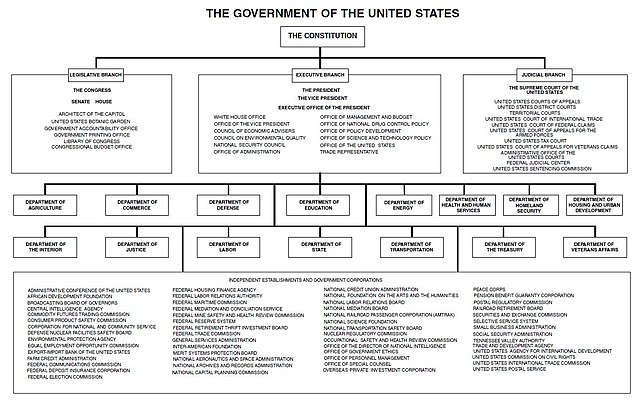
The heads of these agencies and commissions are usually unelected officials.
Often these agencies will sit in the executive branch of government. This is the case in the US.
The administrative state has been a subject of debate in fields such as constitutional law and political science, especially since the late 1800s.
Prior to this, it may be argued that the states of Europe and America were relatively constrained in what they took on. For example, social welfare nothing in size and scope compared to what it is today.
Some agencies even spawn their own agencies. The Securities and Exchange Commission (SEC) was established by Congress in 1934 to enforce laws against market manipulation . The SEC itself established the Financial Industry Regulatory Authority (FINRA), a self-regulatory organisation in 2007.
Some can issue orders to the police or even have police officers of their own that can search, conduct seizures and arrest people. The EPA in the US has it’s own law enforcement officers.

Different countries have different methods for appointing agency heads.
In the US, it is often argued that the President has the power to remove or appoint the department heads.
Certain kinds of employment protection may be in place for agency employees, that would on the face of it, make summary firings more difficult.
Debate has has emerged in the US over the summary firing of agency heads and employees and much of this is presently playing out in the courts.
Agencies establish regulations, rules and procedures as opposed to ‘laws’.
A key question is ‘where exactly can we locate the legal basis for these rules and regulations?’
In the case cited above, are the laws of FINRA even constitutional if we consider that it is Congress that is supposed to make laws?
If an agency is not created by Congress, is it even on a sound legal footing?
A 1935 case, Humphrey’s Executor v. United States found that independent federal agencies have a legislative and legal character.
Last century there was an explosion in breadth and depth of government operations. Some simply interpret this as part of the growing complexity of life. Some see it as a clear social good, especially ‘progressives’ who believe that the state is the panacea for all society’s problems. However, many conservatives see it as governmental overreach. Some specifically cite FDR and his New Deal programs.
In the US, a strong administrative state can enable more radical change. If it regulations are churned out in the back of offices by unelected bureaucrats, it doesn’t have to see the light of day in the same process that would apply if it was forced to pass through Congress.
The stronger the administrative state, the more expansive government becomes.
For those who believe that the Constitution is about individual freedoms being preserved from the tyranny of the majority or the government, the administrative state will seem oppressive.
The administrative state is particularly problematic for those who believe that the individual should come first and the state should come second.
In the popular parlance, the administrative state is sometimes referred to as the ‘fourth branch’ of government.
There seems to be kind of circularity to agency operations. An agency creates rules and tells people to abide by them. The agency will investigate any breaches and issue fines etc if they find that they are warranted. Individuals can appeal, but often the appeal will be to the very agency that issued that fine. Thus critics say that agencies sit basically sit in judgement of themselves and can be expected to uphold their original rulings. In the US, if the individual is still unsatisfied, there may be the option of appealing to an Article III court. But often this court will still refer to the regulations or ‘laws’ of the agency and these do hold some weight. We come back to the following point – why should an Article III court give weight to the regulations an agency if that agency or it’s laws were not created by Congress?
Confused? It sounds circular doesn’t it? And I guess it is.
In a discussion with the Intercollegiate Studies Institute, Rivek Ramaswarmy (a candidate in the last Republican presidential primaries) discussed his thoughts on how to dismantle the administrative state.
He talks of a ‘new federalism’ and is critical Woodrow Wilson.
His thoughts on President Nixon are interesting. While Nixon was also a Republican, Ramaswarmy sees him as ineffectual in tearing down the ‘managerial bureaucracy’ that had been growing up to that point.
He notes that Nixon brought in the EPA, an “fundamentally lawless” organisation in Ramaswarmy’s eyes. But he goes even further. He has suspicions that the administrative state had some role in Watergate, probably because they were threatened by Nixon’s plan for rolling the sprawling bureaucracy back.
Debate around administrative states has been going on for over a century. It began largely in academic circles in the fields of politics, administration and law. On a popular level, it has been a prominent theme amongst many conservatives in the US and particularly so in the last ten years of so. It is a legitimate subject for study and debate. It does have the propensity to morph into conspiracy-theory like discussions, but this should not mask the fact that there are interesting legal questions at play.
 Australia and the World Past and Present
Leave a comment