Late last year, New Zealand was grappling with a controversial piece of legislation known as the Treaty Principles Bill.
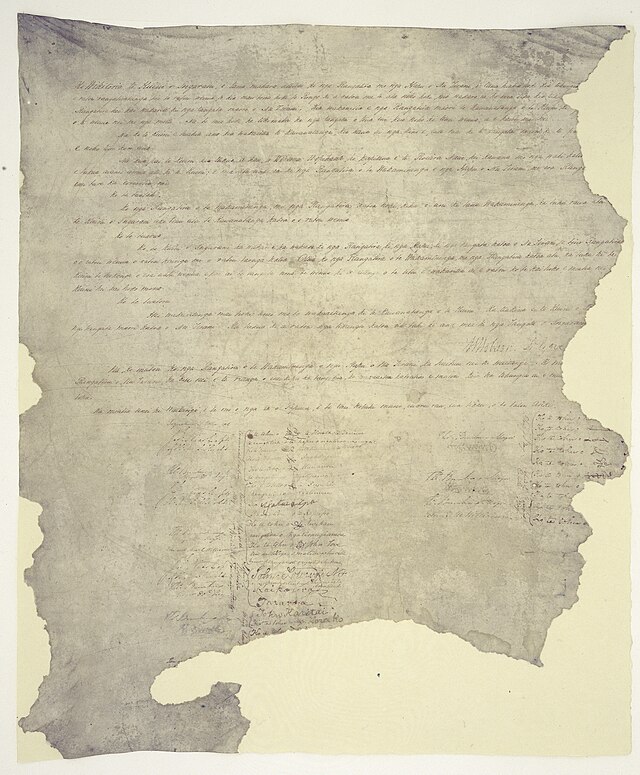
The Treaty of Waitangi is 185 years old. It was signed in 1840 by hundreds of Māori chiefs and the British Crown.
There are two versions of the Treaty – one in English and the other in in the Māori language.
The document is relatively short with just three main points.
Article 1 states, “The chiefs of the Confederation of the United Tribes of New Zealand and the separate and independent Chiefs who have not become members of the Confederation cede to Her Majesty Queen of England absolutely and without reservation all the rights and powers of Sovereignty which the said Confederation or Individual Chiefs respectively exercise or possess, or may be supposed to exercise or possess over their respective Territories as the sole sovereigns thereof.”
Article 2 continues, “Her Majesty the Queen of England confirms and guarantees to the Chiefs and Tribes of New Zealand and to the respective families and individuals thereof the full exclusive and undisturbed possession of their Lands and Estates Forests Fisheries and other properties which they may collectively or individually possess so long as it is their wish and desire to retain the same in their possession; but the Chiefs yield to Her Majesty the exclusive right of Preemption over such lands as the proprietors thereof may be disposed to alienate at such prices as may be agreed upon between the respective Proprietors and persons appointed by Her Majesty to treat with them in that behalf.”
Finally, article 3 states, “In consideration thereof Her majesty the Queen of England extends to the Natives of New Zealand Her royal protection and imparts to them all the Rights and Privileges of British Subjects.”
The Māori version of the document states that the Māori chiefs will retain their rangatiratanga (self-determination).
The recent Treaty Principles Bill was put forward by David Seymour and his ACT New Zealand party – a coalition member of the government.
Seymour has some Māori ancestry through his great-great-great grandmother.
He believes that there are currently different rights for different people in New Zealand based on race or ethnicity and that this is fueling racial division.
The proposed bill claimed to further define the Treaty’s principles and how they would apply to all New Zealanders.
The Treaty of Waitangi has stood unchanged for over a century and half and it might be said that it is the foundational document of modern New Zealand.
Many New Zealanders believe that the Treaty has served them well and are quite reluctant to tinker with it in anyway.
Most political parties have been happy to leave the Treaty alone.
A distinction should be drawn between the Treaty itself and the Waitangi Tribunal. The latter has been much more controversial than the Treaty itself. Many questions have been raised about the Tribunal and whether it has gotten itself involved in matters beyond its remit.
Some have interpreted the raising of the Treaty Principles Bill in parliament as the price that needed to be paid to the ACT in order for the Nationals to form government.
The ACT claimed that whether the bill was passed or not, it was an important issue and was worthy of debate in parliament.
The Prime Minister had ruled out support for the bill in advance, but seemed prepared for the bill to get an airing – at least for a first reading.
New Zealand First MP, Winston Peters (himself part Māori) had an interesting take on it.
He just saw it as part of the coalition agreement and that it was nothing to jump up and down about.
He claims that the debate is being run by ‘elitists’ and is masking ‘real’ Māori issues.
The Treaty Principles Bill is controversial because it goes to the heart of a critical issue. Should there be separate laws and institutions for different racial or ethnic groups? In other words, should the state treat people differently based on a characteristics that people have no control over? Some people argue yes and others argue no. New Zealanders are not starting from a blank slate. The Treaty of Waitangi was established as a guide for future Māori / Pākehā relations. At the current time it appears that most MPs are not supportive of altering how the Treaty is interpreted.
 Australia and the World Past and Present
Leave a comment