Japan is famous for its kigo ( 季語) or season words.
Kigo are used frequently in haiku poems to evoke strong feelings in the reader.
Even in Japan, one can find regional variations in climate, vegetation and fauna.
The country runs on a north-south axis which spans different climatic zones.
A person living their whole life in Okinawa will never see snow. Likewise, someone living in Hokkaido will never see many of the plant species endemic to the south.
Some people have taken the concept of kigo from Japan and have tried to transplant it into their own countries and cultures.
It begs the question – which words would we select as Australian season words?
Does it even make sense to talk of ‘Australian’ season words given the size and diversity of the country?
Most Australians recognise four main seasons – summer, autumn, winter and spring.
This seems to apply quite well in the more temperate parts of the country.
In the northern tropics there is an important wet season / dry season element.
Indigenous peoples recognised their own seasons. For example, the indigenous people around Kakadu recognise 6 different seasons.
Australia’s climatic regions run the full spectrum. Desert spans the vast interior.
Woodland stretches along the interior of the eastern seaboard, reaching up right up into the north.
There is a small patch of rainforest in the far northeast.
Forest makes up much of the eastern coastal fringe and Tasmania.
Australia has sub-tropical and semi-arid regions. There are savannas-like grasslands and regions drenched by monsoons.
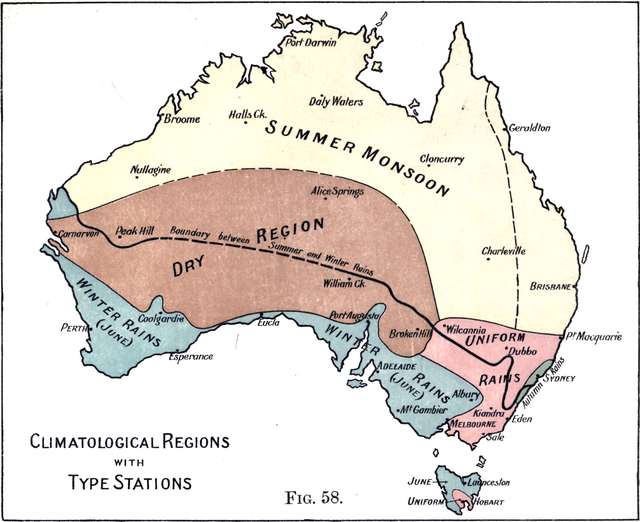
I’ll take a look at three areas to illustrate how talking of ‘Australian’ season words can be problematic.
The three regions
Victoria
In Victoria, you will find black wattle, silver banksia and river red gums. Manna gums and golden wattle are also common.
Some of the iconic Victorian fauna is only found in tiny pockets of the state.
The Leadbeater’s possum is confined to a tiny territory in Victoria’s central highlands.
The Helmeted Honeyeater can be found in small pockets to the east of Melbourne.
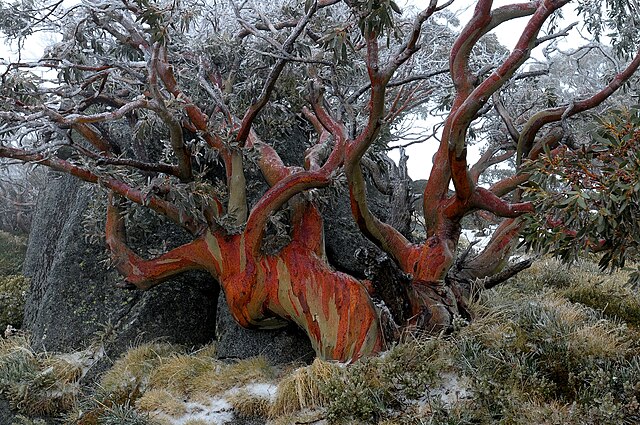
The border region between Victoria and New South Wales hosts Australia’s unique alpine environment.
The vegetation and animals here are vastly different from other areas of the state.
At these high elevations one can find alpine grasses, snow gums and alpine ash.
Hiding away in the ranges are mountain pygmy possums and the Baw Baw frog.
Brisbane
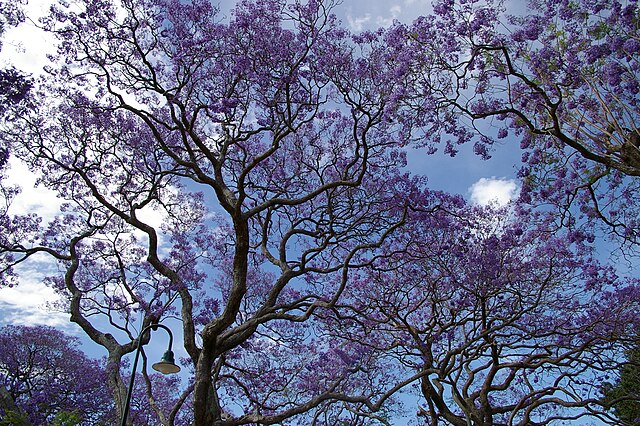
I always know that I am in Brisbane when I see the blooming jacaranda trees and their explosions of purple flowers.
Frangipanis and fig trees add to the sub-tropical vibe. Using ‘jacaranda’ for an Australian season word will ring true in Brisbane but it would have next to no resonance in Victoria or Tasmania.
Dingos stalk the beaches of Fraser Island and around 20 bat species glide silently through the night sky.
Zebra finches (which I never see in Melbourne) dart about and there are scores of lorikeet species.
There are green tree snakes and carpet pythons – a welcome change to the more terrestrial and poisonous Victorian snakes.
Leatherback, loggerhead and green turtles drift about the waters of Queensland.
Darwin
Here, you can find the mighty boab.
The city boasts hibiscus and papaya. You can find the tropical pomelo fruit.
There are clouds of Gouldian finches. Northen quolls hunt for frogs and small mammals and try to escape the notice of foxes and feral cats.
Freshwater and saltwater crocodiles bask on the banks of rivers or lie silently underwater.
Season words need not be confined to plants and animals.
They can also be references to food, festivals, sporting events and cultural practices.
Some may argue that ‘boomerang’ or ‘ANZAC’ may pass for Aussie season words.
Some question whether many of the quintessential Aussie words are outdated. The famous greeting ‘g’day’ is almost never heard today.
The English language has dominated since the colonial period. Some would argue that a greater number of indigenous words should be used for season words. But the words of which aboriginal language? There is no single language that is used over the entire country or even over an entire state. A disproportionate number of aboriginal words entered Australian English from one particular language. This was the gadigal language (around present day Sydney). It pays to be the first.
Words adopted from this language include dingo, koala, wallaby, wombat and boomerang.
Climate change may have a long-term effect of the use of season words. Australian is becoming hotter and drier. The distribution of some plant and animal species is moving south as conditions change.
Some season words are associated with social practices. For example, ‘burning sugar cane’. This term would probably evoke strong emotion in a Queenslander but have less effect south of the border.

The ‘Melbourne Cup’ is said to be the race that stops the nation. But its prominence in Victoria would be greater than in other states.
One can create a list of Australian season words that will reflect the land, climate, people and practices of the nation. Generic terms like ‘bushfires’, ‘haze’ and ‘eucalyptus’ will be pretty safe territory. But once you start getting specific with flora and fauna, you might find that you are really talking about a local aesthetic that may not resonate on the other side of the continent.
 Australia and the World Past and Present
Leave a comment