The street names of the capital of Mozambique, Maputo, have always reflected the spirit of the age.
During the colonial period, the names of prominent Portuguese figures could be found on street signs around the city.
Since independence in 1975 there has been a concerted effort to reclaim Mozambique’s indigenous heritage.
Many current street names pay tribute to sacrifices made during the war of liberation and the idea of resistance looms large.
One street is named in honor of Mozambique’s first President – Eduardo Mondlane.
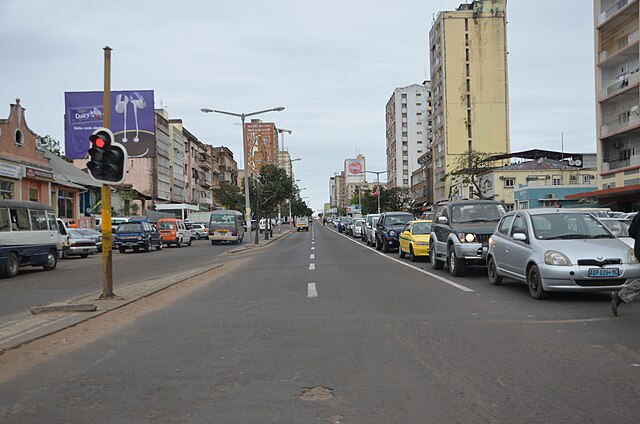
One can also find the liberation heroes of other Portuguese colonies – Ahmed Sékou Touré (the former President of Guinea), Agostino Neto (former President and poet of Angola) and Almicar Cabral (guerilla fighter, poet and agricultural engineer from Guinea-Bissau).
All of these political figures espoused socialist views. Most of the leading anti-colonial movements against the Portuguese were from the left side of the political spectrum. They drew their inspiration from Marxism or socialism. As such, although separated by vast distances, the leadership of the various Portuguese colonies often shared quite similar views.
The theme of pan-Africanism is evident. One can see an alignment with broader African struggles. There are streets are named after other African leaders: Julius Nyerere, Patrice Lumumba and Robert Mugabe.
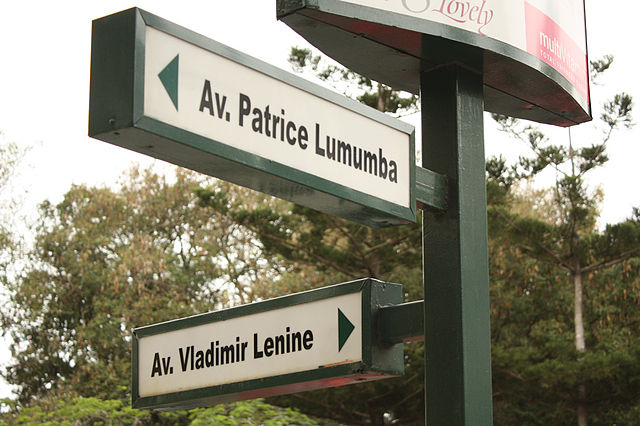
There are leaders who won elections but were killed in coups – Lumumba is one and Salvador Allende is another.
International solidarity is another prominent theme. Post-independence politics in Mozambique has been dominated by FRELIMO. FRELIMO has always been partial to socialism and one can see how this has influenced the choice of street names in the city. Party leaders would suggest that naming streets after the heroes of socialism reflects the egalitarian vision FRELIMO has for the nation.
Socialist luminaries are represented. Thus we find streets named after Friedrich Engels and Karl Marx. These two men were essentially theorists. They didn’t take up arms themselves. But their ideas and writings inspired many others to resort to armed revolution.
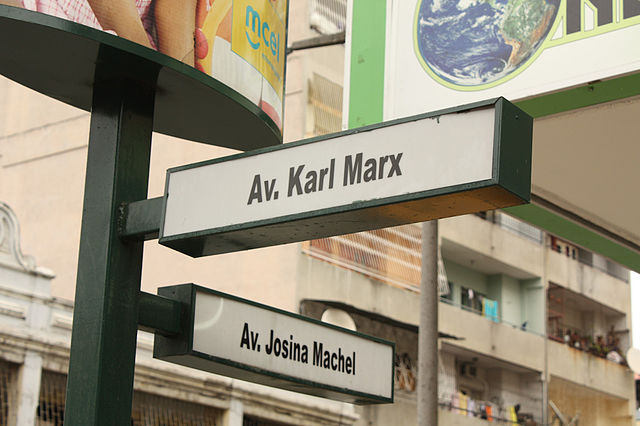
There is a street named after Vladimir Lenin. Lenin was a theorist but he was also a politician. He led the October Revolution and ruled Soviet Russia between 1917 and 1922. He laid down a template for a one-party state that would be copied by many authoritarian regimes around the world. Under Lenin, the USSR abolished private property and nationalised various industries. During the Red Terror tens of thousands of people were either imprisoned or killed. Famine was a feature of Lenin’s Russia. Critics of Lenin accuse him of dictatorship and political repression.
Ho Chi Minh, Kim Il Sung and Mao Zedong also have streets named after them.
Mao’s legacy is also controversial. His Great Leap Forward was meant to transform China from an agrarian society to an advanced industrial nation. Many peasants were forced to leave their work in the fields for work in the factories. In the late 1950s and early 1960s famine also became a feature of Mao’s China. Some claim that the resulting famine killed around 30 million people.
There are streets that honor those who fought for liberation in different regions of the country . There is the Avenue of the Martyrs of Inhaminga, the Avenue of the Martyrs of Machava and the Avenue of the Martyrs of Mueda. These names are interesting in that they don’t follow the dominant pattern of naming streets after individuals. Rather, they commemorate a group of people. The inclusion of the word ‘martyrs’ implies a somewhat sacred character.
Rua Josina Machel honors the role of women in the liberation struggle.
Avenida 24 de Julio has been kept from the colonial period. This date commemorates Portugal’s liberal revolution, which began in 1820.
Some critics of Maputo’s street names say that there is too much focus on political and revolutionary figures. Not only that, but most of the political figures represented were either members of FRELIMO or sympathetic to the party.
Street names in Maputo operate as a kind of collective memory. There has been a symbolic rejection of colonial rule and the colonial legacy.
The renaming of streets has been a symbolic act of liberation and the names chosen affirm the values of an independent nation.
 Australia and the World Past and Present
Leave a comment