For five centuries the Church leadership in Mozambique was Portuguese.
In 1971 there were 34 White Father missionaries operating in Mozambique.1
In that year, they assembled in Beira to decide whether they would leave the territory or whether they would stay. They voted to leave.
News of their decision ricocheted around the world and it divided opinion. Was the decision to leave tantamount to the abandonment of their flocks? Or was is a “prophetic gesture”?2
Portuguese activity in East Africa had had a long history.
Francisco de Almeida had sacked the Arab trading bases of Kilwa and Mombasa.
Portuguese colonialism had a religious aspect from its early days. The second Portuguese expedition to East Africa and India had priests attached to it.
Moors had held the Iberian Peninsula for a time. The Portuguese had thrown off their yoke and were now the ones who sought to expand, take control of new lands and exert their religious influence. There was a certain crusading ethic to the enterprise. Many Portuguese saw it as a civilising mission.
One key characteristic of the Catholic Church in Portugal was Padroado Real (Royal Patronage). From the mid-15th century Portuguese Kings could nominate bishops and pastors – both in Portugal and in the colonies. They would finance new churches and provide financial support for priests. So the Church had a kind of financial dependence on the state.
The Dominicans were active in Mozambique from an early period. By 1600 they had set up 40 chapels.3
Early missionaries produced catechisms in African languages. They often conducted their own ethnographic studies and produced grammars of local African languages.
In 1698 the Portuguese lost Zanzibar and Fort Jesus at Mombasa
By the 18th century, Portugal’s power around the globe had declined.
In Mozambique, churches that had been built no longer stood. There were no African priests.
In 1759, the Portuguese administration went as far as dissolving the Society of Jesus. The Jesuits in Mozambique were taken into custody and sent to Goa.
In 1821, an anti-clerical government came to power in Portugal. Religious orders now had a lot less power and the state confiscated Church land.
In 1834 there was a suppression of all religious orders. By the mid 1840s, missionary activity in Mozambique had been virtually wiped out.
Northern Mozambique was dominated by the Yao. They had had contact with Muslim traders and as a result, they had adopted the Islamic faith. Mosques could be found in the north.
Conditions in Mozambique at this time were not very amenable to Portuguese missionaries.
The authorities in what is now South Africa had wanted to construct a railway from Pretoria to Maputo. But the line would pass through the Nguni-Gaza empire. The Portuguese were engaged in the ‘subjugation’ of this area between 1840 and 1914.
While religious activity in Mozambique was relatively muted at this time, the Portuguese state was quite active. A Commission was established in 1876 to look at draining much of the land around Lourenço Marques. By the time Lourenço Marques became the capital in 1898, the Pretoria-Lourenço Marques railway had already been completed.
Portugal was a relatively small European country and it was surrounded by the much larger Spain. Portugal’s population was relatively small. Overseas colonies were seen as essential for the growth of the nation and for national power.
The Portuguese also controlled Angola on the opposite side of the African continent. The logistics of European colonialism meant that colonies usually began as tiny beachheads on the coast and spread inland – as far as logistics would allow. Ideally, the Portuguese wished to have a one contiguous territory from the Atlantic ocean, across the interior of the continent, all the way to the Indian Ocean. In this respect, they held similar aims to the Germans who wanted to link South West Africa with German East Africa.
Then came the Berlin Conference of 1884/5. Here the raw ‘Scramble for Africa’ could be witnessed.
The British refused to recognise Portuguese claims for the territory between Mozambique and Angola. The British wanted the land for themselves.
Added to this, Portugal at the time was in debt to British financiers. In any case, the British had far more resources available to them in Southern Africa. The Portuguese were not in a position to press their case. But the failure to secure to the land did not go down well inside Portugal. The government fell. In the city of Porto there was a military revolt.
In 1908 King Carlos and his son were assassinated and by 1910, the country had reverted back to a government hostile to religion.
After 1910, religious holidays were no longer observed in Portugal. Church property was taken. There was a ban on wearing the cassock. 31 religious orders were kicked out the country.4 Religious education was not allowed in schools. Only a few seminaries were allowed to operate. Teachers had to be approved by the government, as did the curriculum.
Despite the efforts of Republican governments to cleanse the country of religiosity, the famous sightings at Fatima in 1917 produced a lot of interest. The government was not at all happy with this.
The Republic (1910-1926) was a time of great instability. During this period there were 8 presidents and at least 40 different ministries.5 The first Republican government lasted only 10 weeks. There were assassinations at the highest level. The Republic was politically unstable and the economy was in the doldrums. It set the scene for the coup that took place in May 1926.
Salazar came to power in the early 1930s. He announced the formation of his Estado Novo. The changes of the Estado Novo essentially empowered the executive arm of the government.
Salazar protected the Church. Salazar had had humble beginnings. His father had been a farm manager. Salazar had studied law and had an interest in finance. He decided to enter politics. A key moment came when he finally got the authority to veto government spending. He brought in a form of austerity and balanced the budget.
In the 1930s, the economy grew by around 3% per annum.6
During WWII, Portugal decided to remain neutral.
PIDE, the state surveillance police was established in 1933. From 1954 it was operating in Mozambique.
In 1971 the population of Mozambique was a similar size to that of Portugal.
In 1973 there were around 250,000 Portuguese settlers living in Mozambique.7 Most of them had arrived between 1950 and 1970.
The Portuguese government had made land land grants available to encourage emigration.
In theory, Africans could become assimilados. In order to be considered as such, they were required to be Christian and speak Portuguese. However, it tended to be a mirage on the horizon because when the system ceased in 1961, there were still only around 2-3000 Africans who were considered as assimilados.8
Sex between different races was not illegal in Mozambique but it was in South Africa. Nolan has suggested that there was less racial prejudice in Mozambique than the British colonies.9
Under the Colonial Act, people had to pay tax in the Portuguese currency. How could Africans raise this money? Many resorted to 6 months of work, either building roads or working on the farms of Portuguese immigrants.
Many Mozambican men were recruited to work in South African mines. In 1971 their number was 370,000.10
By 1951, by law, Mozambique was a province of Portugal.
Under Salazar, there was a revival of the Church. Salazar himself was Catholic. Crosses appeared in classrooms. The Republic had tried to separate Church and state. There was religious instruction in state schools too.
Under the Missionary Accord (1940), foreign missionaries were allowed operate in Mozambique, but they had to follow Portuguese laws, renounce their own citizenship and bishops were required to be Portuguese.
Schools in Mozambique were subsidised by the state. A bishop’s salary was on par with the governor of a state. No tax was paid on state assets.
Part of the Colonial Act said that the role of the Church was “to Christianise and educate, to nationalise and civilise”.
Article 2 stated “Catholic Portuguese missions are considered to be institutions useful to the empire.”
Financial support for the clergy in Mozambique did not come from the faithful who were not used to financially supporting the clergy.
The White Fathers started their activities in Mozambique in 1946. Some of the early clergy were Belgian. Charles Pollet had been born in Argentina and had had experience in Rwanda. Albert Garin had been in the Congo. Future missionaries would often do a year in Portugal to acquire the Portuguese language.
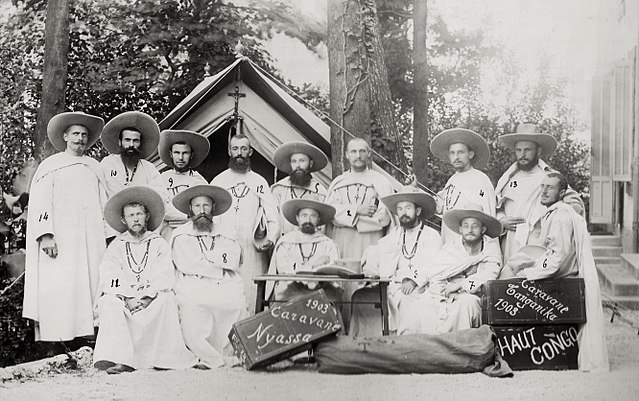
From 1941, the Jesuits were allowed to return to Mozambique. They were all Portuguese and the Jesuits were not known for adopting local vernaculars.
The White Fathers built rudimentary buildings. They traveled around on bicycles. They set up catechism classes and most attendees were male.
Polygamy was widespread.
The White Fathers tended to live rather ascetically. The mission in Barue (1948) was rather spartan. There were 3 Brothers living at Barue. But there was only 1 bed, so the others slept on the floor.
In 1949, 9 German White Fathers arrived in Mozambique.11
There were large floods in 1951 and 1958.
Even by the late 1950s, there were as yet no African priests.
A seminary was set up at Zobwe (only 1 kilometer from Nyasaland). The seminary had electricity and there were a small number of ordinations in 1961.
The facilities at Manga were much more extensive. There was a library with 3000 books.12 There was also a cinema, a health center and a boarding school.
Resende, the bishop at Beira, died aged 61. He would came under PIDE surveillance. He began a newspaper in his diocese, which was sometimes suspended. In 1958 he wrote a pastoral letter suggesting that university-level education be given to Africans in order to prepare them for independence. This created conflict with the colonial authorities and the Church hierarchy. On the other hand, Resende at this time cautioned his clergy about helping Africans to leave the colony to further their studies. Resende appears to have been widely respected. 30,000 people lined his funeral route.13
Frelimo formed in 1962 and had their headquarters in Dar es Salaam.

The Portuguese had tens of thousands of troops in Mozambique.
The authorities had started construction on the Cahorra Bassa Dam in Tete Province. Most of the electricity produced would go to South Africa.
In the 1960s, some of the older White Fathers were retiring. Their new replacements tended to be influenced by Vatican II and its focus on political rights.
The White Fathers were known for using the local vernaculars. This raised suspicions among PIDE agents. They tended not to understand the same languages and sometimes jumped to the conclusion that illicit things were being discussed.
The Pope himself seemed to be rather open to independence movements – much more so than the Portuguese authorities. In 1970, the Pope met with Marcellino dos Santos (FRELIMO) and the leaders of nationalist movements in Angola and Portuguese Guinea.
The Bishops in Mozambique tended not to criticise the methods of the army in Mozambique. Nolan has suggested that “the Bishops were subjugating themselves to colonial oppression.”14
Resende’s successor was Manuel Fereia Cabral. He sold Resende’s newspaper to Noticias de Beira – a pro-government paper.
In rural areas, the Portuguese military was using napalm and deforestation agents.
Aledamentos or ‘protected villages’ were set up. They were surrounded by wire. It became more difficult for Africans to tend to their crops. By 1974 food production had declined.
National service in the Portuguese military was for 4 years.
When Fr Neven (an Assistant on the General Council) visited from Rome, he identified 3 groups within the White Fathers. The first were those who had recently arrived in Mozambique. Most were from northern Europe and they wanted immediate independence. The second cohort had spent a couple of decades in the territory and most were German. They wanted to keep their heads down and get on with the job. They tended to believe that Mozambique was not ready for independence. They had invested so much of their lives working in Mozambique. They were getting old and they believed that it would be very difficult for them to start over in another country and to learn new languages. The third group understood the Portuguese view and accepted that was the way things were.
The approach of leaders within the Church in Mozambique tended to be somewhere between silence and prudence.
There were informers everywhere.
The arrival of Cabral seems to have had a big impact. Nolan notes that the White Fathers were unanimously in favour of staying in the territory prior to 1971, but after Cabral had arrived the situation was different.
Capannel (in Murraca) wrote in a letter dated 19 February 1971 that “the Church is chained, silent, and even an adulteress with the State.”
Whatever the missionaries had wanted, the decision to leave the country had to be taken by their General Council in Rome.
The White Fathers had a consistent policy that it used across the whole continent. They aspired to create a “local church” – meaning one that had African clergy. They wanted their churches in Africa to be self-supporting.
The White Fathers had been operating for more than a century and in 10 African countries.
The final deliberations of the General Council took place on 29 April 1971. They came to the conclusion that their missionaries in Mozambique could not freely conduct their activities. They voted unanimously for withdrawal.
They put out a statement on 5 May 1971 saying, “in Mozambique the Church is not Mozambican but Portuguese.”
It should be noted that no White Fathers had been put in prison physically attacked.
In a letter to the Bishops of Tete and Beira they wrote “The Church is being used to perpetuate an anachronistic situation which will, in the end, fail.”
The missionaries in Mozambique then voted on the decision to leave. Most wanted to go. A few had wanted to stay, but the decision was made that they would all leave together as an expression of solidarity. They left in May 1971.
Most opinion outside of the Portuguese empire supported the White Fathers.
Until 1972, clergy were not arrested by the authorities in Mozambique. That changed on New Year’s Day in 1972 when two priests were taken in to custody.
The Wiriyama massacre on 16 December 1972 was a particularly brutal one.
Young men in Portugal were leaving the country in an effort to dodge national service. The Portuguese government was spending 40% of the budget on the military fighting in the colonies.
Nolan speculates that if Portugal had been willing to enter into a process leading to independence in the early 1960s, it is likely that Mozambique would have been led by the more moderate Mondlane and Simango rather than the more military-minded and marxist Samora Machel. This would have potentially set Mozambque on a different trajectory in the first few decades of its independence. Its hard to know if Nolan is correct.
The first few decades of Mozambican independence were not easy. There were sanctions in place for Ian Smith’s Rhodesia. These sanctions meant less trade going through Mozambican ports and less transit fees. There were floods and drought. Many of the Portuguese settlers left and headed back to Portugal. By the early 1980s the currency was massively devalued.
Machel died in 1986 and new leadership took over.
There were nationalisations of Catholic schools and hospitals.
The case of the White Fathers in Mozambique shows how a religious order was forced to consider how to operate given the overarching issues of colonialism and independence. The relationship between the Church and the state was particularly strong in Mozambique given the Concordat and the Missionary Accord. The state expected the Church to follow their lead. The decision to leave divided opinion. It could be interpreted as an act of morally courageous protest. On the other hand, it could be argued that it was a morally corrupt decision and represented an abandonment of the flock. It depends on your perspective. Most of the other orders did not leave. The Pipcus Fathers made a decision to leave a few years later in 1974, but this was interrupted by changes to the regime in Portugal. What seems crucial in the case of the White Father’s is that they saw the operations of the Church (specifically the Church leadership) as complicit in an indefensible colonial oppression and they didn’t want to be associated with it. Years later, the order would return to Mozambique and its reputation was elevated in the eyes of some Africans as they knew that the order had taken a stand and had spoken out.
 Australia and the World Past and Present
Leave a comment