In 2022 Lula won another election and was back serving as Brazil’s President.
His election was widely viewed as resetting Brazil’s foreign policy.
His predecessor, Jair Bolsonaro, served only one term and it was under his leadership that Brazil’ foreign policy became more isolationist.
Many interpret Lula’s return as a return to a more predictable foreign policy. Many observers are expecting a deeper engagement with the rest of the world.
Lula is a strong supporter of multilateral forums.
Tackling climate change is a key focus for him.
He has generally had good relations with China. Lula would prefer to see the rise of a multi-polar world rather than one that is uni-polar or bi-polar. In a multi-polar world, Brazil gets more of a say on international issues and has more influence.
Lula sees Brazil as a leader of the Global South. He sees his country as being at the forefront of global discussions on poverty alleviation and inequality.
He is keen to work with similarly-sized middle powers around the world to create a coalition that can counter-balance the influence of the Global North. That is why he is a strong supporter of the BRICS grouping. He believes that this forum is crucial for the developing world. Lula seeks to work with Russia, India and South Africa. These countries tend to straddle a middle-ground in terms of development, economic power and technology. Some parts of their societies display high levels of wealth and technological advancement. But such indicators are not evenly spread across all of society. These countries have large populations. If they operate in isolation, their influence is limited. If they can reach agreement between themselves on global issues and speak with one voice, they can advocate more powerfully.
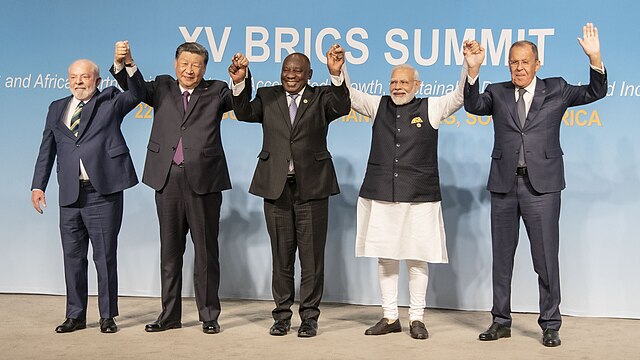
In regards to the war in Ukraine, Brazil has supported a UN resolution calling on Russia to withdraw its soldiers from Ukrainian territory. On the other hand, Lula has suggested that both parties have contributed to the outbreak of the conflict. This had led to a degree of tension with Ukraine itself and with some Western leaders.
Brazil has ongoing contact with Russia through BRICS.
It also has important economic considerations in the relationship with Russia. Brazil sources around 25% of its fertilizer from Russia. Political realists would say that this is a reason for Brazil to be weary of upsetting Russia over the Ukraine issue.
At times China has raised the possibility of expanding the membership of BRICS. A difference has opened up here between Beijing and Brasilia. Lula is rather cool on such proposal.
Lula seems to prefer limiting the membership of BRICS. If BRICS retains a small membership, Brazil can expect to maintain a relatively high level of influence within the group. More members can mean a more powerful bloc. On the other hand, more members may weaken it. The members of BRIC are a diverse bunch. Their interests will not always align. The more members there are, the greater the possibility that the forum will become unwieldy and unmanageable. If BRIC becomes an ever-expanding organisation, it may start to look like a sorry substitute of the UN General Assembly. Some member and partner states are African, some are Asian and some are Latin American. Some are oil-producing and some are not. Some provide credit to other nations. Some are deeply in debt. It really is a mixed a bag.
Bejing has been more keen to expand membership. Perhaps China sees this bloc as a way to spread further its influence around the globe. This may become even more crucial for Beijing in the near future given the tariff tension with the US and the need to develop alternative markets.
Russia may see the BRICS grouping as a way for it to get around its economic sanctions.
Lula also has to contend with domestic politics. Brazilian politics has been especially volatile in recent years. In the last decade or so, multiple Brazilian presidents have faced impeachment proceedings. Politics is always contested. Sometimes it is hard to tell if accusations or proceedings of impeachment are legitimate or whether they simply political power plays designed to weaken or remove opponents.
It is a sad state of affairs if impeachment becomes politics by other means.
It is probably true to say that Lula’s foreign policy will be more outward-looking and predictable than that of his predecessor. Lula is generally in favour of engaging with multinational forums. He seeks alternative structures that can counter-balance superpower interests. And because the world has seen Lula operating as President for many years, most are confident that they know what to expect.
 Australia and the World Past and Present
Leave a comment