Brazil’s first female president experienced torture as a young woman.
Rousseff had been a militant in her youth.
Between 1964 and 1985, Brazil was governed by a military dictatorship.
The junta increased censorship and shut down protest.
Rousseff took the decision to engage in armed struggle against the regime.
She was arrested and incarcerated at Tiradentes Prison, in São Paulo.
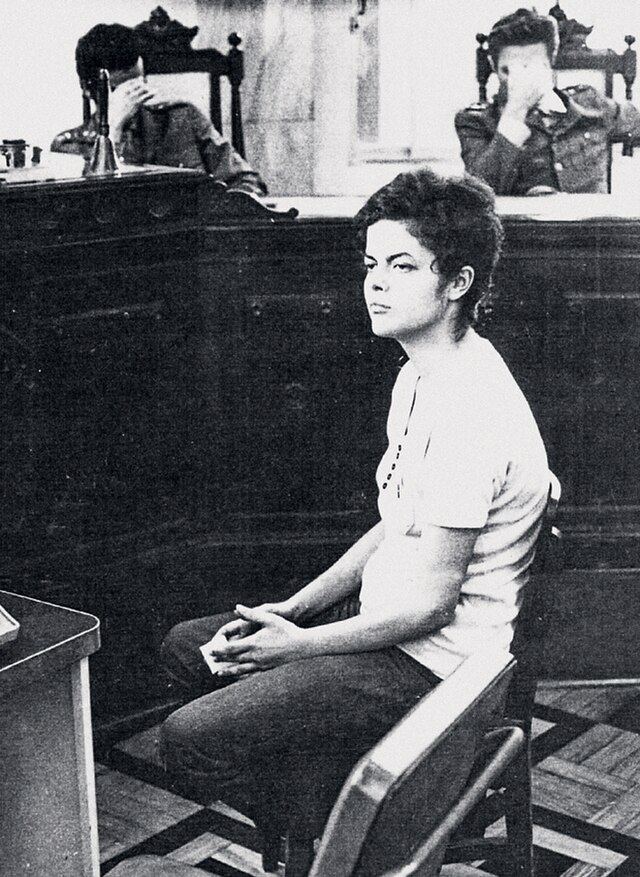
She experienced electrocution and was, at times, left naked.
In prison she retained some control over what she could cook and what she could read.
The torture Rousseff endured left a mark. She chooses not to watch films with scenes of torture in them.
After prison she made a transition into politics – eventually rising to become the first woman president of Brazil.
One her initiatives as President was to create a Truth Commission which she established in 2012.
The Commission investigated murder and torture during Brazil’s dictatorship. The investigation ran for around 3 years. It concluded that 191 people had been killed and that 243 had been disappeared. The Commission also named individuals involved in abuses.
It reopened debate about the Amnesty Law that was passed in 1979. The Commission’s report recommended that the law be changed so that those responsible for abuses could be brought to justice.
For her part, while understanding the point advanced by the Truth Commission, Rousseff chose to not change the Amnesty Law. As someone who experienced torture first hand, she understands the argument to revisit amnesty. But she was of the view that it would be better for the country to move forward into the future than to return to the painful past.
The Commission found that abuses during the military dictatorship were systematic rather than simply isolated events.
The Brazilian dictatorship did not operate in a vacuum when it came to developing interrogation techniques. Other countries shared insights from their own experiences and practices.
Initially the Brazilians were learning from the French. The French had faced armed opposition in Algeria in the 1950s and early 1960s. They developed their own counter-insurgency techniques.
In the 1960s the US became a more influential resource for Brazil. The School of the Americas had been established in Panama. This became a training ground for military officers from right across Latin America. Officers learnt the latest American techniques in psychological warfare and interrogation. Manuals detailing methods were produced. Many of these were declassified in the 1990s, leading to a flood of revelations in the media.
By the 1970s, Brazilian officials were learning from security officials in the UK. The British had been developing their own techniques to combat the IRA.
In Brazil, consideration was given to ‘psychological torture’. The aim was to get information without having to make physical contact. Physical torture often left visible physical damage, such as scars. Physical torture might have been deemed successful inside of prison, but when prisoners were released it produced evidence of injury. This was a dilemma for the military regime. It contributed to an image problem for the government.
Rousseff had two terms as President. In her second term she faced impeachment and was thrown out of office.
Her torture experience even became an issue in her impeachment proceedings.
Jair Bolsonaro dedicated his impeachment vote to Carlos Alberto Brilhante Ustra who he said was “the dread of Dilma Rouseff”.
Ustra was the army colonel who led the Doi-Codi torture unit in the 1970s.
Rousseff’s militancy in her earlier days put her on a trajectory for conflict with Brazil’s military dictatorship. Her experience of incarceration and torture was not unique. Other Latin American leaders had gone through similar experiences. The prison became another arena of political resistance and oppression. It may have been politics by other means. Rousseff was able to emerge from prison, but part of Tiradentes would always be with her.
 Australia and the World Past and Present
Leave a comment