Who is Australia’s greatest explorer? It depends on which metrics you use of course. But if you base it on which explorer never lost a soul in the course their explorations, John McDouall Stuart stands out.
Stuart was not born in Australia. He was born in Scotland where his father had been a captain in the army.
Stuart attended the Scottish Naval Military Academy and became a civil engineer.
He came to Australia at the age of 23.
He disembarked at Adelaide when the city was still a town. Adelaide was just a few years old and tents could be seen everywhere.
He began working for the Surveyor-General, marking out blocks of property for new settlements.
The Surveyor-General at the time was also an explorer – the well-known Charles Sturt. Sturt had named the Darling River. He had also explored the Murrumbidgee and Murray Rivers.
The two mounted an expedition in 1844 where they encountered the Strut’s Stony Desert and the Simpson Desert. Both men suffered from scurvy during the trip.
After the journey, Stuart moved on to live at Port Lincoln. This was followed by a move to the Flinders Ranges.
Stuart began a series of his own expeditions to explore parts of South Australia, central Australia and what is today the Northern Territory.
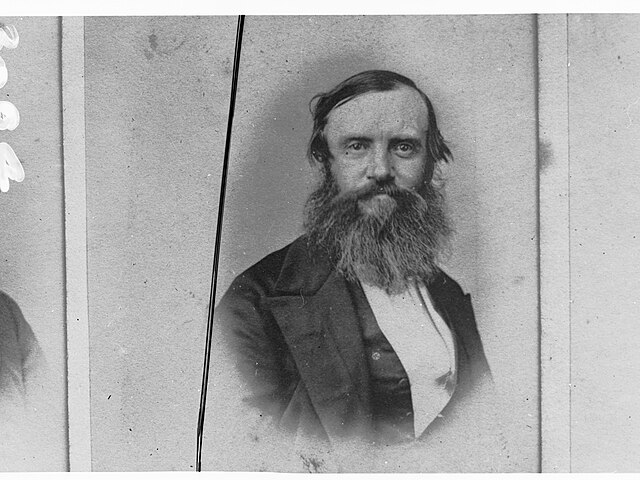
His first expedition was in 1858. His objective was to look for minerals and new grazing land in the north-west of the state.
Stuart located water holes in the course of his travel. He reached the Cooper Pedy area, unaware of the existence of precious opal underneath his feet. Afterwards, he turned south and headed for the coast. This expedition lasted around 4 months.
Upon his return, Stuart returned applied for a pastoral lease.
On his second expedition, he set out to reach what is today the South Australia / Northern Territory border. At this time the land north of South Australia was part of New South Wales.
This journey didn’t go so well. Stuart had turn back after only 100 kilometers due to a lack of horse shoes. The land encountered to the north was not always soft sand. In fact they encountered hard stone which played havoc with the feet of his horses. They needed the protection of horse shoes – and many of them.
People wondered whether it was possible to cross the continent. Much of central Australia was still unknown to Europeans. Vast expanses of the map lay unmarked. Was there an inland sea? Were there more fertile areas hiding inland or was is just vast desert? Could adequate land be found for grazing? These questions occupied the minds of many.
An added incentive was the recent development of telegraph communication. The technology was now available, but the question was how to best establish a network on the continent. Australia at this time was a collection of states. Federation would only come in 1901. Until that time each state distrusted the other and pursued the dream of a telegraph in very parochial ways. Britain was in the process of linking its colonies – from Europe, the Middle East, India. From there, where would the communication network go? Western Australia hoped it would make landfall in its own territory. That way it wouldn’t have to pay transit fees to other states and could charge its own. South Australia wanted the line to make landfall near present-day Darwin and for many of the same reasons. This is what would eventually occur. The worst case from the South Australian point of view would be if the line entered Queensland and then continued to follow population centers down the east coast. If it passed through Queensland, New South Wales and Victoria, all could be expected to add on their own transit fees to communications with South Australia.
Stuart set out on his forth expedition, wanting to find the center of the continent. His party traveled light. This was a key characteristic of his exploration and it was undoubtedly one of the reasons that he was so successful. It ensured that he would not get bogged down with poor supply lines and put the safety of his men at risk.
He located the Finke River.
He also considered that he had located the center of Australia during this trip.
Stuart moved northwards and came across Tennant Creek. At this time his party encountered strong resistance from local aborigines. His camp was raided. Stuart is generally considered to have had good relationships with aborigines. Nevertheless, he was unable to negotiate passage and he was forced to return south once again.
The conflict with these aborigines during his forth expedition had an effect on the composition of the fifth. Now, 10 armed men would accompany him.
Conditions on the fifth expedition were far from ideal. They were traveling in the Australian summer.
The party made it to Attack Creek.
This time around, the local aboriginies did not engage them.
The Burke and Wills expedition was taking place at the same time. Exploration fever was in full swing and there was strong competition between South Australia and Victoria.
As Stuart moved further north, his party was hindered by thick scrub. They found it incredibly difficult to locate a passable route. Stuart was looking for the Victoria River. If he reach it, he would be able to follow it the rest of the way to the north coast. By this stage, his party had been going for 6 months. They were forced to retreat once more.
When he got back to Adelaide, he heard that the Burke and Wills party was missing. He had wanted to search for them. However, it would be another explorer, Alfred Howitt, who would end up leading the search party.
At last Stuart set out on his 6th expedition to the north. With each expedition he had been getting closer to the northern coast. Would he finally reach his goal? Again, he found it difficult to find a route to the Victoria River. He scouted ahead again and again. At last, Stuart reached the other side of Australia. It was July 1862. In classic colonial style, he raised the Union Jack to mark the occasion.
Stuart was clearly a determined individual. Towards the end of his life he was contending with health issues. He had trouble with his vision. In fact, he was almost blind. On the return from the northern coast, he had to be carried for much of the journey.
This man who had done so much to reveal the Australian to continent to European eyes, did not die here and he passed away in London.
He seems a lonely figure at the end of his life. His funeral must have been a somber affair with only 7 people attending.
He was a giant of the European exploration of Australia.
He used horses as his beast of burden. Ne never used camels, which stands in contrast to Burke and Wills.
He did not explore and survey at the same time.
He used Aboriginal guides early on, but later on he abandoned that idea. Presumably his later expeditions could have been sped along if he had been able to earn the trust of northern aboriginal groups and benefit from their knowledge of the local geography. But this never eventuated.
His early explorations were driven, in part, by economic considerations. These included locating valuable minerals, new land for livestock grazing or land acquisition. But more and more it seemed that Stuart was exploring out an innate curiosity in what lay ahead and perhaps out a desire to establish his name in the history books.
He sacrificed a lot in the name of exploration. He never did start a family. He would have better off financially if he had settled down in Adelaide and spent more time on business matters.
The Australian Overland Telegraph would follow the route that he had pioneered and the highway between Port Augusta and Darwin bears his name.
 Australia and the World Past and Present
Leave a comment