For decades Argentina has experienced cycles of foreign debt accumulation, default, restructuring and renewed borrowing.
Argentina started to to acquire significant amounts of foreign debt when the military dictatorship came to power in 1976.
Between 1976 and 1983 the country’s foreign debt went from 8 billion to 45 billion.
Much of this debt had been taken out an a short-term repayment basis.
In 1983 the nation returned to democracy but it still had to deal with massive foreign debt.
By the end of the 80s Argentina was in full-blown economic crisis.
Much of the country’s export earnings went towards debt repayment.
Carlos Menem became President in 1989 and would be in power for the next decade.
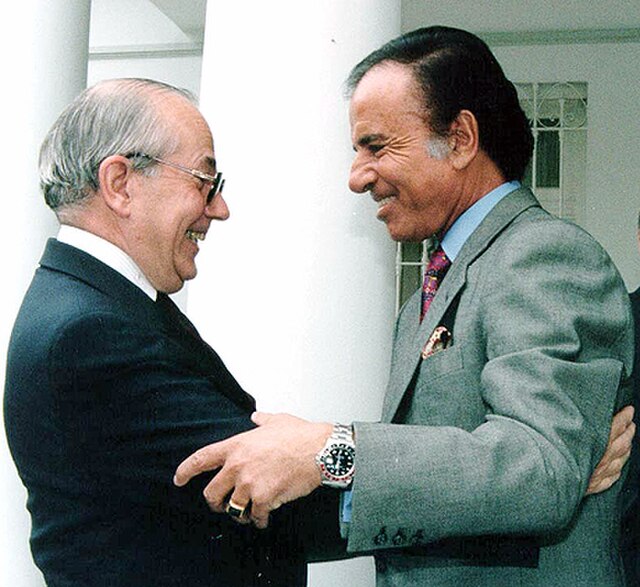
From 1991, Argentina pursued a policy of ‘convertibility’. The peso was pegged to the US dollar at a rate of 1:1.
There were some short term improvements and inflation came right down.
One of the problems with convertibility was that it made Argentina’s exports less attractive and so expansion in this part of the economy was limited.
Nevertheless, foreign debt continued to climb ever higher. While it was $65 billion in 1991, it had jumped up to around 146 billion by 2001.
The level of debt had become unsustainable.
The economy was in recession.
The IMF wanted Argentina to embark on a round of austerity to deal with its liabilities.
In 2001 Argentina defaulted on over $100 billion worth of debt.
The banking system collapsed. Limits were placed on how much people could withdraw from banks.
Despite some early success, the convertibility policy didn’t seem to work in the long term.
A new government de-pegged the peso from the dollar. When it did, the peso suffered a huge devaluation.
Néstor Kirchner became President in 2003. He put forward debt restructure proposals to creditors in 2005. His wife and successor, Cristina, offered another round of restructuring in 2010.
In 2006 the IMF debt was payed off in full. Kirchner and other Peronists dislikes the IMF because they believed that it violates one of their cardinal principles – the maintenance of Argentina’s economic sovereignty.

They resented IMF conditionality. They hated that the IMF recommended austerity as a means of dealing with debt and the economy.
Although the IMF obligations were payed off, the country had used its foreign reserves to do so.
Mauricio Macri won the Presidency in 2015. Between 2016 and 2018, tens of billions of new debt was taken out by Argentina.
In 2018, Macri asked the IMF for a $57 billion bailout – the largest in history at the time.
Inflation soared and the peso lost half of its value.
Again, the debt became unsustainable.
A new leader, Alberto Fernández, won the presidential election in 2019. The following year he offered a new debt restructure deal to private bond holders and in 2022 he offered a deal to the IMF.
Current President, Javier Milei, has threatened to close down the Central Bank altogether and has floated the idea of dollarising Argentina.
Milei has followed a general path of austerity. It may help to reduce the federal deficit. But at the same time there has been a drop in consumption which can lead to less economic activity and the government receiving less revenue.
The peso has also undergone devaluation.
Direct foreign investment is still weak. Milei is keen to have more investment flowing into Argentina and pursues policies that he believes will make the country a more attractive investment destination.
However, potential investors are still concerned about Argentina’s history of policy reversals.
Milei may be well disposed towards greater foreign investment, but many of his predecessors have been more muted on this issue. And power has laid in the hands of Peronist Presidents for most of the post-war period.
There is also the deep structural problem of how to diversify Argentina’s industrial capacity.
Argentina’s debt saga continues. Part of the problem is economic but part of the problem is also political. Austerity can be pursued but it is hard to sustain politically and not all leaders are prepared to weather the storm.
 Australia and the World Past and Present
Leave a comment