The ALP has further entrenched itself while the Coalition lost ground and will have to regroup.
Labor made gains in the House of Representatives picking up 94 seats. This represented a substantial increase from the 77 seats it won at the previous election.
In contrast, the Coalition managed just 43, down from 58.
Labor is dominant in Victoria with 27 seats to the Coalition’s 9.
No so in Queensland however where the ALP has 12 seats to the Coalition’s 16.
Labor is ahead in Western Australia.
In South Australia the Coalition holds just 2 lower house seats.
In a terrible result for the Coalition, they hold no seats at all in Tasmania.
Within the Coalition, the National Party held its ground. They held nine seats before and they still do. They have 6 seats in NSW and 3 in Victoria. They hold no lower house seats in any of the other states or territories.
There are fault lines between the Liberals and the Nationals.
The Nationals have done well for themselves criticising some of the drawbacks of the renewable energy transition. This line of argument seems to play out differently in the regions. After all, this is where most of the solar farms, wind turbines and transmission lines will need to be installed.
But for the Liberals who are usually fighting for suburban or inner-city seats, this is political poison.
Selected seats
In Goldstein the Liberal Party made a gain at the expense of an independent. The result was incredibly close. There was a 3.3% swing to the Liberals. The final result was 50.1% to Tim Wilson versus 49.9% to Zoe Daniel. Independents did relatively well at this election but in this case the independent was not returned.
Kooyong was retained by the independent. There was a 1.5% swing back to the Liberals this time. Again, the result was close with Monique Ryan sitting on 50.7% to Amelia Hamer’s 49.3%. Kooyong used to be a blue-ribbon seat for the Liberals. Josh Frydenberg was defeated at the previous election. The rise of the teals seems to have been at the expense of the Liberal Party, but often it is at the expense of moderates within the party – people like Frydenberg and Dave Sharma in New South Wales (although Sharma has transitioned from losing his lower house seat to the senate). In this case, a young woman lost out in the contest for Kooyong.
Fremantle in Western Australia was retained by the ALP with a huge 16.2% swing.
Mayo in South Australia was won by Rebekha Sharkie of the Centre Alliance. She received a 2.6% swing. It was 64.9% to Labor’s 35.1%.
Indi was retained by yet another independent – Helen Haines.
In Calare (NSW) an independent took the seat from the Nationals. The vote was 56.8% to 43.2%.
Dai Le retained Fowler in NSW.
In Fraser (Victoria) there was a 7.3% swing from the ALP to the Greens, however it wasn’t large enough to effect a change of party.
In Calwell (Vic) there was a swing of 7.3% away from the ALP. This time it went towards an independent.
Zali Steggall further entrenched herself in Warringah for a third term with 61.2% of the vote.
Sophie Scamps retained Mackellar with 55.7% to the Liberal Party’s 44.3%.
Griffith in the Queensland saw a massive swing (21%) against the Greens. The final result was 60.6% to 39.4%. Some have speculated on the reasons for the swing against the Greens at this election. Some have suggested that they have spend to much time focusing on the Israel/Palestine issue and not enough time on pressing domestic issues. Other have suggested that they have been too extreme in voting on bills in the parliament and that voters are punishing them for not advancing action on issues like housing policy reform.
The Greens were further chastised in the seat of Melbourne where the leader of the party lost his seat. There was a 9.5% swing against him there. The final numbers were 53% to 47%.
Farrer (NSW) was retained by the Liberal Party although it suffered a 10.2% swing to the independent candidate.
Wentworth was retained by Allegra Spender with 58.3%.
Lamentably for the Liberals in South Australia, Sturt was picked up by the ALP.
The ALP also took Bass in Tasmania from the Liberals.
Bendigo went to the ALP but suffered a 9.8% swing to the National Party. At the state level, Bendigo is the seat of the Premier and so this result will worry state Labor.
John Howard’s old seat of Bennelong was taken by Labor.
Dickson in Queensland was an ALP gain. This seat was held by the Leader of the Opposition, Peter Dutton. He suffered a 7.7% swing to finish 56% to 44%.
Dutton made developing nuclear energy the centerpiece of his campaign. While voters vote according to many different issues, the prominence of this policy means that it must have a had a significant impact. The policy was a controversial one. A consensus has emerged in recent times that Australia should decrease its carbon emissions. What will replace coal as base load power? Dutton’s solution was to develop nuclear power. But it seems that such a policy will not wash in Australia.
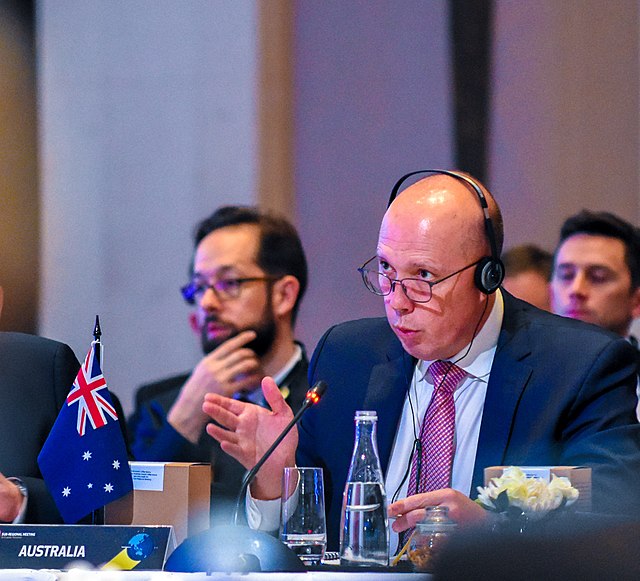
So Dutton’s campaign was not a small target campaign. He went out on a limb, but found that limb was cut off. He tried to sell a solution from opposition. The effect was to make opposition policy the focus rather than government failure.
The ALP picked up Braddon in Tasmania from the Liberals with a 15.2% swing.
The overall pattern was the ALP retaining seats or picking them up at the expense of the Liberals.
Many Australians were happy to give the ALP a consolidated hand. Voters reined in the Greens and sent a message to the Liberals. It seems clear that Australians want to see the country transition further towards renewables. The Coalition will need to regroup and reflect deeply on what it will offer voters at the next election.
 Australia and the World Past and Present
Leave a comment