Peronism is the political ideology associated with the former President of Argentina, Juan Perón
Its three core pillars are: economic independence, social justice and political sovereignty.
Peron was a charismatic leader.
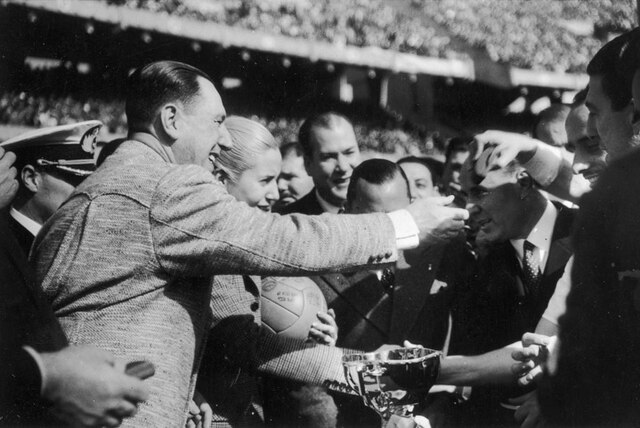
Personism is a broad ideology that has many strands. Within the Peronist tent one can see a radical left-wing, a centre-left or even a centre-right.
Perón was Catholic. In the 1940s the Church played a significant role in providing religious education in public schools.
Despite Argentina’s secular education law of 1884, the 1940s saw the Catholic Church regain a formal role in public schooling. In 1943, the de facto government issued a decree restoring religious instruction in public primary, secondary and special schools as a regular subject.
Congress later ratified this in law (1947), consolidating the Church’s influence in public education during early Peronism.
Perón seems to have used the Church as a vehicle to advance his popularity.
Some Catholics came to be wary of Perón because of the blurring of public and private domains during his tenure.
The Church later became concerned that it was being co-opted into Perón’s cult of personality.
Attempts were made in the 1940s and early 1950s to establish a Christian Democratic Party in Argentina. Perón opposed the creation of such a party. A break between Perón and the Church developed and religious teaching in public schools was wound back by a new law in 1955.
Also, in 1954 Congress approved legislation legalising divorce for the first time in Argentine history. This was another flashpoint for Perón’s eventual conflict with the Church.
Perón wanted to expand women’s suffrage and provide free education in public universities.
He wanted the right to housing recognised in the Constitution.
Perón succeeded in enshrining the right to housing in the 1949 Argentine Constitution. It was later repealed when the Constitution was annulled following Perón’s overthrow in 1955.
He brought in price controls and subsidised food for workers.
Trade unions held a prominent role under Perón. He had been Labour Secretary in 1943.
Perón was elected President in 1946 but was overthrown by the military in 1955.
He won the presidency again in 1973 but died just a year later. His widow succeeded him. She was also overthrown by the military, in 1976.
Most see Peronism as a form of left-wing populism.
One of its central themes is that it is anti-elite. Peronists have no time for an oligarchy.
Some critics saw Peron’s rule as form of fascism or at least state corporatism. Perón sought to influence all areas of society – with the state at the helm and himself at leader of the state. He envisioned the Argentinian nation as a community, but a community that was highly organised and not one that was allowed to evolve organically.
Some have noted that Perón was influenced by Mussolini in Italy. The key idea in Mussolini’s Italy was that the individual was subservient to the state.
Perón came form a military background. Command structures were what he was familiar with. Yet he was not simply a military leader. He harboured ideas about social justice and social reform – not things traditionally seen in the military. He was concerned about social relations, economics and the plight of workers.
What comes through above all else is Peron’s self-promotion and desire to have a say in every aspect of society.
He distrusted business. He was not content to leave business to its own devices. His Argentina was one in which the economy was planned. He believed that government should direct the economy.
Perón was not all that engaged in foreign affairs. He had to deal with foreign relations simply by virtue of being President, but one gets the sense that it was domestic matters that concerned him most. He was warm towards Cuba, Allende’s Chile and the People’s Republic of China. A small island, a neighbouring country and the world’s most populous nation on the other side of the world – these were Argentina’s relationships. Quite heterogeneous. Argentina’s foreign policy was largely non-aligned. Argentina had remained neutral in WWII. Yes, Argentina had relationships with other countries but one gets the picture that it was a rather inactive foreign policy, rather than an activist one. By and large, Perón was happy if the world left Argentina alone.
Peron’s Argentina was protectionist.
Peron’s electoral strategy seemed to be to appeal to every sector of society – every sector except business. He courted immigrants, Amerinidans, Jews, Arabs and workers.
Before 1943, Argentina’s indigenous community was barely spoken of. Perón raised its profile. For the first time in their lives, the indigenous people of Argentina were able to secure citizenship documents. They were invited to become part of the Argentinian community in a way that they hadn’t before.
Perón’s relationship with Nazi Germany is still controversial. Prior to WWII, the authoritarian states of Europe were respected in some quarters for their perceived strength and the ability to mobilise the masses. This model of governance became more and more discredited through WWII, as the negative aspects of these political models became clearer. For example, Nazi Germany combined strong, centralised state control with a virulent antisemitism.
On the one hand, Perón established diplomatic relations with Israel in 1949 and Argentina saw a massive influx of Jewish immigrants. Argentina’s Jewish population would rise to become one of the most numerous outside of Israel and the largest in Latin America.
On the other hand, many former Nazi officials also made their way to Argentina after the war where they sought a safe haven away from the central Europe. This was the case with high-profile Nazi leaders Adolf Eichmann and Joseph Mengele.
Some have argued that while Perón may have been attracted to corporatist states and authoritarian strongmen, he was not antisemitic and neither was Peronism.
The 1970s saw the rise of Vatican II and Liberation Theology. Perón adopted many of the same issues advanced by progressive clergy. He talked about looking after the poor and the destitute.
After Perón’s death there was always a question as to whether his movement would live on. Peronism was so widespread during his time that many of Argentina’s political class came to identify with it.
Enter Carlos Menem.
Governor, Senator and future President.
Menem was born to Syrian parents.
Carlos had met Perón in 1951.
Menem was arrested in 1956 but was out the following year.
He led the La Rioja chapter of Peronist Youth.
He was a labour lawyer before entering politics and he visited the former President while Perón was in exile in Spain.
Menem self-identified as a Peronist and much of his early career pointed towards sympathising with a Peronist worldview.
He would serve as President between 1989 and 1999.
Once President, he started to move in directions that made the left-wing of Peronism uncomfortable.
He embarked on a program of privatisation. This included ENTEL (telecommunications) and Aerolíneas Argentinas.
His rhetoric was less anti-capitalist. He attacked the upper class less than Perón had.
Government spending was more subdued than it had been under Perón.
There was economic growth in Menem’s time and an influx of foreign investment.
But the economic record was mixed. Despite more investment and economic growth, many Argentinians were moving below the poverty line.
Foreign debt increased substantially.
Argentina’s Jewish community was rocked by terrorist attacks in 1992 and 1994. In 1992, 29 people willed killed in an attack on the Israeli Embassy. Then, two years later 85 were killed when the AMIA building was bombed.
Under Menem, Argentina moved from a non-aligned foreign policy stance towards a more pro-US position.
Argentina’s dispute with the UK over the Falkland Islands / Malvinas still cast a shadow. Despite talking big during electioneering in 1989, Menem reestablished diplomatic relations with the UK in 1990.
He was a founder of Mercosur (Southern Common Market) in 1991. So much for protective tariffs.
There are questions about his relationship to Catholicism. He was Muslim. But the Argentinian constitution required presidents to be Catholic (at least prior to 1994). Like Perón, there is a question of whether Menem used Catholicism to advance his political career.
Perón cast a long shadow over Argentine politics. Peronist Presidents have dominated Argentinian politics in the post-war period. Peronism is a wide umbrella movement that contains multiple strands and factions. Perhaps its diversity is one of its strengths. Economic independence, social justice and political sovereignty are all important concepts for the movement. To this we can probably add another essential element – populism. Peronism has a habit of throwing up charismatic, populist leaders.
 Australia and the World Past and Present
Leave a comment