Much of the state was now serviced by railways.
In 1920/21, 143,251,216 passenger trips were recorded. In the same year 7,770,694 tons of goods and livestock were been transported by rail.1
In 1920, railway receipts were basically split 50/50 between passenger fares and freight charges. Here are some rates per ton, per 100 miles:
The most expensive category was livestock – perhaps due to the difficultly of loading, transporting and unloading live animals. Livestock attracted a rate of 111 shillings.
The next highest rate was for agricultural machinery and implements. Perhaps this was due to the difficulty of loading and unloading such heavy items. They cost 51 shillings.
Next was wool at 47 shillings. Poultry was 34 s.
The rates on dairy products was 25 s., 21 s. for fresh meat and 16 s. for fresh fruit2
The Victorian government had set up a “Closer Settlement” scheme. Land was to be allocated to returned soldiers. By 1921, 5,257 soldiers were listed as having settled on land granted from the Closer Settlement Board.3 People were also sent to the Mallee district in the hope that they would increase the population of this region and boost development there.

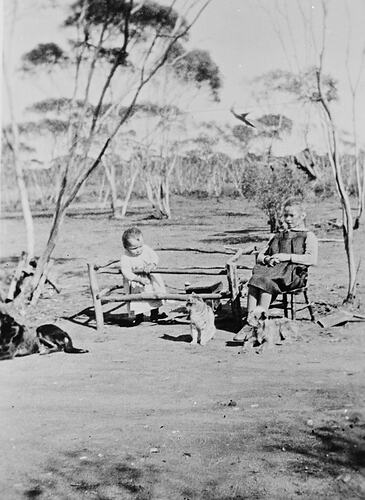
In 1921, the vast majority of sheep could be found in the Western district (3,982,441). Sheep could be found in Gippsland, but their numbers were much lower (859,722). Gippsland had the highest number of cattle in the state with 356,201.4
After WWI, the number of mutton carcasses for export exploded. In 1918-19, the number was 401,382 but the following year the number jumped up to 2,468,090. However, in the year after that, number fell away sharply to only 288,190.5
If we turn our attention fishing, the busiest scene was Western Port. Western Port included a number of locations, such as Cowes, Flinders, Grantville, Hastings, San Remo and Tooradin. Here, one could find 166 boats and 258 hands.
The Gippsland Lakes were not far behind. There were 139 boats with 221 men operating here.
There was a busy operation at Corner Inlet, Welshpool and Toora with 49 boast and 72 men.
Port Albert is listed separately with 25 ships and 47 crew.
Despite its relatively close proximity to Melbourne, Mornington only had 25 ships and 32 crew.
St. Kilda was even smaller. – 14 boats and 30 men. It would seem that commercial fishing based out of the Bay and so close to the city was not very popular.
There were only 3 boats operation out of Anderson’s Inlet, providing employment for 5 individuals.6
Australia was an important source of commodities for the UK. There was a clear surge of Australian imports in the immediate aftermath of WWI. Australia did export during the war, but it was nothing compared to what followed. Perhaps it was now much easier to ship goods from one part of the globe to another. Perhaps there were now more ships freed up for trade rather than the war effort. Perhaps rationing was giving way to a new-found level of consumerism.
Between 1915 and 1918, Australia shipped 3,417,400 pounds worth of wheat to the UK. But in 1919 that figure was 13,623,629.
From 1915 to 1918, 6,627,772 pounds worth of meat went to the UK. The following year the meat trade was worth 10,594,415 pounds.
The same pattern can be seen for wool. During the war years (1915-1918), 21,107,699 pounds worth of wool was sent to the UK. In 1919 it was 57,522,055 pounds worth.7
New forms of machinery were being developed and adopted for use by farmers.
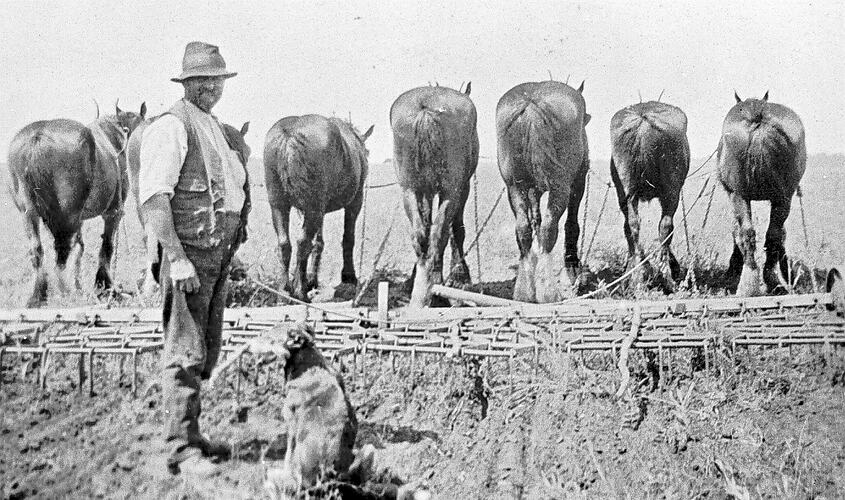
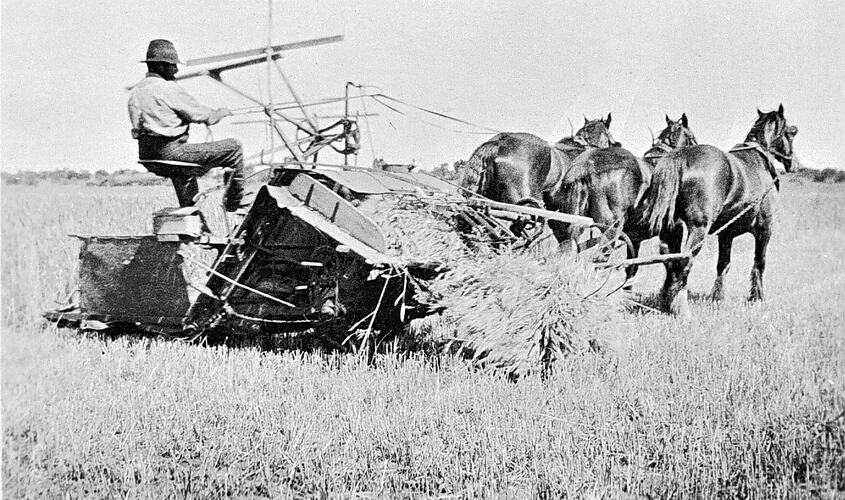
Industrialisation kept advancing. In 1871 there were only 1,740 factories in Victoria. By 1920-21 that number had exploded to 6,532.8
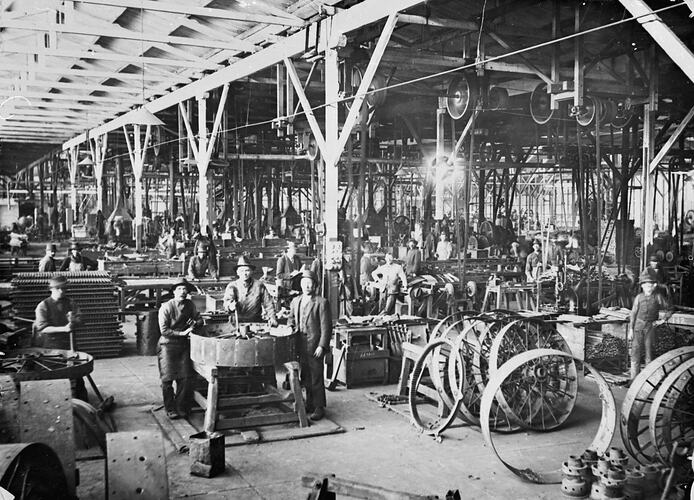
Changes were continuing in the realm of energy generation. In 1911, the number of factories using steam for their power and those using electricity was about on par. Ten years later, that situation had changed. By then, electricity was certainly the power source of choice. The numbers were 3,128 (electricity) to 941 (steam).9
 Australia and the World Past and Present
Leave a comment