Hastings Banda, the long-time President of Malawi, was the odd man out among leaders in Southern Africa.
While an African nationalist, he was also thoroughly westernised and his personal history and anti-communist attitude left him somewhat ostracised from other African leaders in neighbouring states.
Banda was born right at the end of the 1890s. There is some uncertainty around the exact year of his birth as records in what is now Malawi were not what they are now.
He was born near Kasungu.
He went to school in Mtunthama, then in Chikondwa.
By 1908 he was attending Chilanga mission station.
He was baptised in 1910 and that is when he took on the Christianised name of Hastings.
He moved to what was then Southern Rhodesia (Zimbabwe).
In 1917 Banda decided to move on and he traveled to Johannesburg.
In South Africa he would work at the Witwatersrand Deep Mine for some years.
It is clear from looking at Banda’s life that education and travel were very important to him and in his younger years he would travel the globe. This stands in stark contrast to his later years after he became President of Malawi.
In 1925 Banda left Africa for the first time and travelled to America where he would attend high school in Ohio.
He continued his education studying pre-med at Indiana University.
From there he transferred to the University of Chicago where he contributed to the fields of anthropology and linguistics. He was in a unique position of being able to provide insight into his own Chewa tribe.
He changed institutions once more and studied medicine at the University of Tennessee.
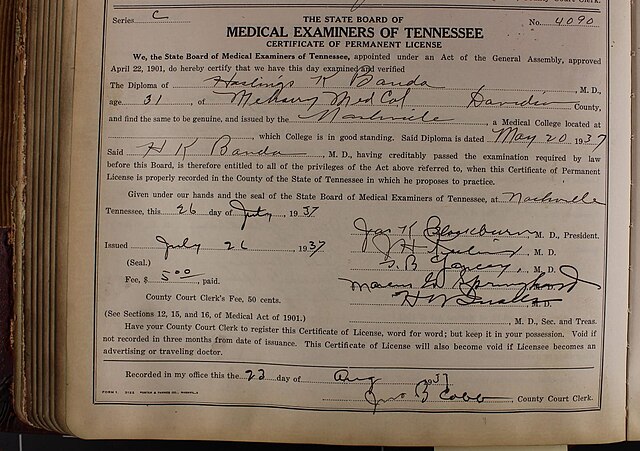
Banda’s American sojourn was complete and now he crossed the Atlantic headed for Britain – the colonial ‘motherland’. From 1941 to 1945 he was working as a doctor there.
While initially studying in Edinburgh, he later lived in North Shields and Newcastle upon Tyne. He would also live in London.
Back in southern Africa a major political issue was brewing. Some were agitating for a federation between Southern Rhodesia, Northern Rhodesia and Nyasaland. A federation began in 1953 but would only last 10 years. It was variously called the Central African Federation or the Federation of Rhodesia and Nyasaland.
At the time, important secondary industries were emerging in Southern Rhodesia and there was a copper boom in Northern Rhodesia. Some in the Southern Rhodesia were agitating for the union – chiefly along economic lines. They were keen to access more labour from Nyasaland.
Banda was clear in his views on the federation. He was strongly opposed to it. Nyasaland would be the smallest and weakest part of the union and consequently would have less say and influence than the other members.
Banda chose to return to Africa but to a different country. From 1953-58 he was practicing as a doctor in Ghana – the first African country to achieve independence.
When Banda returned to Nyasaland he had been living outside of the country of his birth for over 3 decades.
Public demonstrations were fermenting and Banda was imprisoned in 1959 but was released the following year.
He was appointed Prime Minister in 1962. Britain was still in control of the territory at this stage. Britain had set up institutions for colonial rule. They now belatedly set about trying to create institutions for self-rule and ultimately, independence. Unlike many of the countries in Southern Africa, there was no large armed insurrection in Nyasaland in the immediate period prior to independence. Banda was installed as Prime Minister before the country became independent.
That occurred two years later in 1964. The country was to be a republic and so Banda the Prime Minister became Banda the President.
Banda himself was largely responsible for choosing the country’s new name. He had liked name of Lake Maravi and the name of Africa’s latest nation is said to be variation on this.
For those who wished to see a vibrant democracy in Malawi, Banda was a a disappointment.
He seemed to like control. Many observers saw his regime as an authoritarian one.
Internal power dynamics raised their head right from the get go and set the tone for the next three decades.
There was the so-called ‘Cabinet Crisis’ of 1964. Some of Banda’s cabinet ministers had pressed for limitations on the President’s powers. Banda dismissed four of them.
A new constitution was came into effect in 1966.
Only one political party was allowed to operate inside Malawi – the Malawi Congress Party (MCP).
In 1983 there was the ‘Mwaza Four Incident’. Discussions around multi-party democracy were taking place. People were discussing whether Malawi should follow that path. Three ministers had expressed support for the idea. These three ministers and another member of parliament were later found dead. It was announced that their deaths were as a result of a “traffic accident”. It is believed that a car accident was staged in order to cover up the manner of their deaths.
In Banda’s Malawi citizens were required to carry MCP party cards and produce them for inspection when asked.
The Malawi Young Pioneers were a paramilitary group that had a fearsome reputation in the country. They were frequently used for surveillance.
Communications were limited. There was only one radio station and only one daily newspaper. There were no television broadcasting stations.
Banda’s conservative social views had an impact on society. Women were not permitted to wear short skirts and men couldn’t have long hair.
In Banda’s time there was a flurry of road construction. Communications development in the British colonial period had been limited. Certainly some roads had been built and some schools and hospitals had been set up but the system didn’t adequately serve the needs of most of the population and wasn’t befitting of a modern, independent country as it approached the close of the twentieth century.
Most African heads of state had opposed US involvement in the Vietnam War with many believing that the war was about the right of Vietnam to choose its own future free from outside influence.
However Banda supported US involvement. Here was his anti-communism showing through. To his compatriots in Southern Africa, Banda’s views may have seemed counterintuitive. From their perspective it appeared that Banda had a tin ear. Surely the average Malawian, they reasoned, would support a former colonised country fighting for it’s independence and oppose one of the strongest nations in the world trying determine events in line with its own interests.
Banda was comfortable with being an outlier. He had his own views and stubbornly stuck to them.
Another issue that caused a rift with other leaders in the region was trade with Apartheid South Africa.
Most countries in the area traded with South Africa to some extent. Even if it was to ship their goods via South African ports or to access oil via the same ports. Most nationalist leaders were loathe to do this but reasoned they had very little choice. They had to choose between a bad situation and a worse situation. Banda thought that these leaders were hypocrites – telling others not to trade with South Africa while they were doing it themselves.
Trade was one thing. Diplomatic relations were another. Again, Malawi under Banda was a pariah state. Malawi had diplomatic relations with Pretoria- something that other states refused to do. Banda would argue that even if you didn’t agree with Pretoria, it was important to continue to engage with them and have dialogue with them.
Not only did Banda maintain a relationship with South Africa but he also maintained relations with the Portuguese colonial government in Mozambique. This was not popular with other African leaders and the insurgency group within Mozambique – FRELIMO – was absolutely outraged.
Banda could have argued that the was trying to advance Malawi’s interests – ensuring access to Mozambican ports for Malawi’s imports and exports. Banda may have been looking at the present situation but he was burning up his political capital with FRELIMO. The future lay with FRELIMO. They would govern Mozambique after 1975 and they would not forget the position Banda had taken in the years leading up to independence.
In some ways Malawi was a island within Southern Africa. Banda was politically isolated. If Malawi had been a larger country or had had greater mineral wealth, his leadership could have become a larger flashpoint than it did. While the leaders of southern states were not happy with everything that Malawi was doing, they could turn their back on him to large degree and get on with more pressing issues.
Banda had wanted to move the capital from Zomba to Lilongwe. What was the rationale for this? There seems to be two main explanations.
Zomba was in the far south of the country. It was closer to the major city of Blantyre. The British were not at all keen to see a new capital city carved out in the middle of the country. They couldn’t understand why Banda would move away from all of the development that had already taken place in south. Banda himself argued that the new capital would stimulate growth in the center and north of the country. In this way it could be interpreted as an example of nation building – something to stitch the country together.
Another explanation is that he wanted to move the center of Malawian power away from the south and towards the center of country. This was the region of his birth and where his ethnic group was concentrated. The surrounding area would profit from increased development.
If one looks at a map showing ethnicity in Malawi a few things become clear. The northern third is dominated by the Tumbuka. The central zone is dominated by the Chewa and the southern third is much more ethnically fragmented.
Zomba had severed as the capital of the territory until 1974 and the parliament remained in there until 1994. According to the 2018 census people identifying as Lomwe constitute the largest ethnic group in the city while Chewa comprise 12.76%.
If you look at the case of Lilongwe, Chewa make up 42.28% and the next largest group is the Ngoni with 17.13%.
Lilongwe has over a million residents. In 1904 it served as an administrative center. It earned official town status in 1947 and since being declared as Malawi’s capital the departments of state have slowly been moving from Zomba to Lilongwe.
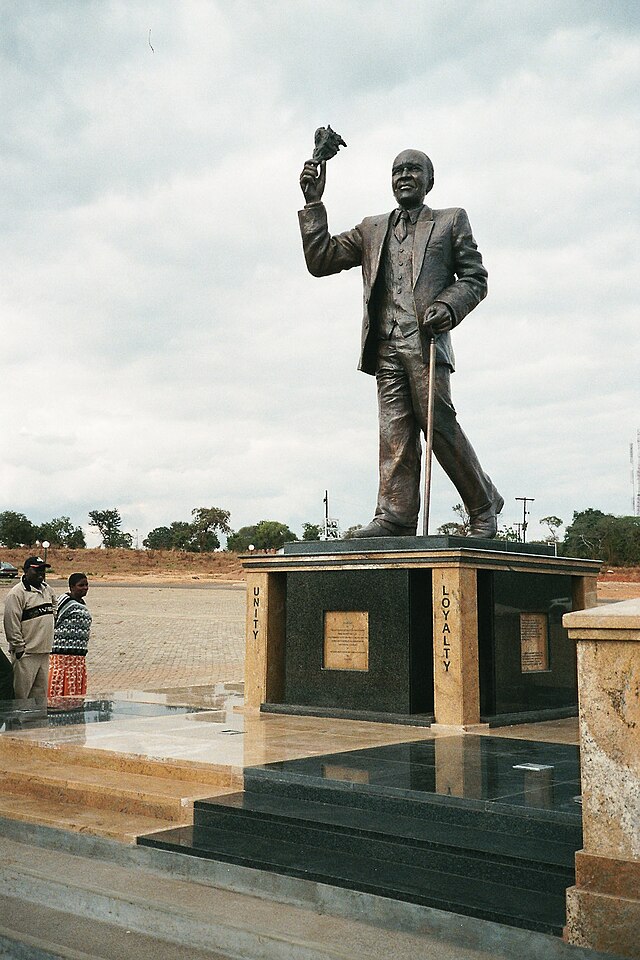
The main concept in the city’s design was that the city would be linear and have multiple centers of activity. Population growth has been very strong – considering that Lilongwe only had around 19,000 residents in 1966.
During the 1980s, Banda was playing both sides in Mozambican War.
After independence he did support FRELIMO. However, he also supporting their rival – RENAMO.
He penned an agreement in 1984 with Samora Machel that called on Malawi to stop supporting RENAMO. In reality, even after this time Malawi acted a conduit for South African support to RENAMO. Again, FRELIMO was fuming. Banda was particularly concerned about Malawi’s access to the Mozambican port of Nacala.
The end of the Cold War put greater pressure on Banda. There was greater pressure on him to move towards multi-party democracy. The US had won the Cold War and domestic sentiment in the US and the UK wouldn’t tolerate further support for authoritarian leaders. Banda saw that the writing was on the wall and he allowed a referendum on the question of multi-party politics. In the referendum 64% voted in favour of the change.
Banda ran in the 1994 presidential election but lost.
It is one of the paradoxes of Banda’s rule that after three decades of ironfisted rule, the transition to multi-party democracy was essentially peaceful.
The following year the former President was arrested and charged with the murder of former cabinet ministers. He was later acquitted of the charges.
How do we explain the difference between Banda and the other independence leaders in Southern Africa? Banda was a generation older than most of the other leaders. While he was born at the turn of the century, many others were born much later.
Robert Mugabe was born in 1924. Kenneth Kuanda was born in the same year. Namibia’s Sam Nujoma was born in 1929 and Samora Machel was born in 1933.
When Banda was receiving his early education, British colonialism in the region was much stronger than it was when many of his compatriots were at school. To Banda, British colonialism and culture would have seemed like the next stage of modernist development. As the colonial system dragged on there would have been more to criticise. Banda had less criticisms of colonialism than Mugabe or Kuanda.
In Banda’s formative years, it was not yet clear that British colonialism would go on a downward trajectory and in the space of decades would no longer have a say on the future of the territories of the region. In Mugabe and Kuanda’s time, they could see that this would be the case and they could envision a different future for their countries.
Banda had lived in the two most influential Wetsern countries – The US and the UK – for decades while these other leaders had not. Banda saw Western culture from the inside. He saw its positive aspects as well as the negative. While in the US he was able to study at the country’s peak educational institutions. He received support from American individuals during his years of study. While many today may talk about American colonialism or neocolonialism, the US didn’t have a history of colonialism in Southern Africa. The US had even fought its own War of Independence against the British.
Banda also spent a long time living in Britain – inside the ‘belly of the beast’. While there, he worked in one of the most respected professions available – medicine. Banda was there during the tense years of WWII. He may have saw the negative aspects of British society but he also saw the the country standing up against the fascism and antisemitism of Hitler’s Germany. He was there when Britain faced its greatest threat and rose to its greatest challenge.
None of the leaders in Southern Africa had lived outside of their own countries as much as Banda had. None of them had lived in the US or Britain. When they had lived outside of the country of their birth, they had moved to other African countries that had either recently turned independent or were in the middle of their own fights against colonial powers.
Mugabe earned a scholarship to study in Fort Hare in South Africa’s Eastern Cape. He also spent time in Lusaka in what was then Northern Rhodesia (now Zambia). In 1958 he moved to Ghana which just happened to be the first country to gain its independence. In 1960 Mugabe returned to the country of his birth.
Kenneth Kuanda had lived in Tanganyika (now Tanzania).
The first president of Namibia, Sam Nujoma, went into exile in Tanzania. Nujoma was quite well-traveled within Africa, but not outside. He had set up SWAPO’s headquarters in Dar es Salaam and spent 29 years in exile and before returning to Namibia in 1981.
Finally, the first president of Mozambique, Samora Machel, had also been in Dar es Salaam and had had military training with FRELIMO in Algeria. He served as president from 1975 until his death in a plane crash in 1986.
So, this group formed a cohort. They were exposed to brewing African independence movements in a way that that Banda had not.
In a way, Banda’s experiences were more worldly than those of this brethren. But in southern Africa in the latter half of the twentieth century there was only one doctrine in town – independence, independence, independence. Hastings Banda was the odd man out.


Leave a Reply