The ethic of barn raising in Amish communities is one of the most vivid expressions of communal life in rural North America. Among the Amish, a barn is essential infrastructure for storing crops and keeping animals. When a family needs a new barn, the wider church district comes together to build it – typically in a single day. This practice reflects a deep commitment to mutual aid and shared responsibility.
No one family is expected to shoulder a burden alone. Instead, dozens and sometimes hundreds of men arrive early in the morning with tools, prepared timbers. Women of the community prepare and serve meals for the workers. Boys fetch tools. Children learn a lot by watching all the activity taking place. The event is not only a construction project but also a social gathering. A feast often follows the completion of construction. These projects reinforce bonds across generations.
This communal approach reflects the Amish understanding of church as a lived, practical fellowship. An Amish church district is relatively small with perhaps 20 to 40 families. Districts tend to be geographically compact. Members depend on one another economically and socially. Barn raising demonstrates that interdependence is not theoretical. Success is a shared achievement.
Barn raising is highly organised. On the appointed day, tasks are assigned according to skill and strength. Experienced builders oversee the framework. Others lift or secure joints. Because many participants have taken part in numerous barn raisings, there is a shared knowledge base. Efficiency grows from repetition and collective memory.
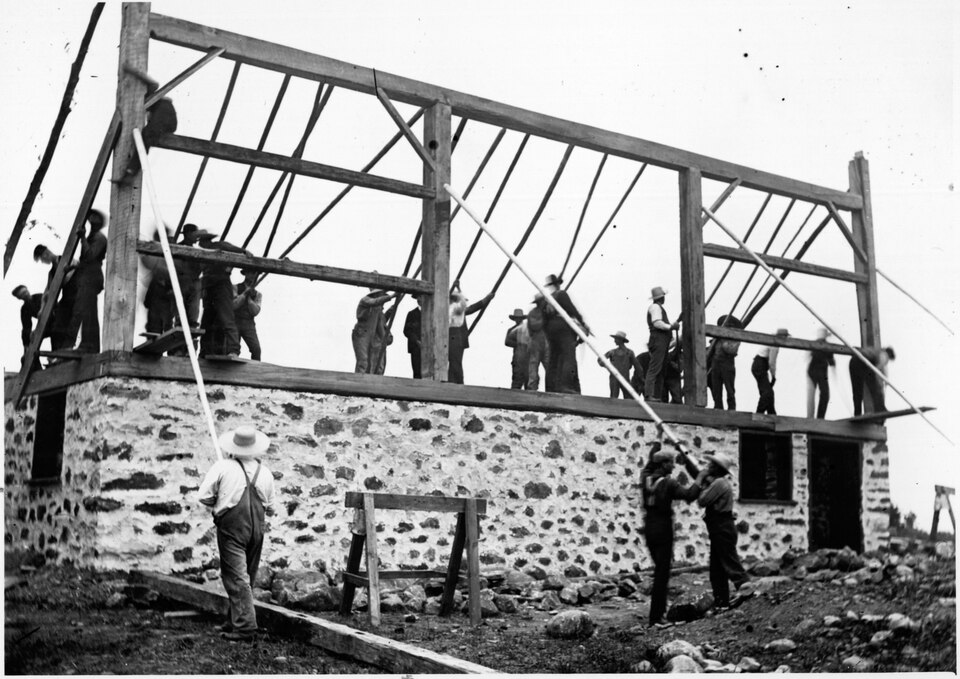
Is this more efficient than each family building its own barn independently? In many respects, it is. If one household attempted to construct a barn alone, the process could take weeks or months – especially while balancing daily farm duties. Framing requires the coordinated lifting and positioning of large beams. This would be difficult and dangerous for just a few people. By concentrating labour into a single day, the Amish reduce both time and risk. What might take one family around 1000 labour-hours over several months can be completed in a day.
This labour is not monetised. It is reciprocated. A family that receives help today will contribute labour to others in the future. This system reduces the need for loans or paid contractors. This aligns with Amish caution about debt and outside dependence.
A barn raising strengthens trust networks. Young people observe cooperation in action. Elders pass down skills. These outcomes would be lost if each family worked in isolation. These kinds of community projects build social capital.
Membership in the church entails obligations. Refusing to participate without good reason would carry social consequences and could lead to censure.
The Amish practice of barn raising is both an ethical statement and a practical strategy. It reflects a worldview in which community welfare takes precedence over individual autonomy, and where mutual aid is an expectation rather than an exception. Compared with each family building alone, barn raising is generally more efficient in time and labour coordination. Barns are symbols collective effort. They are visible signs that, in Amish life, prosperity is something that is built together.


Leave a Reply