The Shinkansen, commonly known as Japan’s “bullet train” is one of the most successful high-speed rail systems in the world.
Since its introduction in 1964, the network has expanded from a single line connecting Tokyo and Osaka into a nationwide system serving much of the country.
The origins of the Shinkansen can be traced to the rapid economic growth experienced by Japan after the Second World War. By the 1950s, the conventional rail line between Tokyo and Osaka, known as the Tōkaidō Main Line, was operating at full capacity. Passenger and freight traffic had increased dramatically, creating a need for a faster and more efficient means of transport.
According to the 1965 census, Tokyo City (23 wards) held around 8.8 million people while Osaka City contained about 3.2 million. So together the line had well over 10 million potential customers. The figure is significantly higher if we look at the Greater Tokyo Area and the Keihanshin (Osaka/Kyoto/Kobe) region, with an estimated 27-29 million people all together.
Even if we take the more conservative figures, we can see that the 2 main Japanese cities had more people in 1965 than Sydney and Melbourne do today (with around 5 and a half million each).
Construction of the first Shinkansen line began in 1959.
The line was completed in time for the 1964 Tokyo Olympic Games. Initial trains operated at speeds of up to 210 kilometres per hour, making them the fastest scheduled trains in the world at the time.
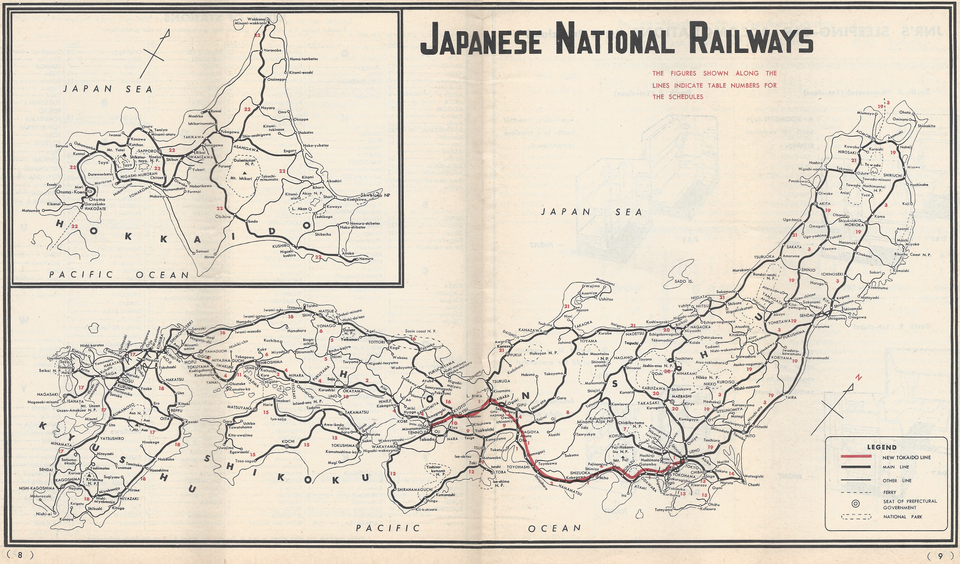
The success of the Tōkaidō Shinkansen encouraged further expansion.
During the 1970s, the Sanyō Shinkansen was progressively extended westward from Osaka to Okayama and eventually to Hakata in Fukuoka on the island of Kyushu.
These extensions significantly reduced travel times between major cities and strengthened economic links across western Japan.
Expansion continued during the 1980s and 1990s. New lines were built to connect northern regions of Japan.
The Tōhoku Shinkansen linked Tokyo with cities in the Tōhoku region, while the Jōetsu Shinkansen connected Tokyo with Niigata on the Sea of Japan coast.
These routes improved accessibility to areas that had previously been relatively distant from the country’s major economic centres.
The Shinkansen became an important tool for regional development and encouraged tourism.
A significant turning point occurred in 1987 when Japanese National Railways was privatised and divided into several regional companies collectively known as the Japan Railways Group (JR Group).
Although some observers feared that privatisation might hinder expansion, the regional railway companies continued to invest heavily in high-speed rail.
From the 1990s onward, train speeds increased steadily. Maximum operating speeds rose from around 210 kilometres per hour to 320 kilometres per hour on some routes.
Safety has been one of the defining characteristics of the Shinkansen. Since its inception, the system has maintained an exceptional safety record. There have been no passenger fatalities resulting from train accidents or derailments. The safety record is particularly striking because Japan is highly earthquake-prone.
The twenty-first century has seen continued geographical expansion. The Kyushu Shinkansen was completed in 2011, linking major cities on Japan’s southernmost main island.
The Hokkaido Shinkansen extended high-speed rail through the undersea Seikan Tunnel to Japan’s northernmost island.
Construction has also continued on the Hokuriku Shinkansen, connecting Tokyo with the Japan Sea coast and gradually extending westward.
Japan’s Shinkansen has evolved from a single high-speed rail line serving the Tokyo–Osaka corridor into a comprehensive national transportation network.


Leave a Reply