The Order of Boyacá is Colombia’s highest civilian honour, awarded to foreign nationals for “exceptional service” or as a gesture of international friendship.
Its history can be traced back to the Battle of Boyacá in 1819, where generals were awarded the Cross of Boyacá.
This was a one-time affair. The award was re-instituted in the military in 1919. From 1922, civilians could receive the honour.
The award is sometimes given during state visits or when recognising important bilateral relationships.
The political ideology of Latin American recipients has been mixed.
Even authoritarian or conservative leaders in Latin America have received the honour.
If one focuses on the recent recipients, one might notice a tilt toward left-wing Latin American leaders. That reflects the recent political cycle in Latin America (the “Pink Tide” ) and the orientation of the Colombian government at the time (President Gustavo Petro was left-wing).
Over the long term, recipients are more mixed.
Early recipients included Spanish Royalty – Victoria Eugenie and Alfonso XIII – both in 1925.
The first Latin American head-of-state to receive the award was Venezuela’s Juan Vicente Gómez in 1925.
Gómez had been a military general before assuming the presidency. He was President 3 times – 1908-1913, 1922-29 and 1931-35.
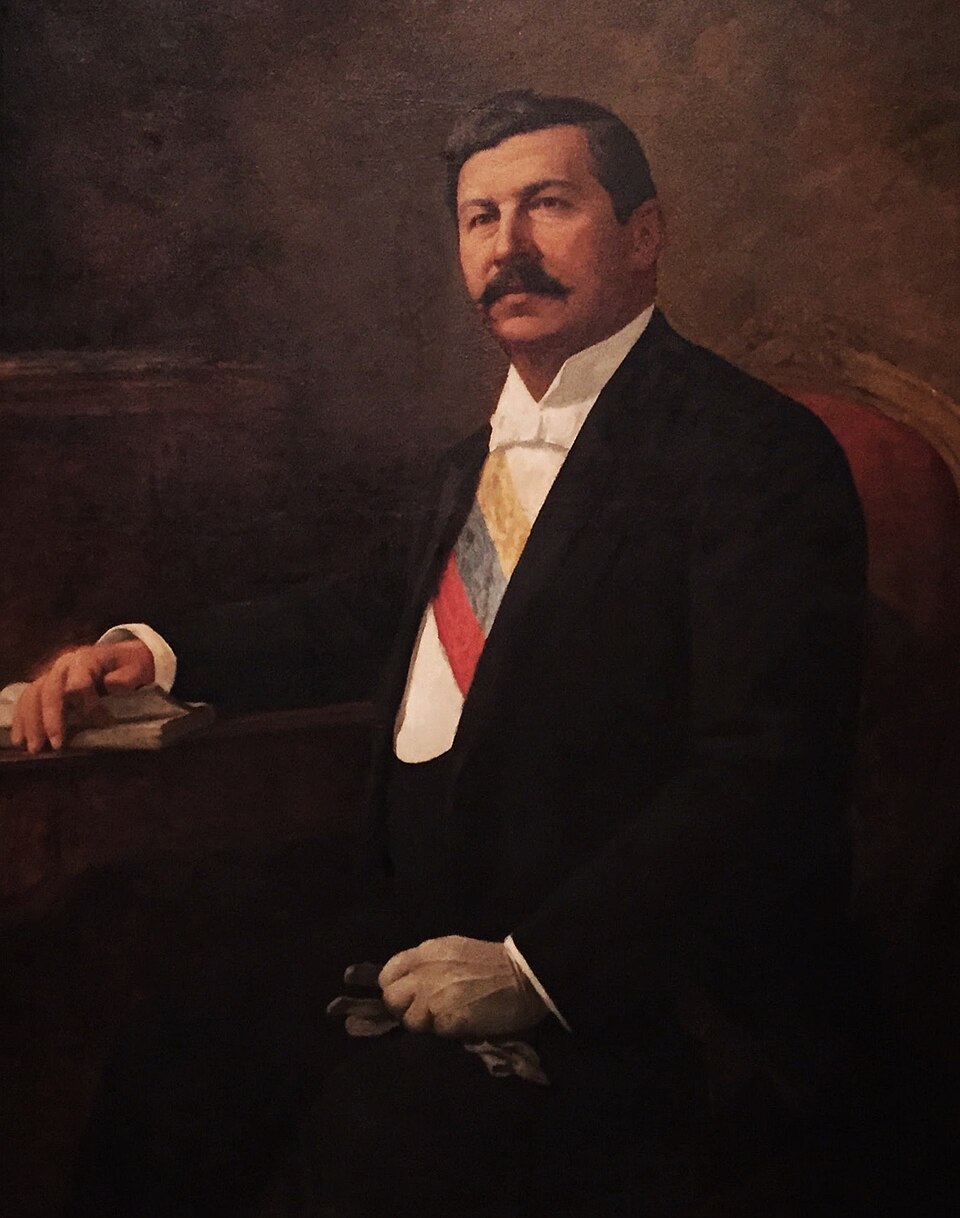
Then there was Maximiliano Hernández Martínez of El Salvador. He received the award in 1936.
He too was a military officer.
He served as president between 1931 and 1944. His presidency sparked off a succession of military leaders that would rule El Salvador until 1979.
During his rule, only one political party allowed in El Salvador.
Construction of the Pan-American Highway began during his rule.
He resigned in 1944, fleeing to Honduras.
King Juan Carlos I and Queen Sofia were recipients in 1976.
In 1979 José López Portillo (President of Mexico) received the honour.
Portillo had been a writer and a lawyer before becoming President. His administration ran from 1976 to 1982.
His government made it easier for political parties to be registered.
At the beginning of his presidency, important oil reserves were discovered in Veracruz and Tabasco.
Under Portillo, public spending increased.
There was significant investment in the oil industry. However in 1981 the price of oil dropped, leading the nation into a debt crisis.
He nationalised the banks.
Corruption was an often-cited problem of his time.
At the regional level, Mexico was backing the Sandanistas in Nicaragua.
Chilean Sebastián Piñera was another recipient of the Order of Boyacá. He was president twice. His first administration ran from 2010 to 2014 while his second lasted from 2018 to 2022. He was the first president of Chile to have been democratically elected since 1958.
One might call Piñera a liberal-conservative.
The rescue of 33 trapped miners occurred on his watch, in 2010.
Same-sex marriage legislation was passed during his tenure (2021-2022).
Luis Abinader was the recipient in 2022. From the Dominican Republic, he had been a businessman before becoming president in 2020. He headed the Modern Revolutionary Party.
Before entering politics, he was the General Manager of Grupo ABICOR, a company focused on real estate and construction.
Abinader strongly opposed illegal immigration and in 2022, his government began construction of a wall to restrict illegal immigration and smuggling from Haiti.
The Dominican leader forged close ties with the US and was a critic of Nicolás Maduro in Venezuela.
Under Abinader public debt increased sharply.
Gabriel Boric received the Colombian honor in 2023.
The Chilean leader has often been called a socialist.
He won the Chilean presidency in 2021, becoming the youngest person ever to do so. He was out of office by 2026.
Crime remained a problem, as did inflation.
His first cabinet was lauded by some for including many women. On the other hand, Chile had 3 cabinet reshuffles in 1 and half years, pointing to instability.
When Boric took office, inflation was the highest it had been in around 3 decades. Inflation decreased strongly during his time in office.
The legal working week was reduced to 40 hours and the minimum wage was increased.
One interesting feature of Boric is that unlike many other Latin American presidents of the Left, he was willing to criticise the excesses of leftist regimes.
For example, he was critical of the Cuban regime. He also criticised Daniel Ortega in Nicaragua and even the Chinese government.
He was vocal about Maduro in Venezuela because that regime had caused the flight of millions of its own citizens.
So we can see that recipients have been a mixed bag.
Recipients have included royalty, military officers and civilians.
At certain times it may appear that people from one side of politics are favoured. In recent times, most recipients have been of the Left.
Looking at recent recipients we can find left or centre-left figures like José Mujica, Gabriel Boric, Luiz Inácio Lula da Silva and Dilma Rousseff.
But this is a consequence of who happens to be in power at the time.
It just so happened that Gustavo Petro has been in power in Colombia for the past few years.
If we take a longer view, we can see that both sides of politics are represented.


Leave a Reply