The British campaign against slavery was one of the most significant reform movements of the late eighteenth and early nineteenth centuries.
A number of British activists played important roles in organising public opposition to the slave trade and, eventually, slavery itself.
Their methods included parliamentary campaigning, religious activism, petitioning, publishing, public speaking and the creation of a mass political movement.
Among the most prominent were Granville Sharp, Thomas Clarkson, William Wilberforce, Olaudah Equiano, Elizabeth Heyrick and Thomas Fowell Buxton.
Granville Sharp (1735–1813)
Sharp was one of the earliest prominent British opponents of slavery. A civil servant and scholar, Sharp became involved in the cause after assisting Jonathan Strong, an enslaved man who had been severely beaten.
Sharp became increasingly interested in the legal status of enslaved people in Britain and challenged the idea that slavery was automatically enforceable on English soil.
His efforts contributed to the legal arguments surrounding the famous Somerset v Stewart case of 1772, in which the courts ruled that an enslaved person could not simply be forcibly removed from England against his will.
Sharp subsequently helped establish the Society for the Abolition of the Slave Trade in 1787.
Thomas Clarkson (1760–1846)
Clarkson became one of the movement’s most energetic organisers.
While studying at Cambridge, he wrote an essay on whether it was lawful to enslave people and was deeply disturbed by the evidence he encountered. He subsequently devoted much of his life to abolition.
Clarkson travelled extensively throughout Britain, interviewing sailors and collecting evidence about the conditions aboard slave ships. He also gathered implements used in the trade. He gathered leg shackles and branding irons. Clarkson’s investigations provided abolitionists with powerful evidence that could be presented to Parliament and the wider public.
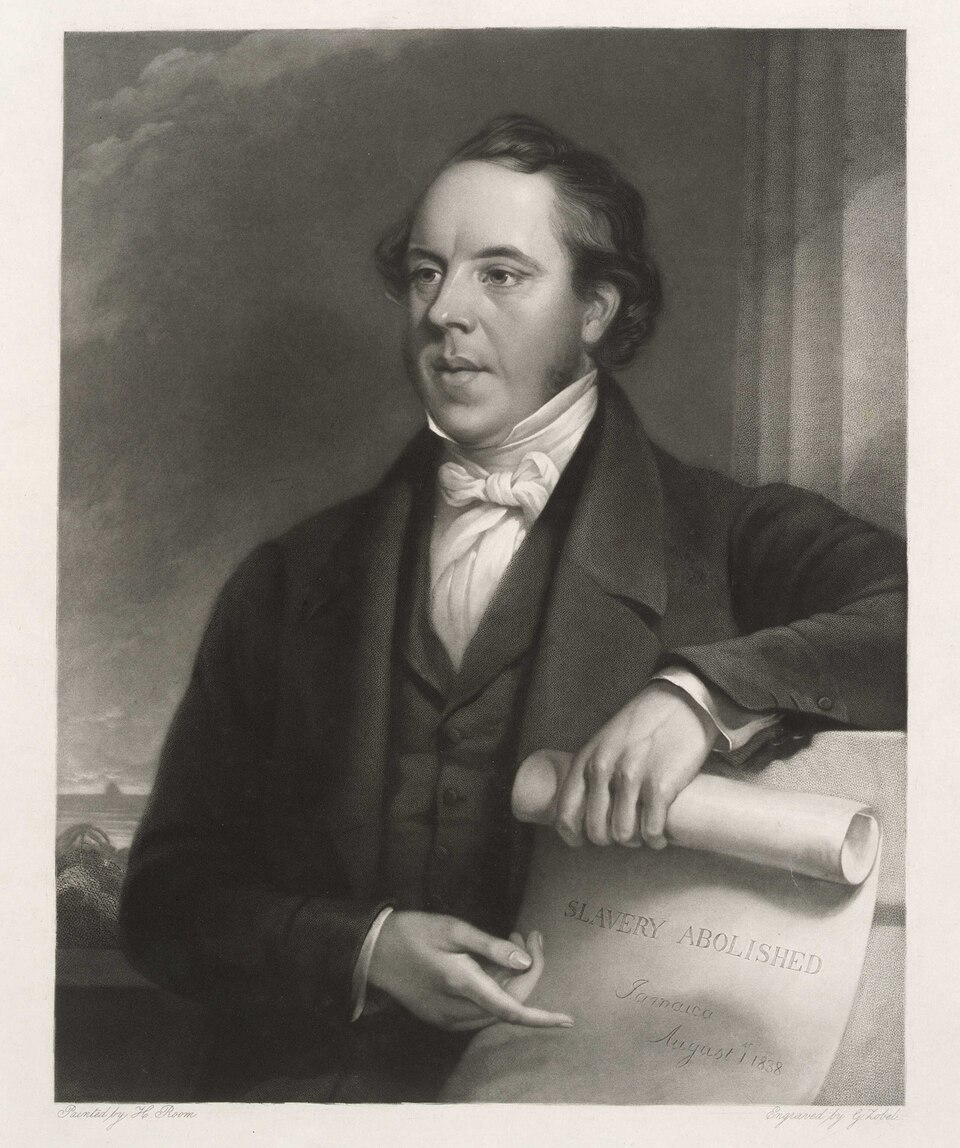
His legacy was particularly important in developing the techniques of modern political campaigning – research and the use of compelling visual evidence.
William Wilberforce (1759–1833)
Wilberforce was the most famous parliamentary advocate of abolition.
A Yorkshire MP and evangelical Christian, Wilberforce worked closely with Clarkson and other abolitionists.
Beginning in the late 1780s, he repeatedly introduced measures aimed at ending Britain’s involvement in the slave trade. Vested economic interests and the wars involving revolutionary France repeatedly delayed success. Nevertheless, Wilberforce and his allies eventually achieved a major victory with the Slave Trade Act of 1807, which abolished the British slave trade.
Wilberforce subsequently campaigned for the abolition of slavery itself. He lived long enough to see the 1833 Act pass parliament, but he passed away before the bill had received Royal Assent.
His legacy is that of the movement’s most prominent parliamentary spokesman.
Olaudah Equiano (c.1745–1797)
Equiano provided a particularly powerful voice because he had personally experienced enslavement.
Born in West Africa, Equiano was enslaved as a child and eventually purchased his freedom.
In 1789 he published The Interesting Narrative of the Life of Olaudah Equiano, an autobiographical account that became an important abolitionist text.

He travelled and spoke in support of abolition and used his own experiences to challenge European assumptions about Africans and slavery.
Equiano demonstrated that formerly enslaved people could become influential political activists and authors in their own right.
Elizabeth Heyrick (1769–1831)
Heyrick represented a more radical strand of British abolitionism.
A Quaker and activist from Leicester, she criticised gradual approaches to emancipation.
In the early 1820s she published Immediate, Not Gradual Abolition, arguing that slavery should be ended without delay.
Thomas Fowell Buxton (1786–1845)
Buxton succeeded Wilberforce as one of the leading parliamentary abolitionists.
A Quaker-influenced reformer and MP, Buxton worked for the abolition of slavery throughout the British Empire.
His campaigning contributed to the passage of the Slavery Abolition Act 1833, which provided for the legal abolition of slavery in most of the British Empire from 1834, although important qualifications and exceptions remained.
Buxton’s legacy therefore lies in helping convert the abolitionist campaign from opposition to the slave trade into legislation ending legal slavery itself.
The British abolitionist movement was the product of many different forms of activism.
Sharp helped establish its legal foundations, Clarkson developed its investigative and campaigning methods, Wilberforce carried the cause into Parliament, Equiano gave it the testimony of a formerly enslaved person, Heyrick demanded immediate emancipation and strengthened women’s activism and Buxton helped secure the final legislation.


Leave a Reply