The following artricle is based on US diplomatic cables available on Wikileaks.
As such they are significant primary sources.
Ambassador Robert Vossler Keeley (1929-2015) was on the ground at the time. Between 1971 and 1973, he was Deputy Chief of Mission in Uganda. He would later act as Ambassador to Mauritius and Zimbabwe.

The first cable is dated 9 March 1973.
One of the responsibilities of the embassy was to monitor media reports.
The embassy was monitoring The Voice of Uganda which had mentioned that President Amin had met a PLO representative and had made comments affirming his support for the plight of the Palestinians.
At the end of the cable Ambassador Keely wrote “as usual identifying terrorists and freedom fighters“.1
At the very beginning, relations between Amin and the UK and Israel were on relatively good terms.
Amin travelled to both countries in 1971.
But the following year, he travelled to Libya and met with President Gaddafi, who promised loans for Uganda and help to supply Uganda’s armed forces.
So began a process where the Israelis were kicked out and the Libyans were welcomed in. It was quite an about-face. Amin’s public language changed significantly. He was now frequently talking about Zionism and his opposition to it.
Also in 1972, Amin expelled Uganda’s Asian population. In response, India cut off diplomatic relations.
So, by 1973, key historical diplomatic relations had already broken down.
In March, Keeley discussed the pros and cons of the US in having an embassy in Uganda.
He prefaced his remarks by noting that they were his personal opinion.
He wrote “The U.S needs an embassy in Kampala because the U.S., as a great power, has world-wide interests and responsibilities encompassing the small powers as well as the great ones. The size (but not the existence) of the mission should be a function of the importance of the relationship. In the case of Uganda the smallest viable mission would be what is called for”. 2
He continued, “Disagreement with a country’s aims (or methods) is not a good argument for removing a diplomatic mission but rather a very good reason for maintaining one. A resident diplomatic mission is less essential in a country with which we enjoy excellent relations…Thus, diplomatic missions in London and Bonn are a great convenience, but in Moscow and Peking they are a necessity. And, merely having an embassy in a country does not imply approval or encouragement of the regime in the receiving state.”3
“The only really sound reason for withdrawing or not establishing a resident mission in a country is that the local security conditions are so bad that our diplomats cannot function safely there….In the opinion of the undersigned they are that bad, and they will remain so for as long as General Amin’s regime stays in power.”4
It wasn’t until 1979 that troops from Tanzania helped to overthrow Amin’s regime. However, as can be seen from the following cable, there was talk about a possible intervention from Tanzania, even as early as 1973.
“Over the weekend GOU has announced QTE imminent UNQTE invasion from Tanzania. Original announcement on March 23 said advance party had been captured by security forces. Advance party allegedly claimed that 3,500 soldiers were massed on Tanzania border ready to attack. Force was made up of Tanzanian soldiers, Ugandan guerillas and non-citizen Asians.”5
But Keely noted that the Ugandans were not moving significant military units to the south. Keeley believed that it was likely a rouse by Amin to blame an outside actor and deflect criticism from his own regime.
In April Keeley was reporting on his own meeting with Amin.
By this stage, Ambassador Melady had been recalled to the US.
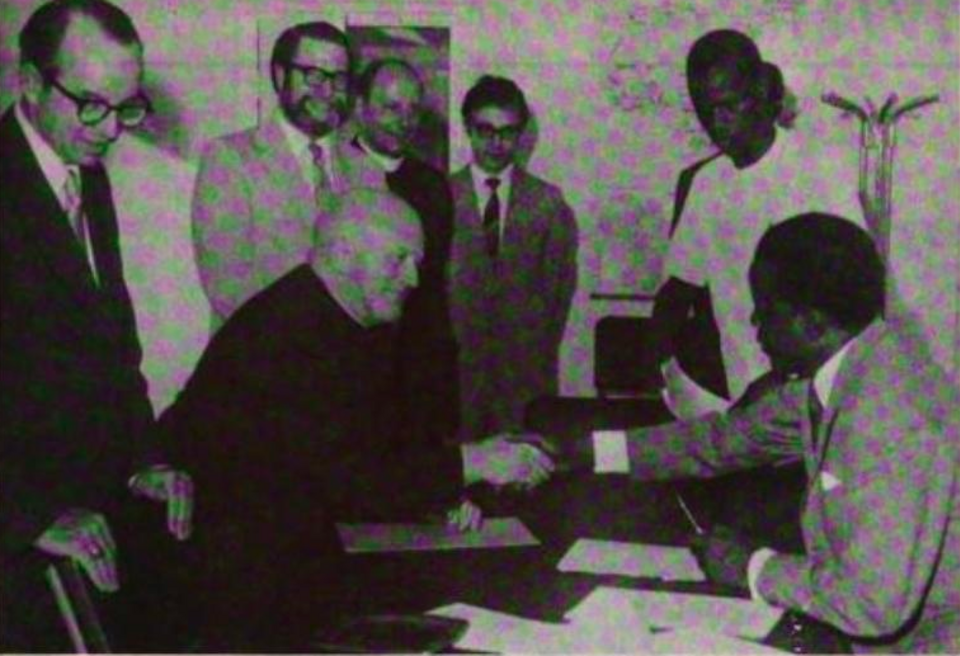
Keeley wasn’t impressed that he was kept waiting for 70 minutes before seeing Amin. He notes that when he is summoned by the President, it is usually with short notice.
It seems that Amin had wanted the Americans to stay. But outside of meeting with the US diplomat, Amin was often publicly critical or hostile to US foreign policy.
Keeley reveals that the reason for Melady’s recall was Amin’s telegrams to President Nixon.
What comes across from this cable is Keeley’s observation that Amin was essentially making policy up as he went along. There was little strategic planning. Much of what was going on was rather reactionary. Further, Keeley observed that “It is strongly characteristic of General Amin that he does not like to hear bad news and likes even less to publicize anything that might tend to reflect on his performance.”6
On April 12, the state of UGS-GOU relations was covered. The cable reflected the embassy team’s collective opinion.
The belief was that Amin wanted to get the relationship with the US back on track.
Amin kept raising the issue of Vietnam, and this did not please the Americans.
At this time, most of the assistance personnel at the embassy were being withdrawn.
The embassy was looking ahead to when Amin was no longer in power. They distinguished between the regime and the Ugandan people. Part of the dilemma was how things might be viewed by a future Ugandan government, if the Americans decided to shut down their embassy. Would a future government consider that the US had abandoned them? The US wanted to ensure that they could easily reestablish relations when Uganda “once again enjoys the benefit of a rational, humane, and responsible government.”7
Godfrey Binaisa is mentioned in May 1973. He would become a future President of Uganda (1979-1980), albeit for a short time.
He is described as being “a very good friend of the embassy”. It seems that he had put out the feelers and wanted the US embassy opinion of whether he should return to Uganda. Unsurprisingly, the embassy was reluctant to get involved.
Binaisa was Muganda. There weren’t many of them in Amin’s regime.
But the embassy thought that he would be in danger if he returned.8
At this time Libya was lobbying Arab and African countries to sever relations with Israel, and ban them from flying over their airspace.
During this period, Amin was calling the United States either imperialist and neo-imperialist.
Amin repeatedly inserted himself into commentary on conflicts around the world – Korea, Vietnam and the Israel/Palestine dispute.
In a letter to Lon Nol,he writes “the present American government of President Nixon has attained the highest degree of mass murder and interference in the internal affairs of other states in the world.”9
In July, Amin sent a message to Nixon to commemorate the 4th of July. Amin concluded the letter by stating “While wishing you a speedy recovery from the Watergate Affair, may I, excellency, assure you of my highest regard and esteem.”10 Unsurprisingly, the Americans were far from amused.
Ambassador Keeley met with Amin on July 10. He noted that he had to wait 45 minutes. The meeting lasted half that time. The media was there. Keeley viewed it a propaganda exercise.
Keeley said that Amin’s style was “the usual rambling, half-coherent soliloquy.”11
The Ambassador even noted that Amin burped during the meeting.
Amin said “In Uganda we recognize only three religions – protestant, Roman Catholics, Muslims. We must not have any other kinds. There are 22 other religious sects that Americans have planted here and they must go.”12
A month later, Amin was commending the British saying “Britain had trained many Ugandans, and singled out Christian missionaries for special praise.”13
Amin liked that Nixon had visited China and sought better relations with the Soviet Union.
By October 1973, things were quite paranoid. Amin was alleging that a CIA and British commandos would make an attack on Uganda.14
At the end of October, the Americans were discussing what to do if they were to leave – who would be their diplomatic representatives in Uganda? Possible options were the representatives of Sudan, Saudi Arabia and Zaire.
The Saudi ambassador was noted as “a good friend…is very pro-American.”15
It was thought that it might be good to have an Arabian ambassador as a representative, given Amin’s stance on Middle Eastern affairs.
Interestingly, much of the attractiveness of these candidates stemmed from their personal relationships with Amin. Keeley believed that these personal relationships mattered just as much the respective foreign policies settings.
Keeley viewed Amin as extremely unpredictable.
By November the US delegation had chosen to leave, with West Germany taking over as the US representative. This raised Amin’s suspicions about the Germans.
In his final cable before closure of the embassy, Keeley wrote “The tragedy is what one man, who is unfit for the office he holds but whom nobody apparently has the guts to remove, has done, is doing and will continue to do to ruin this country of Uganda and its 10 million people. In my opinion Amin reached a position at the upper end of his capacities when he was a top sergeant in the King’s African Rifles. Even since then he has been over his head, and today is nothing less than an embarrassment that such a dangerous buffoon can occupy the post of a “chief of state.”16
Overall, the material contained in the cables are what we would expect. they fit in with what was known at the time about the Amin regime and what the Amercians thought of him.
They give us an insight into the formal mechanisations of diplomatic work. We get the sense of foreign policy professionals trying to engage a regime that was unpredictable and at times hostile to US interests.
Amin was not the first leader to present challenges for American foreign policy.
- Story in March 9 Voice of Uganda, Canonical ID: 1973KAMPAL00890_b ↩︎
- Reasons for having an embassy, 12 March 1973, Canonical ID: 1973KAMPAL00916_b ↩︎
- Ibid ↩︎
- Ibid ↩︎
- Invasion threat from Tanzania, 25 March 1973, Canonical ID: 1973KAMPAL01101_b ↩︎
- Meeting with General Amin, 4 April 1973, Canonical ID: 1973KAMPAL01228_b ↩︎
- USG-GOU Relations, 12 April 1973, Canonical ID: 1973KAMPAL01313_b ↩︎
- Godfrey Binaisa in UK, 10 May 1973, Canonical ID: 1973KAMPAL01589_b ↩︎
- Telegram from President Amin to Lon Nol, 3 July 1973, Canonical ID: 1973KAMPAL02145_b ↩︎
- “Congratulatory” message from President Amin to President Nixon on occassion of July 4 anniversary, 3 July 1973, Canonical ID: 1973KAMPAL02147_b ↩︎
- USG-GOU relations; Meeting with General Amin, 10 July 1973, Canonical ID, 1973KAMPAL02238_b ↩︎
- Ibid ↩︎
- Amin calls for improved relations with HMG, praises British, 4 August 1973, Canonical ID: 1973KAMPAL02481_b ↩︎
- USG-GOU Relations, 23 October 1973, Canonical ID: 1973KAMPAL03165_b ↩︎
- USG-GOU Relations: Possible protecting power, 25 October 1973, Canonical ID: 1973KAMPAL03208_b ↩︎
- Closure of Embassy: Final Classified Message, 10 November 1973, Canonical ID: 1973KAMPAL03355_b ↩︎


Leave a Reply